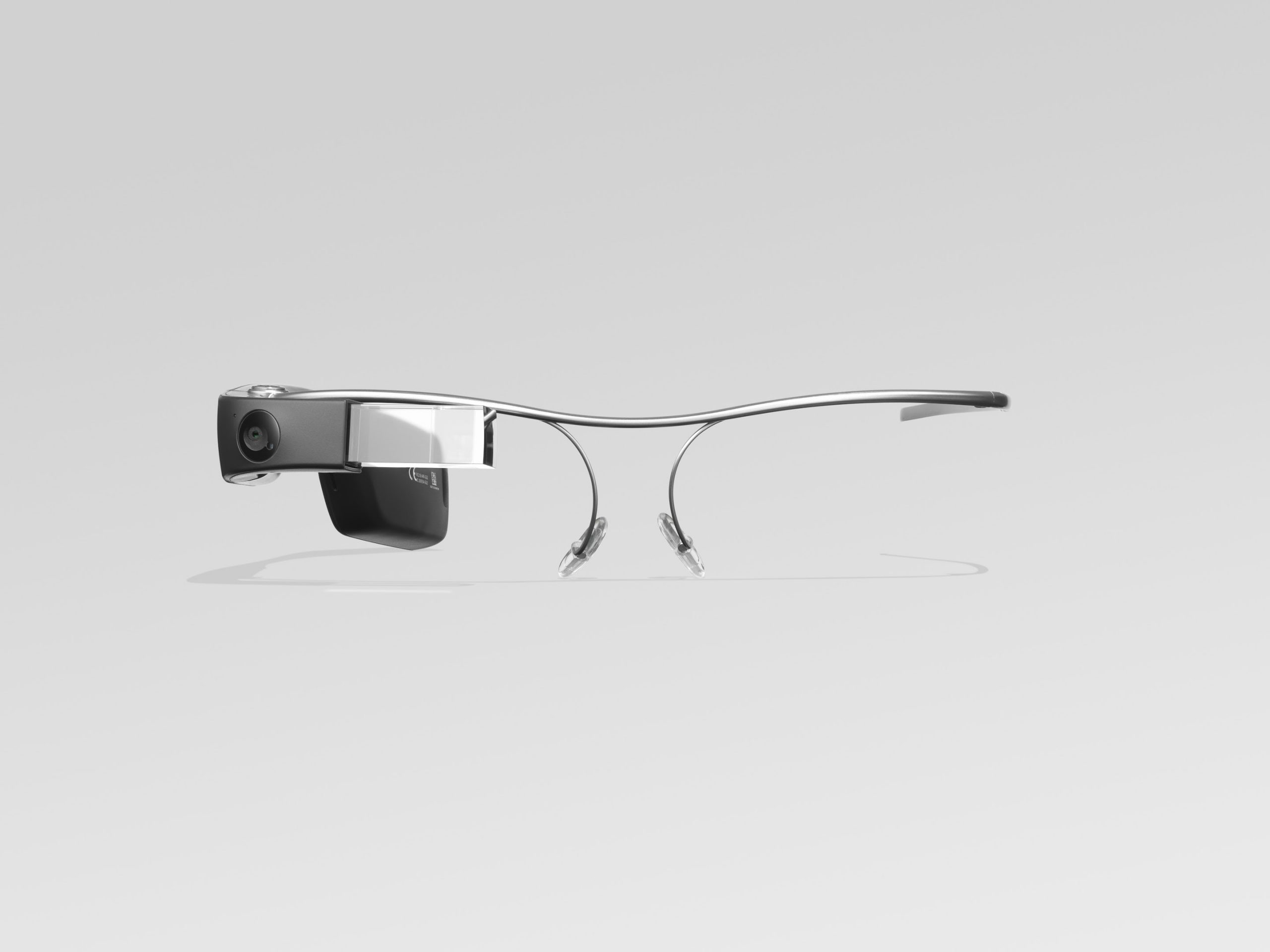
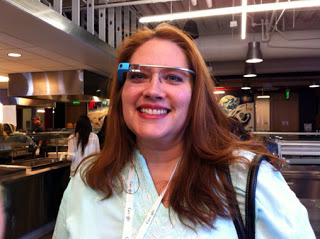
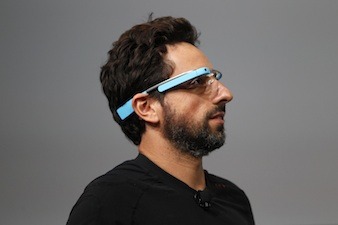
While all the focus of late has been on the Moto 360 and other Android Wear smartwatches, Google is giving some attention to its other wearable: Glass.
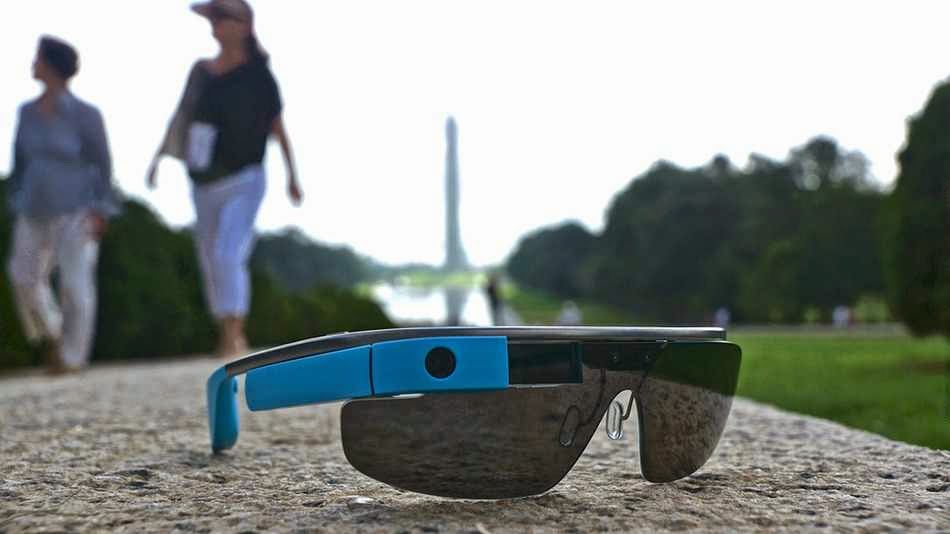
You can now buy the Explorer edition from the Play Store, though the price is the same as when it was an invite-only product: $1,500. As a “perk” Google is throwing in a pair of shades or frames free when making the purchase.
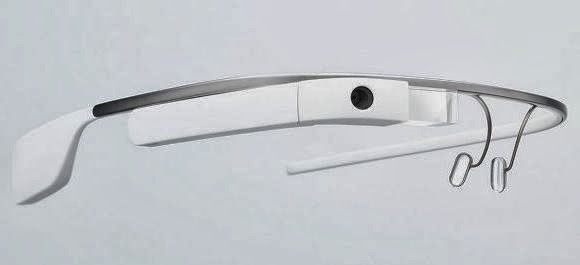
Glass comes in five different colors and ships from the warehouse in one to two business days.
Although the device will support KitKat and a couple of new features, including new tools for working with photos easier, Google has also decided to remove the option to do video calls from Glass for the time being.
Google says video calls from Glass didn’t live out to the company’s “high standards.” Only about 10 percent of Glass users currently use them, and because of this, the Glass team has made “the hard decision to remove video calls from Glass until the experience is better.” It’s unclear when this feature will return, but Google tells Glass users to keep an eye out for video-streaming apps in the MyGlass app library for third-party solutions. Given that video calls from Glass were always one of the device’s marquee features, it does come as quite a surprise that Google would remove this, even if just a few percent of its current users use it.
Is Hangout Really Enough?
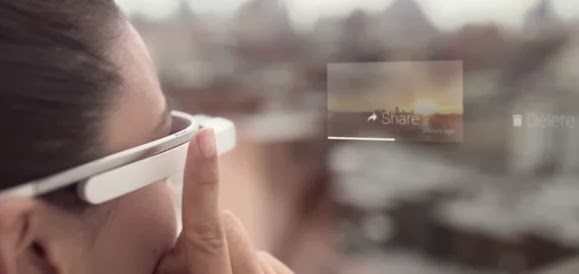
As for the photo updates, Google now finally bundles photos together so when you scroll through your timelines, it’s not cluttered by lots of photos, and the photos you take are easier to find. Glass now bundles all your videos, photos and vignettes into a single bundle for each day. If you take a lot of photos on Glass, that’s definitely a major improvement.
Despite losing the video calling feature, Hangouts on Glass are still an option for chats, and with this update, Google now allows users to more easily send photos in Hangout messages.
Other new updates include a voice command menu that’s now sorted by frequency and recency, as well as the ability to more easily send feedback about Glass right from the device.
According to Google, there are a few more features in this update, too, but it hasn’t updated its Glass Journal blog yet. We will update this post with a list of all the new features as Google makes this information available.
In compliance to Google’s announcement last week, everyone in the U.S. will be able to buy Google Glass today, starting from 9 a.m ET. “Every day, we get requests from those of you who haven’t found a way into the program yet, and we want your feedback too,” the company wrote in a blog post.
Google Glass is not commercially available yet; it’s been available only to Google Glass Explorers — in other words, only through a very limited beta-testing program.
Now, Google is opening up the program and folks in the U.S. will be able to get the Glass for $1500 + tax. Google has apologized to everyone else, saying it’s “just not ready yet to bring Glass to other countries.”
The price is steep, but at least Google will throw in frames or a shade of your choice.
To get the Glass, you need to be 18 years old, and you need to be a U.S. resident with a U.S. shipping address. Then, go to this address today, April 15, at 9am ET. Be fast, as the number of spots available is limited. You can also sign up for a reminder at the same address.
If you are wondering what this pair of glasses will do for you, poke your cursor on this link to find out.
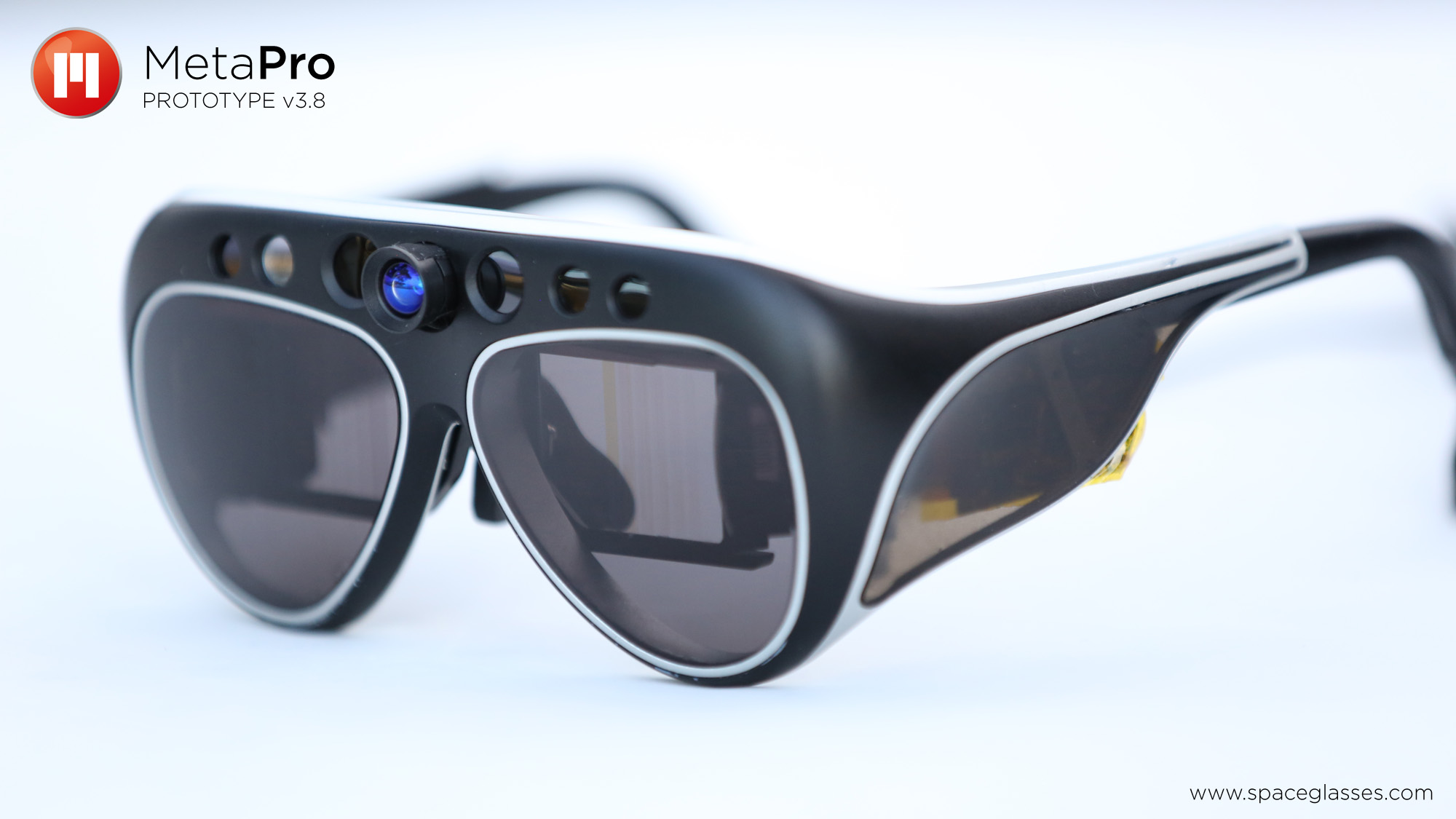
Meta, the augmented reality technology company, has captured the attention of the gadget world with the launch of the Meta Pro, the $3,000 headset that aims to bridge the gap between fully immersive virtual reality tools such as the Oculus Rift and (relatively) more subtle wearable devices such as Google Glass. You can read much more about the Meta Pro, which TechCrunch named one of the best devices at this most recent CES conference in Las Vegas, here.
The Meta Pro is up for sale online now, but it won’t start shipping to customers until this summer. So we stopped by Meta’s Portola Valley, California headquarters to get an early look at the latest prototype of the device.
There are any number of uses for the Meta Pro, as the company has an SDK which allows developers to create programs to use with the glasses. In a news today, Techcrunchwrote on their website:
In our visit, Meta’s CEO and founder Meron Gribetz showed us how the glasses can be used in place of traditional CAD software to design a 3D printed object using only your hands. I’m told that the final version of the glasses which will ship to users this summer will be a bit lighter and more sleek in the design, but this prototype gives a good idea of the core technology and capabilities.
Meta, which makes wearable devices with augmented reality technology, is a particularly ambitious breed of startup — a staff of fewer than 50 employees squaring away against competition from the likes of Google and Apple. But then again, it took a good deal of ambition for Gribetz to set out a few years ago on his own with the goal of building a real-life version of something that had previously only been seen in movies such as Iron Man. It will be exciting to see how this technology continues to develop as more people play with it.
This post was first seen on Techcruch | Image & video credit: Laptopmaga.
IDG NEWS SERVICE – Virgin Atlantic revealed last week that it is testing the use of Google Glass devices among its staff to see how the technology could be used to improve the experience of the airline’s highest-paying passengers.
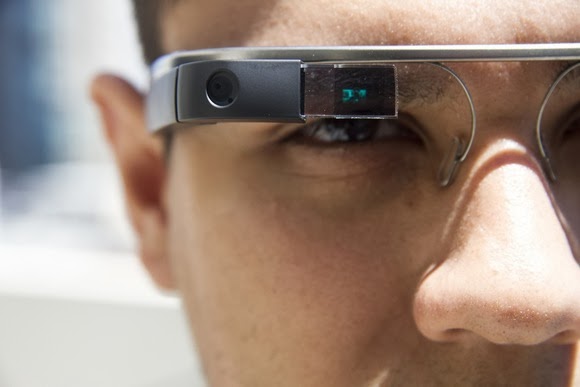
The Google Glass spectacles include a small screen that can be used to deliver apps, directions, social media streams, and webpages just above the right eye. The wearable computer also allows wearers to take a picture, record a video, and read messages.
Over the next six weeks, concierge staff working in Virgin Atlantic’s Upper Class Wing at London Heathrow’s Terminal 3 will aim to use Google Glass to check-in customers and provide them with flight information, weather and local events at their destination and translate any foreign language information.
In order to make this possible, Virgin Atlantic has integrated Google Glass with a purpose-built dispatch app built by SITA and the Virgin Atlantic passenger service system.
Sony’s SmartWatch
The dispatch app manages all task allocation and concierge availability. It also pushes individual passenger information directly to the assigned concierge’s smart glasses just as the passenger arrives at the Upper Class Wing.
Virgin Atlantic said Google Glass also has the potential to tell staff their passengers’ dietary and refreshment preferences.
The airline is also testing the use of Sony’s SmartWatch 2 over the same six-week time period.
“The fact that air travel has become so accessible has led to some of the sheen being lost for many passengers,” said Dave Bulmad, Virgin Atlantic IT director. “By being the first in the industry to test how Google Glass and other wearable technology can improve customer experience we are…putting innovation at the heart of the flying experience.
Google Glass and other wearables are being tested by an increasing number of businesses, including the New York Police Department, which said last week that it was investigating whether the technology could be used to help enforce the law.
Glass, Google’s head-mounted, Internet-connected device, won’t be available commercially until sometime in 2014. Even so, there are thousands of Glass “Explorers,” or early adopters, already using the high-tech eyewear on the job. Many are discovering that, in addition to being a geeked-out plaything, Glass can in fact solve everyday business problems, help people be more productive, enhance workflows and deliver other real-world benefits.
Here’s a look at some of the practical and innovative ways Explorers are using the $1,500 prototype device in their work – from automotive repair to sports reporting.
1. Live, Remote Sales Training
Josh Cohen is CEO of TownSpot, an online video network startup. The company has no actual offices, Cohen says, with team members scattered around the country. The virtual organization structure makes it challenging to train the sales team—a problem Google Glass is helping to solve, according to Cohen.
For example, on a recent sales call to a new customer in Los Angeles, with the customer’s permission, Cohen streamed video of his view in real-time via Google Glass to an Atlanta co-worker. Cohen’s colleague could see the customer’s reactions and hear how he delivered the sales pitch, he says, adding that this type of easily set up, live and remote training “could never have been done before.”
Often, salespeople are trained by accompanying the sales leader or CEO on customer calls, Cohen notes. This usually requires flying the sales person to another location, among other costs. Glass lets Cohen virtually take multiple people on sales calls with him wherever he goes, thereby reducing travel and other training expenses.
2. Hands-free sports reporting
Andrew Abramson, the Miami Dolphins beat reporter for The Palm Beach Post, uses Glass on the job. He was interested in the device mainly for its video and photo capabilities.
”Video has become a huge part of sports reporting,” Abramson says. “While the traditional TV reporters still enter locker rooms with their bulky cameras, other reporters are often uncomfortably holding up their cell phones and shooting their own clips.”
Meanwhile, Abramson finds it much easier to wear a video camera on his face. “With Google Glass, I can shoot photos and videos simply by pressing a button or using voice commands,” he says. “I can instantly upload photos and videos to the Web without using my hands.”
Abramson has received “an overwhelmingly positive response” from Dolphins fans who follow his reports, and about half of the Dolphins’ players have tried on his pair. Reaction varies, he says, from ridicule to amazement to “Where do I get my pair?”
3. Sharing conference sessions
”Literally every day, there are different start-up related conferences and events,” Cohen says. He can’t make it to them all, but with Google Glass—and the permission of conference organizers—Cohen and his team divide and conquer.
Recording the events in real time “is easier and less obtrusive than using a video camera,” he says, and it gives employees the convenience of watching a conference or event on their own time.
4. Taking notes
Evernote, the popular note-taking Web service and application, is among the few official Google Glass apps currently available—and Shazafar Khaja, integration architect for The Kroger Company, says Evernote is the most useful app thus far for Glass.
”Before I go to meetings, I email myself the minutes from previous meetings and action items. I have all of this accessible to me in the meeting at the flick of a finger, with Glass,” he says. “I’ve also started to record (with everyone’s permission) parts of brainstorming sessions where we have ideas flying around. This enables me to be involved without having to fiddle with a phone or camera.”
Khaja admits he could do all of the above using traditional methods, “but with Glass, I’m less distracted and more focused on what’s going on.”
5. Fixing cars
Glass Explorer Will Elias says Glass has helped him with the complexity of fixing vehicles. “With cars changing so quickly, and everything computerized, I was able to work on a vehicle with the assistance of an ASE-certified mechanic,” Elias says. “He watched what I was doing (through a Glass video chat) and guided me on how to fix the vehicle correctly.”
6. Showcasing your company
Google Glass is an ideal way to show off a company’s customer service experience, notes Hilary Topper, CEO of HJMT Public Relations: “Imagine walking in and videotaping, with a first-person perspective, the way someone would be treated if they entered your restaurant, spa or bank.”
Topper’s firm used Glass to make a reality video to both showcase the firm and show off Glass. The video, Glasslandia, has received more than 50 million social media impressions,” she says.
7. Staying up to date while out and about
Matt McGee is editor-in-chief of Marketing Land and also runs the popular Glass Almanac blog. “With Glass I can get RSS feeds, Tweets, emails and so forth sent right to me while I’m out and about,” he says. “It’s great at conferences, for example, to be able to consume this kind of information while walking the halls or expo floors. It keeps me in the know.”
McGee admits that he could get these updates on his iPhone – but consuming that kind of information at a conference means stopping, find an out-of-the-way spot and reading. With Glass, on the other hand, he can keep walking and see headlines and tweets as they come to him. “I can even speak a reply,” he says. “And it’s all done hands-free with my head up, so I don’t have to worry about walking into someone.”
8. Troubleshooting a website from a distance
Cohen says the capability to share visual information immediately can help solve tech issues. If he encounters a bug or other technical glitch on his company’s website, the Los Angeles-based Cohen can say, “OK, Glass, take a picture,” and share a photo of his computer screen with his two Web developers in Virginia. The real-time sharing lets his Web developers understand the issue better and react immediately, Cohen says. The downsides of Google Glass at work
The built-in battery is notorious among Explorers for its short life, especially when video is involved. “With moderate use, the battery will only have to be charged once or twice a day, allowing you to use GPS, text messaging and occasional photos,” Abramson says. “But if you’re recording or watching video, the battery will die in less than an hour.”
Cohen bemoans the inability to bulk delete multiple cards. (Glass displays information, such as text messages, as individual cards.) Cohen can receive as many as 600 business emails per day, and not being able to tell Glass, “wipe all email cards from today,” means that Cohen can’t access any other information on his Glass without scrolling all those emails.
But the biggest limitation is the lack of Google Glass apps, most of which are limited in their features, McGee notes. Twitter won’t take a Tweet received on Glass and send it via email, he says, nor can headlines received over RSS get sent in an email. Meanwhile, the new, unofficial WordPress app seems to be geared toward photoblogging. “I’d like a WordPress app that would let me speak a headline, speak some text and then send that to my WordPress install,” MeGee says. The future of Google Glass on the job
Though Glass already helps workers in a variety of occupations, the technology could be of particular importance to specialized fields.
For example, Glass could be used to improve an airline’s baggage handling process, says Stephen Fluin, chief strategy and innovation officer for MentorMate. Most bag lines have one person scanning bags, to verify their destination and other information, and another physically moving bags. Smaller lines use one person to both tasks, picking up and putting down a scanner repeatedly. Using technology such as Glass, Fluin says, a single baggage handler could scan bags with both hands free to move the bags.
Glass Explorer Chuck Webster says third-party apps from developers in industries such as healthcare, education, security and system repair will really make Glass valuable to workers. He points to the advantage of surgeons using Glass to confer with experts during surgery, adding that early responders could also wear Glass to receive “just-in-time clinical decision support.”
Webster says Glass will likely shine when integrated with current workflow management, business process management and adaptive case management technologies. “We’re going to see some very interesting mashups between Glass and business process management software,” he says. That’s why Webster refers to Glass not as a smartphone on your face but, rather, “workflow on your face.”
If your first reaction to Google Glass is, “That’s amazing and also horrifying!”, you’re not alone. Wearable Internet is certainly the future, and probably the nail in the coffin of social grace.
We’ve noticed that holding a conversation and even walking around in public can be tough while wearing Glass. That’s why we’re offering this warning about Glassholes: People whose DoucheFactor™ is off the charts thanks to the distracted, creepy behavior associated with wearing a voice-activated face camera.
Computerworld – Sergey Brin, CEO and co-founder of Google, wears Google Glasses during a product demonstration at the Google I/O 2012 conference last month. (Image: Stephen Lam / Reuters)When one talks of computers today, he or she could be referring to a laptop, a desktop or maybe even a smartphone. However, if Google’s latest plan stays on track, the definition of a computer could broaden significantly. At its Google I/O developers conference in San Francisco, the company threw a lot of effort behind the unveiling of a prototype of its so-called Google Glass computerized eyeglasses. The Android-powered eyeglasses are equipped with a processor, memory, camera, GPS sensors and a display screen. Google co-founder and CEO Sergey Brin said the Google Glass development effort is all about “doing brand new risky technological things that are really about making science fiction real.” In that world of science fiction, he said, computers won’t always look like what we now expect from the term. The next generation of computers won’t necessarily sit on one’s desk or lap or in one’s hand. The devices may not have a have a monitor and/or keyboard. Someday – probably in the near future – computers will be worn, whether incorporated into glasses, or in a piece of jewelry such as a bracelet or something else, analysts say. “Google Glass changes the way we will look at computers,” said Patrick Moorhead, an analyst at Moor Insights & Strategy. “It isn’t just research, it’s a workable prototype.” “Glass serves to stretch the technology ecosystem to even greater lengths, Moorhead said. “I believe that in five years we will see many different form factors and brands of wearable computers. We will have computers embedded in our glasses of course, but also in our jewelry and watches.” Moorhead noted that the U.S. military, especially the Special Forces units, already use wearable computers to for communications and GPS tasks. That technology hasn’t yet reached consumer or business users, he added. Google’s research efforts could hasten the mainstream use of the technologies. “As we see real devices in use that we previously saw only in movies and books, it will expand the possibilities even further,” said Moorhead. “We can go beyond the glasses and visualize computers in our jewelry, in our watches and even inside our bodies.” Charles King, an analyst at Pund-IT, said such new computing form factors are an extension of the current mobile trend, taking GPS-enabled smartphones, growing compute power and multiple new communications capabilities to the next level. “It’s the ever smaller and ever more powerful mobile technologies,” he added. “It’s about the things we used to see and think about in relation to sci-fi novels or Star Trek. The idea of highly mobile and highly powerful computers is extremely intriguing.” King said he expects there will be great demand for what he calls “mobile computing lifestyle choices” in a few years. “It would not surprise me if we see a lot of this in, say, five years,” he noted. “As the technology becomes more sophisticated and cheaper, it becomes something everybody can afford.” “Some years ago, a smartphone like the Blackberry was considered something that only business professionals needed. It doesn’t seem farfetched to think we could see Google Glass widely adopted in five years,” King added. Rob Enderle, an analyst with the Enderle Group, pointed out that Google Glass or other wearable computers could be very useful in many workplaces — not just the next big thing to help users look cool or geeky. “They could be used regularly for things like taking inventory in warehouses, and for tasks on factory floors and other places where folks need to use computers and their hands at the same time,” Enderle said. At the Google I/O conference, the company said it is offering prototype versions of Google Glass, dubbed the Google Glass Explorer Edition, to developers for $1,500. Brin said he expects the glasses to be generally available in 2014 — at a lower price. “If the developer community can come up with interesting solutions, the sky’s the limit,” said King. Enderle said that wearable computers could be a big step toward a new generation of compute form factors that can be embedded inside the human body. Putting aside visions of Star Trek’s Borg initiative, Moorhead and Enderle agreed that wearable computers are a bridge to the first such computer implants. “It’s an interim step toward imbedding computers into people and creating some kind of biomechanical interface that bypasses the eyes,” Enderle said, adding that he believes that computer generation is some 25 to 50 years away.
“The change we are working toward … is one of the big changes we will see in computing this century. It will redefine personal computing by the time it has fully matured,” he added.
Sharon Gaudin
Author Biography:
Sharon Gaudin covers the Internet and Web 2.0, emerging technologies, and desktop and laptop chips for Computerworld. Follow Sharon on Twitter at @sgaudin, or subscribe to Sharon’s RSS feed . Her e-mail address is [email protected].