Tag: US

  • The US Government finally put an End to Phone Records Collection Program

    The US Government finally put an End to Phone Records Collection Program

    Yesterday marked the end of NSA’s program to collect bulk phone records in the United States. Advocates all over the world questioned the The US government fairness about surveillance technology and started pushing for privacy since former NSA contractor Edward Snowden exposed the program to journalists 2 years ago.

    The masses gained the government attention earlier this year with Congress passing the USA Freedom Act. But in light of the terror attacks that rocked Paris earlier this month, many hawkish lawmakers have attempted to hold off on shutting it down.

    Reports reaching us says that the Office of the Director of National Intelligence announced on Sunday that the program shut down as scheduled.

    As the program finally came to its ultimate doom, privacy advocates took a victory lap on Monday. Here are those hot takes.

    Senator Ron Wyden of Oregon wrote:

    “This program’s very existence was concealed from the American public for over a decade.  Across two administrations, senior officials from US intelligence agencies and the Justice Department repeatedly made false and misleading statements that concealed the truth about what they were doing.  These officials relied on a secret body of law to justify the mass surveillance of the American people. Fortunately, in America sooner or later the truth always comes out.  When Americans found out about this secret, unconstitutional surveillance two years ago, they were rightfully outraged.  And they made their voices heard.  The result was historic reform legislation that required the government to shut this program down.”

    Senator Mike Lee said:

    “Today both the safety and Constitutional rights of American citizens are more secure thanks to the USA Freedom Act. Not only did the USA Freedom Act strengthen the Fourth Amendment rights of all Americans by ending the bulk collection of personal data, but it also better ensured national security by closing a loophole that prevented the government from tracking foreign terrorists once they entered the United States.”

    Members of the House of Representatives also reiterated their support of the law. Bob Goodlatte, John Conyers, Jim Sensenbrenner and Jerrold Nadler issued the following statement:

    “The implementation of the USA Freedom Act represents government at its best: it is the product of a robust public debate and intense bipartisan negotiations dedicated to finding a way to protect our Constitutional rights while enhancing the safety of our country. The bipartisan law ends the bulk collection of telephone metadata once and for all, enhances civil liberties protections, increases transparency for both American businesses and the government, and provides national security officials targeted tools to keep America safe.”

    The implementation of the Freedom Act highlights that in a government marked by gridlock, there have been many major policy decisions that impact the tech industry from Washington this year. After little happened for the industry last year, 2015 brought significant reforms to the government surveillance and made net neutrality the law of the land.

  • US spy court appoints lawyers to panel of advisers

    US spy court appoints lawyers to panel of advisers

    Under the USA Freedom Act, the panel is to advise the judge on privacy and technical matters

    A secret U.S. spy court has appointed a five-member panel of advisers as part of the reform of the surveillance of the National Security Agency.

    The presiding judges of the Foreign Intelligence Surveillance Court and the Foreign Intelligence Surveillance Court of Review have jointly designated five persons to be eligible to serve as an amicus curiae, or friend of the court, according to a notice on the FISC website.

    The appointments have been made under the USA Freedom Act, the reform legislation that was signed into law on June 2 by President Barack Obama.

    The panel consist of four lawyers and a professor of law, and does not include technology experts, although the USA Freedom Act provides for a panel of experts at the FISA court to provide guidance on matters of privacy and civil liberties, communications technology, and other technical or legal matters.

    The persons appointed to the panel are Jonathan G. Cedarbaum, a partner in the law firm of WilmerHale, criminal defense lawyer John D. Cline, Laura Donohue, a professor of law at Georgetown Law, Amy Jeffress, a partner in the the law firm of Arnold & Porter, andMarc Zwillinger, a privacy and data security lawyer.

    The reform of the NSA was taken up after revelations in 2013 by its former contractor, Edward Snowden, about widespread surveillance by the agency in the country and abroad, including its collection of bulk phone records of Americans.

    Obama promised in January 2014 significant reform of NSA surveillance, and called on Congress to authorize the “establishment of  a panel of advocates from outside government to provide an independent voice in significant cases” before the FISA court, to ensure that the court hears a broader range of privacy perspectives.

    Under the USA Freedom Act, the amicus curiae is expected to provide to the court, as appropriate, legal arguments to promote the protection of individual privacy and civil liberties, information related to intelligence collection or communications technology, and legal arguments or information regarding any other area relevant to the issue presented to the court.

    Another key part of the reform – the bulk collection by the NSA of phone metadata records of Americans- is set to end by the close of this month. The USA Freedom Act places curbs on the bulk collection program by leaving the phone records database in the hands of telecom operators, while allowing only a targeted search of the data by the NSA for investigations.

    In September, the FISC court appointed a lawyer Preston Burton as amicus curiae in connection with a specific application by the government to retain already acquired  phone records beyond Nov. 28 for use for technical and litigation purposes.

  • Tor Users ‘are neither invisible nor untouchable’, said head of Europol’s European cybercrime center, Troels Oerting

    Tor Users ‘are neither invisible nor untouchable’, said head of Europol’s European cybercrime center, Troels Oerting

    The leader of Europol’s European cybercrime center said those hiding behind the anonymous communication encrypted system facility, Tor should not consider themselves invisible – at least from the European cybercrime center.

    Coordinated raids by law enforcement agencies in the U.S. and 16 European countries have closed hundreds of underground websites, including dozens dealing in weapons and drugs, and led to the arrest of 17 people.

    The raids took place on Thursday and were the biggest so far against sites running on the Tor network, according to the U.S. Department of Justice and Europol, which cooperated on the action.

    Tor is an encrypted system that facilitates anonymous communication. It has plenty of legitimate uses, particularly for evading surveillance in countries with authoritarian governments, but its use by criminals has caused controversy. Police have increasingly been targeting underground websites on Tor, and Thursday’s raids are the latest in that work.

    Troels Oerting, head of Europol’s European cybercrime center, said criminals using Tor have long considered themselves beyond the reach of the law, but that’s no longer the case.

    “We can now show that they are neither invisible nor untouchable,” he said in a statement. “The criminals can run but they cant hide.”

    The list of shuttered sites included names such as Blue Sky, Hydra and Cloud Nine, and the DOJ said they dealt in drugs, fake currency, stolen credit card data and fake ID documents. Executive Outcomes dealt in firearms and shipped worldwide, Fake Real Plastic sold counterfeit credit cards, Fake ID sold fake passports and Fast Cash and Super Notes Counter sold counterfeit Euro and U.S. currency in exchange for bitcoins, authorities said.

    The first hint of the raids came on Thursday, when police in the U.S. said they had arrested the alleged operator of Silk Road 2.0, a website allegedly used to sell illegal drugs, computer-hacking tools and fraudulent identification documents. At the time they didn’t say that the arrest was part of a larger action.

    “As illegal activity online becomes more prevalent, criminals can no longer expect that they can hide in the shadows of the dark web,’” said U.S. Attorney Preet Bharara, in a statement. ”We shut down the original Silk Road website and now we have shut down its replacement, as well as multiple other dark market sites allegedly offering all manner of illicit goods and services, from firearms to computer hacking.”

    But despite the assertions of Oerting and Bharara, it still remains incredibly difficult for law enforcement to discover who is behind a Tor website. The same safeguards built into the system that keep the identity of a dissident secret from a government also help criminals stay anonymous. Typically, a true identity is discovered because of a clue such as an email address that has inadvertently been left in the open.

  • US Court Officially bans Aereo from streaming live TV to devices

    US Court Officially bans Aereo from streaming live TV to devices

    Aereo can no longer relay TV shows to its customers using its teeny-tiny antennas (for now, that is), according to US District Judge Alison Nathan. 

    It’s been a while since the Supreme Court decided that the service violates the law by “transmitting performances of copyrighted work to the public,” but it’s only now that a judge has issued a temporary ban order. For those who’ve forgotten what it is: Aereo used to stream live or nearly-live programming to its subscribers’ phones, laptops or tablets for $8 a month.
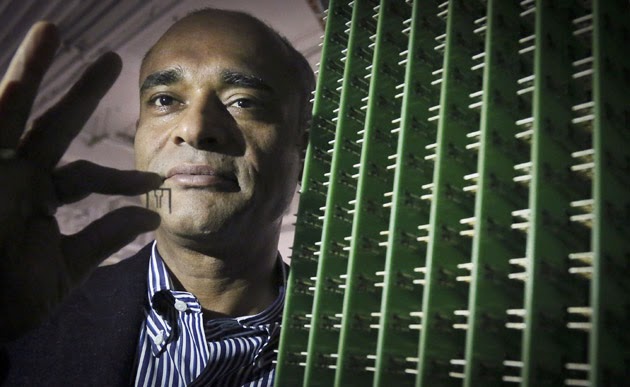
    Each customer is assigned a minuscule antenna of his own (pictured above), which captures shows from the airwaves, as well as a DVR that stores recordings for a later time. Now, though, it’s no longer allowed to beam on-air TV shows to people’s devices anymore. Even worse, Judge Nathan has refused to acknowledge it as a cable service, which means it can’t reinvent itself as one — even if it’s now willing to pay those licensing fees.

    Wondering what’s next for Aereo? Well, the jury’s still out on whether it can record and store programs to be aired at a later time. The judge didn’t grant TV networks their request to stop the company from doing so, since they didn’t include it as part of their demands when they first filed a lawsuit. She’s currently investigating whether she should grant that request, though — and whether to order a final, permanent ban against Aereo. If you want to know more about the temporary injunction, prepare to pore over 17 pages of legalese before checking out the official court documents.

    [Image credit: AP] SOURCE: Scotusblog, Bloomberg, Hollywood Reporter,Injunction (Scribd) Via Engadget.

  • Obama Gives Smartphone Users the Freedom to Unlock their Devices

    Obama Gives Smartphone Users the Freedom to Unlock their Devices

    The President has signed a bill into law that allows American citizens to legally unlock their phones. That means you can take your mobile device, no matter which carrier subsidized it, and move with it to a competing carrier.

    Unlocking phones was made illegal in January of 2013, when an exemption to the DMCA expired. The bi-partisan bill was passed last week by the U.S. House of Representatives, after already being approved by the Senate.

    There is bit of a catch: the Unlocking Consumer Choice and Wireless Competition Act, as it’s called, is valid only through 2015. For now, it ensures you have a choice in matters of your mobile device, as long as your phone is compatible with another carrier’s network and you’ve complied with your previous contract. And even if you don’t fancy yourself as technologically savvy, the bill allows you to seek outside help.

    It’s been a long journey to get to this point. About a year ago, the National Telecommunications and Information Administration (NTIA) filed a petition urging the FCC to make a ruling that would require carriers to unlock phones and tablets at the customer’s request. While most carriers have been kind about unlocking devices, tools for consumers to unlock those phones and tablets themselves were considered illegal.

    So, what are you waiting for? Go forth and be free! At least until the next time this exemption expires.

  • Sony To Close Two-Thirds Of Its US Retail Stores

    Sony To Close Two-Thirds Of Its US Retail Stores

    Sony announced today that it is shuttering 20 of its 31 retail stores located throughout the States. The 11 remaining stores are located near major markets.
    This shouldn’t come as much of a surprise. As the company’s press release states, this move is designed to place Sony in a more competitive stance. The Sony of today is in flux. It’s offloading unprofitable divisions left and right in an attempt to right the capsizing ship and sold off its PC business just last month. The company has eliminated over 12,000 positions over the last two years. These store closings will kill an additional 5,000 jobs.

    Sony is clearly looking for any way to reduce its liabilities and size. Even though it’s had retail stores for more than a decade, the stores never took off despite a rebranding in 2011. They used to be called Sony Style stores and were awash in Sony products. They were lifestyle stores, designed to showcase product rather than sell it.

    But while Sony’s retail strategy was influx in 2010 and 2011, Apple’s stores were taking off. Sony later cloned Apple stores and dropped the word Style from the name. But it didn’t work.

    Retail is hard. Ask Circuit City, Gateway and small town computer shops. To be successful it requires equal parts luck and skill. Sony clearly doesn’t have either.