Have your friends recently texted you about spam originating from your Yahoo Mail account? If so, that may be because you (and many of your friends) were hacked.
Yahoo acknowledged Thursday that attackers now own an undisclosed number of usernames and passwords to Yahoo Mail accounts. In a blog post, Jay Rossiter, the senior vice president in charge of Yahoo’s platforms and personalization products, wrote that the attackers had most likely hacked an external, third-party database and obtained the information there.
“We regret this has happened and want to assure our users that we take the security of their data very seriously,” Rossiter wrote.
Yahoo did not say how many accounts had been compromised, nor when the attacks had taken place. However, the company says it began notifying users that the attacks had taken place, and had begun using second sign-in verification to allow users to re-secure their accounts. Users who have been affected, unsurprisingly, will be asked to change their password, and may receive an SMS text to that effect, Yahoo said.
Yahoo said that it was working with federal law enforcement to find the culprits and would take further precautions to prevent this from happening again.
Finally, Rossiter stated the obvious: “In addition to adopting better password practices by changing your password regularly and using different variations of symbols and characters, users should never use the same password on multiple sites or services,” he wrote. “Using the same password on multiple sites or services makes users particularly vulnerable to these types of attacks.”
In December, Yahoo Mail went down for several days, stranding about 1 million users of the service without email—or word from the company. While the outage began on Monday, it was Friday before CEO Marissa Mayer apologized on behalf of the company.
However, this week Mayer touted Yahoo Mail and services like Flickr as “a strong foundation for revenue growth,” even as that revenue fell by 6 percent compared with a year ago.
Earlier this week, Yahoo announced that it had acquired Aviate, a startup providing contextually relevant information on Android homescreens, but it didn’t say anything about the acquisition price. TechCruch has revealed that the deal cost Yahoo a whooping sum of $80 Million.
Below is the full extract from TechCrunch.
My source didn’t know any of the details beyond the amount — the mix of cash and stock or how much of the total is tied to an earn out, for example. Regardless, that’s an impressive price for a young startup that raised a $1.8 million Series A (from Highland Capital, Andreessen Horowitz, and others) less than a year ago. (It was also incubated at StartX.)
When I reached out for this story, spokespeople from both Yahoo and Aviate declined to comment on the terms of the deal.
Yahoo has on a pretty visible acquisition streak since Marissa Mayer took over as CEO. Last month, for example, it acquired content delivery network provider PeerCDN. During her keynote at the Consumer Electronics Show, Mayer said that Aviate’s technology will allow Yahoo to deliver content in “smarter and more personalized” ways on Android phones.
LAS VEGAS—Forget search. The future of Yahoo is content. Yahoo’s loss to Google in the search engine wars was already quite evident before the 2014 International CES, but CEO Marissa Mayer revealed a new focus for the company during her Tuesday keynote at the tech trade show. “A comment theme is us simplifying our business,” Mayer said at the show. “Fundamentally when you look at Yahoo it’s about four core areas: search, communications, digital magazines, and video. These are four things people do as part of their daily habits.”
Mayer made a slew of announcements about new Yahoo products tied those core areas. In the process, she answered a few questions like: Why on earth did the company hire TV anchor Katie Couric and former New York Times technology columnist David Pogue?
Marissa Mayer, right, greets Katie Couric onstage at CES 2014.
Riding the content wave
Couric is anchoring interviews and original content for Yahoo’s mobile apps, while Pogue will lead the Yahoo Tech digital magazine, one of the first magazines Yahoo will launch this year. The company also trotted out Nick D’Aloisio, the teenage CEO that made headlines when Yahoo last year acquired Summly, his summarization technology. Summly is now baked into another new app that Mayer unveiled at CES, Yahoo News Digest.
Mayer presents to the audience at CES 2014.
News Digest delivers two daily news summaries of current events to users, one in the morning and another at night, and pulls content from all over the Web—tweets, photos, infographics, maps, and so on—to make the stories more visually appealing.
D’Aloisio said the app is the best of both the tech and journalism worlds, because “the stories are algorithmically produced but editorially curated.”
News Digest isn’t a unique concept. Apps like Circa have been trying in recent years to solve readers’ thirst for extremely short, but incredibly high-quality content. But Yahoo’s news efforts needed a shot in the arm: News Digest is its attempt to stay relevant in the world of bite-sized information.
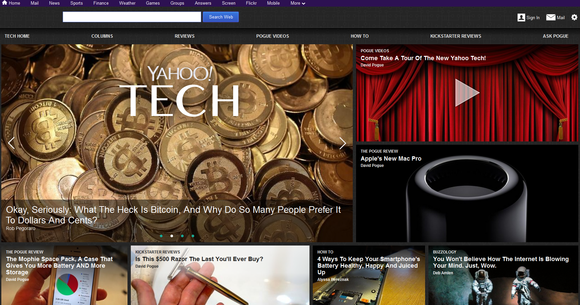
Yahoo’s new digital magazines feature some heavy talent, like David Pogue, formerly of the New York Times and now editor of the new Yahoo Tech, which is shown above.
While 140-character news is on the rise, readers are also thirsting for visually rich long-form stories, which is where Yahoo’s new digital magazines aim to compete. Mayer hired big-name journalists like Pogue for Yahoo Tech, which launched Tuesday along with Yahoo Food. As with News Digest, the concept of a niche digital mag is nothing revolutionary, but it offers Yahoo a chance to ride the wave of popularity of apps like Flipboard.
Pogue posed Yahoo Tech as a tech site for “normal people” who don’t live in San Francisco or New York, hoping to garner mainstream users who don’t follow tech blogs (or Yahoo’s struggles to stay hip).
All about ads
Yahoo’s digital magazines, like the rest of its products, are free, but that’s OK: Yahoo has a whole new advertising plan. The magazines will incorporate native ads, the company has a new ad manager and ad exchange for businesses, and ads on Tumblr are about to get more sophisticated.
Tumblr CEO David Karp joined Mayer to talk about how Yahoo’s ad tech will power the micro-blogging site’s ads, and boasted about the reach of sponsored posts on Tumblr (which are re-blogged an average of 10,000 times). What does that mean for users? You guessed it: highly targeted ads, and a lot more of them.
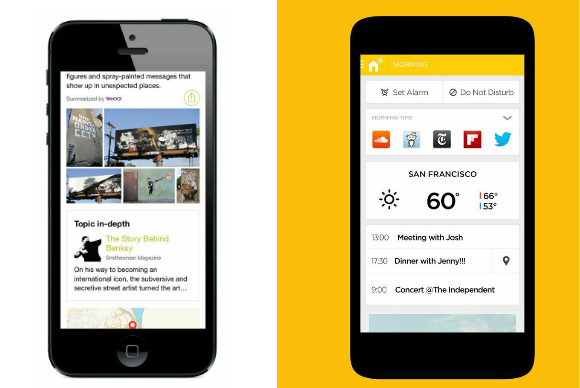
News Yahoo apps like News Digest (left) and Aviate reflect a company in flux.
Yahoo says search is still a core part of its business, and Mayer kicked off her keynote announcing the acquisition of Aviate, which will use your phone’s location and your daily routine to surface the apps you use most.
“We believe home screens should be smarter and more personalized,” Mayer said. “Imagine that your phone could deliver the right experience to you at the right time instead of you having to search for it.” A good example would be a fitness app that pops up when you’re at the gym.
That’s not exactly active search. But let’s be honest: The company under Mayer is well on its way to becoming a content and advertising company. Ads have always key to Yahoo’s business, but if the company can marry advertising and original content in a way that doesn’t anger readers, it could become more than just the site you glance at for stocks and sports before making your way to other parts of the Internet.
Yahoo CEO Marissa Mayer just made her first announcement onstage during her Consumer Electronics Show keynote — that the company has acquired Aviate, a startup that taps the apps on your smartphone to bring up information at the moment that it’s relevant.
Mayer suggested that Yahoo could use Aviate’s technology to deliver its content in ways that are “smarter and more personalized.” For example, she said that your homescreen could automatically show you stock quotes at the beginning of the day, instead of forcing you to open a finance app.
We envision homescreens becoming smarter, more personalized, aware of your context. Aviate helps us bring this vision to life. Aviate auto-categorizes apps on your Android phone and intelligently gathers them into “spaces.” By using signals to understand your context – WIFI, GPS, Accelerometer, Time, etc – Aviate automatically surfaces information at the moment it’s useful. So whether you’re just waking up, driving, at work, or maybe out for the night, Aviate learns your habits and helps anticipate the information and apps you need – making your phone smarter.
Note that Aviate is an Android product, and the blog post says Yahoo plans to make it “a central part of our Android-based experiences in 2014 (and beyond)” — not, it seems, on iOS. When it was independent, Aviate told techcrunch that it had iOS plans, but I’m guessing its capabilities would be significantly limited. It’s also interesting to see Yahoo making an Android-focused acquisition, especially since we’ve written about the company’s challenges in launching a big, sustainable hit on Apple’s platform.
The Yahoo post doesn’t offer any details about the financials of the deal, but it does suggest, unsurprisingly, that the Aviate team is joining the company. The startup raised a $1.8 million round of funding last year from Highland Capital, Andreessen Horowitz, and others.News Source: TechCrunch
Yahoo’s Mail service is reported to be still down for some users a day after the company said access would be restored.
The problem began affecting users Monday night, due to a hardware problem with one of its mail data centers, said Jeffrey Bonforte, senior VP of communication products, in a statement recently posted on Tumblr.
Yahoo first acknowledged the outage early Tuesday afternoon Eastern time in a post on its Facebook page, as well as on Twitter. Yahoo said it was aiming to restore access within the next few hours after those posts but, as of Wednesday morning, Mail was still down for some people.
”The issue has been harder to fix than we originally expected,” Bonforte said. Dozens of the company’s employees are working to get the problem fixed by 6 p.m. Eastern time, he said.
Who is affected
The number of people affected by the outage is not clear, and a Yahoo spokeswoman declined to comment further. But it could be on the order of multiple hundreds, if not somewhere in the thousands, judging from the level of activity in Yahoo’s Mail forum.
The problem could have widespread implications on people’s ability to communicate and get work done, given Yahoo Mail’s prominence. With more than 100 million daily users, Mail is one of Yahoo’s most important products.
In the forum, the discussion thread for the outage had more than 1200 votes on it by mid-afternoon Wednesday EST, with more than 500 comments from users. A smaller number of people appear to have taken to Twitter to express their frustrations.
For some of these people, their access to Mail has been down for two to three days.
Yahoo also has sent mixed messages about the outage. When trying to log in to Mail, some users have seen a page telling them that “scheduled maintenance” is taking place.
”I don’t believe for one minute this is a scheduled maintenance thing,” one person wrote in the forum. “They have been hacked and just don’t want people to know what’s going on.”
Another person offered more practical advice. “People relax. It’s not life or death. Has another email account, like Hotmail or Gmail,” he said.
Other problems
Yahoo has had a bit of a rough time with its Mail service lately. It was redesigned in October with a new Gmail-like interface, but since then some people have complained about the way that it looks, or how it functions.
Yahoo has even had challenges getting its own employees to use it, according to a recent report in AllThingsD.
Yahoo CEO Marissa Mayer has said that Mail is one of the top things she wants to improve to attract new users to Yahoo.
Yahoo says it has fixed the flaw that allowed hackers to steal more than 450,000 passwords from one of its many services.
The company also provided more information about whose passwords had been pilfered. “We have…now fixed this vulnerability, deployed additional security measures for affected Yahoo! users, enhanced our underlying security controls and are in the process of notifying affected users,” the company announced in a post to its blog early Friday. Yahoo has offered no specific information about the attack, how it was carried out or even when. Itconfirmed the attack Thursday. The hacker group D33Ds Company took responsibility for the breach, saying it had exploited a basic SQL injection vulnerability in a Yahoo service to steal the usernames and passwords associated with 453,000 accounts. The group published the passwords and e-mail addresses on the Web.
Hack Affects Associated Content Accounts
Yahoo also confirmed that the stolen account credentials belonged to registered users of its Yahoo Contributor Network, which was previously known as Associated Content. Yahoo Contributor Network is a platform that generates high-volume, low-cost content by letting writers photographers, and others share their work with Yahoo members and earn money based on the traffic their content generates. Users who contribute to the network are required to sign in using a Yahoo, Google or Facebook ID.
Associated Content, which was founded in 2005, was bought by Yahoo for just over $100 million in May 2010. Yahoo renamed the service in late 2011, when it also launched Yahoo Voices, a portal where users access content posted by the Yahoo Contributor Network. According to Yahoo, only people who registered as providers with Associated Content before the 2010 acquisition were affected by the password theft. “[The] compromised file was a standalone file that was not used to grant access to Yahoo! systems and services,” Yahoo maintained. Just under a third of the stolen passwords were linked to accounts registered to a yahoo.com e-mail address, security company Rapid7 said Thursday. Significant chunks of the file, however, were composed of Gmail (23.6 percent of all accounts) and Hotmail (12.2 percent) addresses. All users with older Associated Content accounts, no matter the e-mail address used, should immediately change the passwords for those e-mail accounts as well as any identical or similar passwords used to secure other online services or websites, security experts have said. Rapid7 security researcher Marcus Carey said Thursday that the file published by D33Ds included 123 government e-mail accounts — ones ending with “.gov” — and 235 military-related addresses (ending with “.mil”). Among the government e-mail accounts, Carey found several associated with the FBI, the Transportation Security Administration (TSA) and the Department of Homeland Security (DHS).
Security Experts Blast Yahoo
Security experts have been scathing in their criticism of Yahoo, in large part because the passwords were stored in plain-text, making the hackers’ job of exploiting the stolen accounts a breeze. Mark Bower, a data protection expert and executive at Voltage Security, said, “It’s utter negligence to store passwords in the clear.” Rob Rachwald, director of security strategy at Imperva, also took Yahoo to the woodshed. “To add insult to injury, the passwords were stored in clear text and not hashed (encoded),” Rachwald wrote in a blog post. “One would think the recent LinkedIn breach would have encouraged change, but no. Rather, this episode will only inspire hackers worldwide.” The LinkedIn breach Rachwald referenced came to light last month, and involved approximately 6.5 million encrypted passwords belonging to members of the networking service. In its Friday blog, Yahoo again apologized to users affected by the password theft.







 The company also provided more information about whose passwords had been pilfered. “We have…now fixed this vulnerability, deployed additional security measures for affected Yahoo! users, enhanced our underlying security controls and are in the process of notifying affected users,” the company announced in a post to its