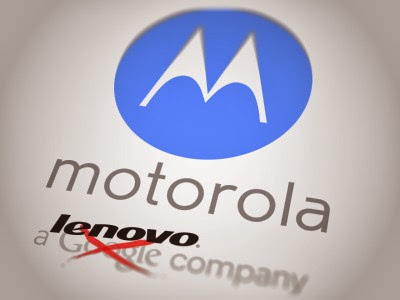
Motorola Mobility is being sold to Lenovo, in a deal worth $2.91B. Google is divesting itself of the handset division it purchased for $12.5B in 2011, but it will keep some of the assets — including patents.
“Google will maintain ownership of the vast majority of the Motorola Mobility patent portfolio, including current patent applications and invention disclosures,” says Motorola Mobility CEO Dennis Woodside. “As part of its ongoing relationship with Google, Lenovo will receive a license to this rich portfolio of patents and other intellectual property. Additionally Lenovo will receive over 2,000 patent assets, as well as the Motorola Mobility brand and trademark portfolio.”
When Google purchased Motorola Mobility, much of the discussion swirled around whether it was buying it simply to own a hardware pipeline on which to deliver its Android juice — or whether it wanted patents for protection. The answer, as is typical, lay somewhere in the middle. Though the Motorola patents never turned out to by incredibly effective winning solo battles against Google’s patent enemies, they did work as a part of a larger tactic which has seen Google aligning itself via cross-licensing with OEMs like Samsung.
One segment of the statement today by Woodside was interesting:
Since being acquired by Google in 2012, Motorola has transformed itself, focusing on solving real consumer problems and providing amazing experiences built on a foundation of pure Android. The result has been Moto X, Moto G, and a reinvigorated Droid line. Together, these devices have won over consumers and critics alike and helped re-establish the Motorola brand around the world.
Indeed, Google’s purchase and investments in Motorola did raise the flagging manufacturer’s profile significantly over the intervening years. They have several well-received smartphones on the market and have made a lot of noise about technology innovations in wearable computing and DARPA-think-tank-director hires.
Techcrunch – TechCrunch has confirmed reports that Lenovo is buying Motorola Mobility from Google. This is the division within Google that the company purchased in 2011 for $12.5 billion. Motorola Mobility will go to Lenovo for $2.91 billion.
Of that $2.91 billion, $1.41 billion will be paid at the close of the deal. $660 million will be comprised of US cash and $750 million in Lenovo ordinary shares. The remaining $1.5 billion will be paid in the form of a three-year promissory note. Google will maintain ownership of the vast majority of the Motorola Mobility patent portfolio. Lenovo will still receive 2,000 patent assets and the Motorola Mobility brand and trademark.
According to a separate report published by Reuters, Lenovo is being advised by Credit Suisse Group while Lazard Ltd advised Google on the transaction.
“As part of Lenovo, Motorola Mobility will have a rapid path to achieving our goal of reaching the next 100 million people with the mobile Internet. With the recent launches of Moto X and Moto G, we have tremendous momentum right now and Lenovo’s hardware expertise and global reach will only help to accelerate this,” said Dennis Woodside, CEO, Motorola Mobility, in a released statement.
According to our source, Google wanted to dump the asset for some time. The company had to hold off selling the division for tax reasons.
Motorola Mobility’s performance has yet to live up to its purchase price. Since Motorola split and its consumer division went to Google, it has been a constant source of red ink. Motorola lost quite a lot of money: $248 million in the last quarter alone. Google sums this well, noting that the loss was “-21% of Motorola Mobile segment revenues.” Motorola lost $192 million in the year-ago quarter, so the trend here isn’t positive.
Google previously sold off the cable box division of Motorola Mobility for $2.4 billion.
This comes just weeks after Google purchased the hot hardware startup Nest. Since then, Nest’s role in the budding conglomerate that Google is turning into has been widely speculated about. With Motorola gone, Nest’s superstar team that includes many former Apple engineers seemingly has an empty playground.
It seems this complete’s Lenovo’s quest for an established cell phone business. It was rumored back in October that the company submitted a bid for BlackBerry. That deal clearly didn’t pan out.
Simply buying its way to the top worked for Lenovo in the past. In 2005 Lenovo purchased IBM’s personal computer division for $1.25 billion. That purchase alone caused Lenovo to be the world’s third-largest computer maker. But, using the established brand, Lenovo scaled the PC division to become the largest shipper of PCs in the world. In the last months of 2013 Lenovo overtook HP.
Just last week, Lenovo announced a plan to buy IBM’s x86 server business for $2.3 billion.
As the dust settles on this deal, it’s clear that Google took a large loss on its venture with Motorola Mobility. Google acquired an established brand with a vast portfolio of patents, a mature distribution system and a knowledgeable manufacturing arm. Even after pouring money and resources into the historic American brand, Google couldn’t make lemonade with Motorola. Maybe Lenovo, the now-leader in personal computers, will have better luck.
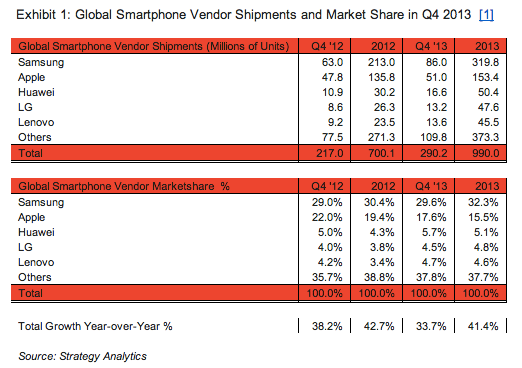
Techcrunch – To coincide with Apple releasing its Q1 earnings, Strategy Analytics has put out its quarterly and full-year figures for how the smartphone market has fared, along with figures on the wider mobile phone market. Overall, there were nearly 1 billion — 990 million — smartphones shipped in 2013, representing growth of 41% over 2012′s 700 million units. Smartphone shipments for the last quarter of 2013 were 290.2 million, up 34%.
Mobile phone shipments, meanwhile, were just under 1.7 billion — and as a mark of how smartphones are where all the buying has shifted, the wider mobile phone market grew only 5% over a year ago. While 41% growth sounds good, Ken Hyers, an analyst at Strategy Analytics, notes that it is actually down slightly on the 43% growth of a year ago. He says this is because of “high penetration in some major markets like the United States.” This was something that had a direct effect on Apple. Traditionally a strong player in the U.S., CEO Tim Cook noted today that Apple’s sales in North America declined.
As we pointed out earlier today, although Samsung continues to remain in the lead with its 32% of all smartphone shipments, the real story appears to be about what is happening underneath that.
Apple continues to fall (pardon the pun) and is now at 15.5% for the full year (compared to 19% a year ago) on 153 million units. And although Huawei, LG and Lenovo are all behind Apple, together they are nearly overtaking the iPhone maker in units, with a combined share of 14.6%.
That’s not to overlook that Samsung’s growth is nothing short of impressive: its 319.8 million smartphones shipped in 2013 was the “largest number of units ever shipped by a smartphone vendor in a single year,” according to the analyst group’s executive director Neil Mawston. Samsung also retained its title as the world’s biggest mobile phone maker overall: it shipped 451 million units for a 27% share of the market.
Although Apple made a point today of talking up its emerging market business, Strategy Analytics (and perhaps others, given the stock decline) are not buying it: “Apple remains strong in the high-end smartphone segment, but a lack of presence in the low-end category is costing it lost volumes in fast-growing emerging markets such as India,” writes Mawston.
As in quarters past, the Samsung/Apple juggernaut is all but dominating the smartphone world in terms of vendors.
“Large marketing budgets, extensive distribution channels and attractive product portfolios have enabled Samsung and Apple to maintain their grip on the smartphone industry,” writes analyst Linda Sui.
The question will be whether the economics of making cheaper phones will mean that the smaller vendors like LG, Huawei and Lenovo can stick around longer, or whether they will eventually find themselves in the same positions as Nokia, BlackBerry and HTC — all out of the top five rankings now partly because it eventually became unsustainable to play in the smartphone game without scale.
In any case, although in times past it seemed that the route to being a worldwide phone leader was to have a strategy of offering devices across a range of price points and feature sets, today that’s not as clear.
Over 70% of the handsets Samsung’s shipping right now are smartphones. And Apple, the number-three player in mobile sales overall, is a smartphone-only vendor. Meanwhile, Nokia’s smartphone share these days is so small that Strategy Analytics doesn’t break it out, meaning that its number-two position among mobile phone makers is based largely on its power at the lower end of the market.
However, it turns out the strategy of not having a killer smartphone lineup not only is not lucrative but eventually self-destructive.
Nokia’s global mobile phone shipments fell 25% between 2012 and 2013, from 335.6 million units to 252.4 million units. “Nokia faced tough competition from Samsung in developing markets like India, while LG and others ramped up the pressure in developed regions such as Western Europe,” writes Mawston. “Nokia’s Windows Phones have been performing relatively well, but this was not enough to offset sluggish demand for its Asha models and other feature phones during the course of the year.”
As Strategy Analytics points out, one route for smaller, national players to survive longer term is to continue to grow internationally. Huawei, it notes, is expanding in Europe; LG’s Optimus range “is proving popular in Latin America”; Lenovo’s Android models are selling at competitive price-points across China. “Samsung and Apple will need to fight hard to hold off these and other hungry challengers during 2014,” notes Sui.
Abuja – The fast growing computer technology company Lenovo is currently in need of a sales manager for it’s smartphone branch in Nigeria.
Though the China based company announced the vacant position eight days ago on LinkedIn, information reaching EWT has confirmed that no official appointment has been made, hence, the position is still up for grabs for people residing within Nigeria. See below for requirements and job responsibilities.
Key Objectives of Position:
Responsible for channel management and managing the distribution landscape across Nigeria
Manage key relationships in both direct and indirect Large Format Retail partners
Drive sell thru and sell out through the effective execution of various schemes and promotions and assessment of the ROI of these programs
Manage the field promoter program and Point Of Sale with retailers
Key Performance Indicators (Metrics)
Sales Targets
Increase in Retail Share of Wallet month on month
Successful Schemes and Retail Visibility in the region
Evaluate ROI for partners
Position Requirements
Success Factors
Channel Management
Retail Management
Problem Solving capabilities
Good Communications Skills
High Energy
Result Oriented
Team Work
Decision Making in Ambiguity
Influencing & Negotiation skills
Essential Experience & Key Skills
7-10 years of experience in direct sales roles out of which at least 3 years should be in the feature phone / smart phone category
LAS VEGAS—More PC makers are bringing Android to desktops as users increasingly turn to the Internet for apps, storage and entertainment.
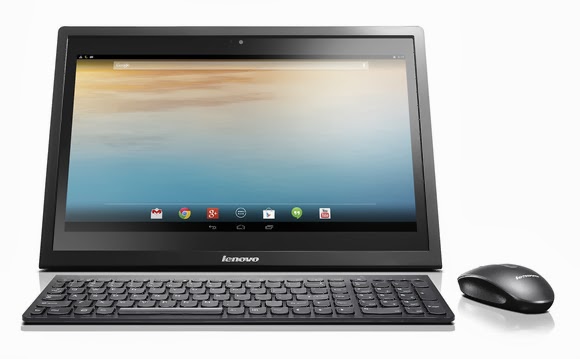
Lenovo and Hewlett-Packard showed inexpensive all-in-one PCs running Android at the International CES event in Las Vegas this week. The $450 HP Slate 21 Pro has a 21-inch screen, and the $399 Lenovo N308 has a 19.5-inch screen.
Android is mostly used on tablets and smartphones, and PC makers are trying new desktop usage models with Android on large-screen PCs. The use of Internet-based applications, entertainment and storage services is growing, and Android is designed for that type of computing, said Nick Reynolds, Lenovo’s executive director of marketing. ”Everyone is finding they have an explosion of personal digital content and they need to store and manage it,” Reynolds said. “It changes the way people are working with their traditional desktop.”
Lenovo’s N308 all-in-one PC.
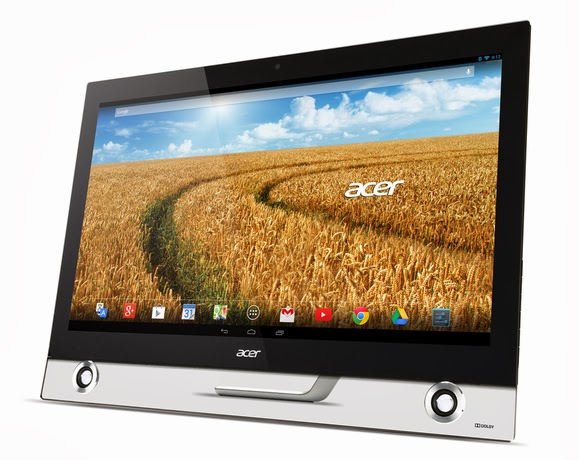
Android was also loaded on to high-definition professional monitors, seemingly as an afterthought. Lenovo’s ThinkVision 28-inch 4K monitor is primarily designed to be used as a professional display, but can also function as an Android all-in-one PC. Acer’s $1100 TA272 HUL is a 27-inch professional display that also doubles as an Android all-in-one when needed.
Windows is designed more for desktop computing, while Android all-in-ones would be a great hub for communications, home automation and online entertainment, analysts said. The PC makers view Android all-in-ones as hub computers in offices or homes that can sync easily with public or private cloud services.
”Most of the Android AIOs are essentially smart monitors, which I think makes them still a bit different—and certainly less powerful—than a true PC,” said Bob O’Donnell, principal analyst at Technalysis Research.
Once of Acer’s new all-in-ones.
Android all-in-one adoption could grow as more apps migrate to the cloud and hybrid computing models, said Jim McGregor, principal analyst at Tirias Research.
”Throughout this year, you will see more and more productivity apps go that route using Android and iOS, which really weakens the argument for traditional PCs,” he said.
The Android PCs are based on ARM processors and cheaper to build than Windows PCs, McGregor said. ARM processors are less expensive than Intel chips used in Windows PCs, and Android is virtually free.
”You eliminate the Windows license fee and you can use a mobile processor that is a fraction of the cost of an x86 processor. That simplifies your system design because it is easier to [build] and the overall design can be much simpler,” McGregor said.
HP’s Slate 21 Pro.
Beyond the cost, HP also liked Android for its Slate 21 as the OS could be heavily customized. The company has modified Android with specific software and fine-grained management and security features designed so that a fleet of Slate 21 PCs could be easily managed in corporate environments.
But there are challenges for Android all-in-ones. They are not designed to run high-end applications, and like mobile devices, are most effective when connected.
Also, most Android apps are written for mobile devices, and questions remain on how effective those apps will be on all-in-ones, where touch input is secondary, O’Donnell said.
”My guess is we’ll see some application compatibility problems and other issues that could be a problem for market success,” he said.This was originally posted on PC World
PCWORLD – A story posted on pcworld today has confirmed that we are likely to see a new generation of PC anytime soon. With microsoft paying more interest in the production of windows 8 smartphones, it is now clear to everyone that windows are likely to swap places with the android OS in the technology world.
Accidentally leaked user manuals from PC maker Lenovo show that the company is preparing a new laptop that runs Android instead of Windows.
Called the IdeaPad A10, the laptop has a 10.1 inch HD screen and is listed as an Android device, according to the manuals uploaded on Lenovo’s site.
The laptop’s 10-inch display also functions as a touchscreen. It can be opened up to 300 degrees, supporting the screen for reading or touching while the keyboard rests face down. In addition, the keyboard has signature Android buttons for “home screen”, “previous” and “apps screen”, found on the bottom of many phones and tablets running the Google OS.
Lenovo had planned on making an official announcement for the device, said Chris Millward, a spokesman for the company, on Thursday. But somehow, Lenovo unintentionally leaked the user manuals online, he added.
“The product has not been canceled. It will be going out to the market,” he said. Lenovo will later announce launch dates and pricing information.
The laptop’s specs show that it could be a budget product. It has an Arm quad-core 1.6GHz processor from Chinese firm Rockchip, 1GB or 2GB of RAM, and 16GB or 32GB of storage. There is also a 0.3 megapixel camera, a microSD card slot and an HDMI port.
Tech vendors are increasingly experimenting with Android at a time when demand for traditional Windows PCs has been waning. Earlier this year, Acer and Hewlett-Packard showed all-in-one desktops using the Google operating system. HP’s product, called the Slate 21, has a price of $399.
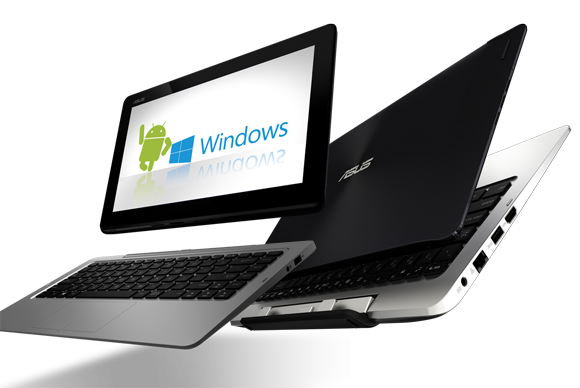
On the convertible PC side, Asus has shown a hybrid device that can run both Windows and Android. Called the Transformer Book Trio, the product operates as a stand-alone Android tablet, but when attached to its keyboard it can also boot up Windows.