Category: News

  • Ten Countries Account for 70% of IMF’s Total Outstanding Debt

    Ten Countries Account for 70% of IMF’s Total Outstanding Debt

    A review of the International Monetary Fund (IMF) recent debt profile reveals that 70% of the total of $117.6 billion in outstanding debt obligation is owed by the top ten countries. The report reveals that 91 countries have outstanding debt obligations to the IMF as of 8th May, 2025. 

    According to the report, the cumulative outstanding debt obligation of the top ten most indebted countries to the Fund totalled $82.44 billion. 

    The majority of countries featured were from low and emerging-market, mostly domiciled in Africa, South America, the Caribbean, and Asia. Less than 10 countries owing outstanding balances to the IMF were from Europe, and no G20 country had any balance with the Fund. 

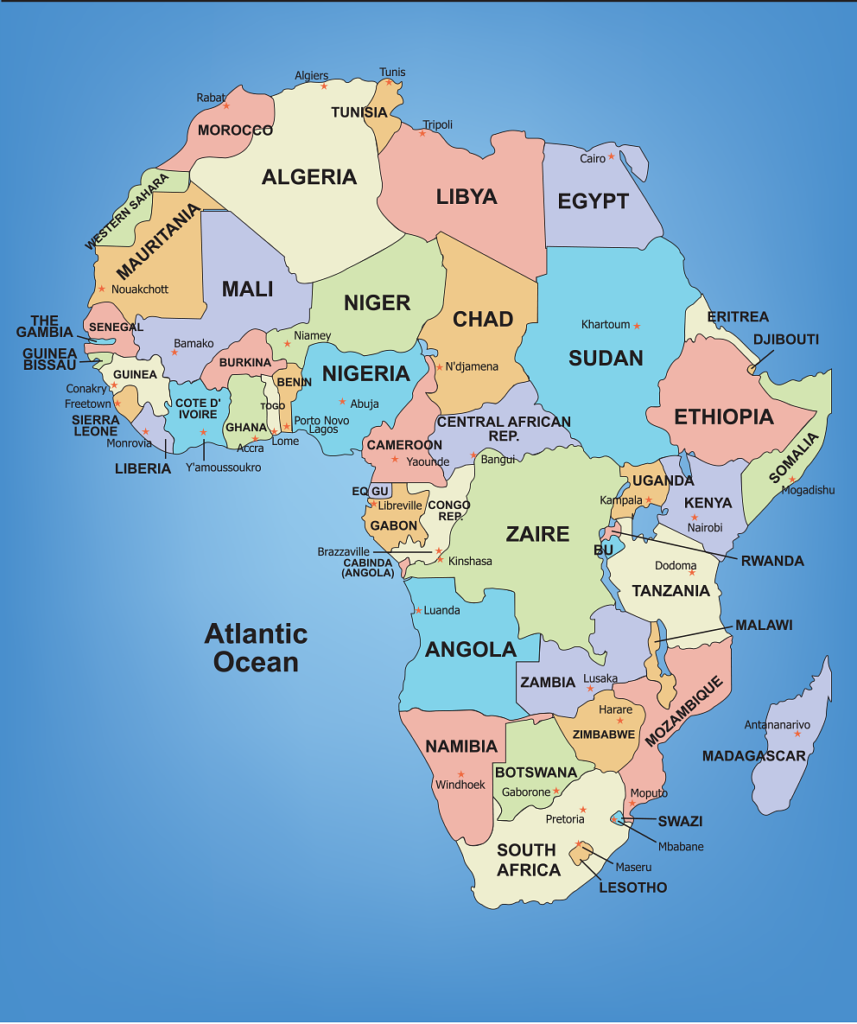
    Of the top ten countries most indebted to the International Monetary Fund (IMF), five are from Africa, two from South America, two from Asia, and one from Europe, war-torn Ukraine.
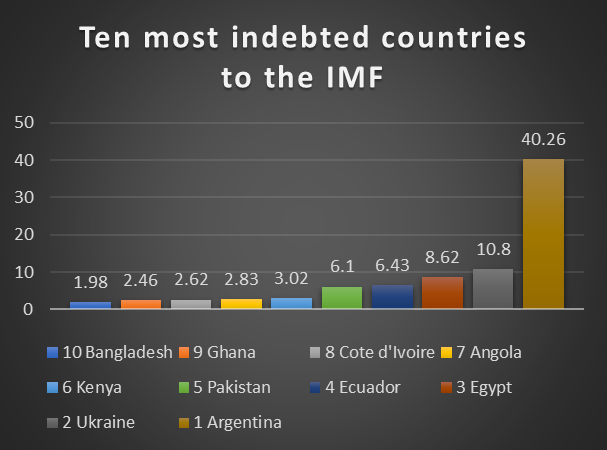
    Source: IMF

    10. Bangladesh ($1.98 billion)

    In 2024, Bangladesh reached a staff-level agreement with the IMF where the fund agreed to provide $645 million comprising Standard Drawing Rights (SDR 325.2 million (about US$426 million) under the External Credit Facility (ECF) and External Fund Facility (EFF) and SDR 166.7 million (about US$219 million) under the Resilient and Sustainability Facility (RSF).

    Since 2020, the IMF has reached an agreement on support facilities totaling $4 billion but has only drawn around $355 million. In May 2020, the country reached a Rapid Financing Instrument (RCF) of $355.5 million. 

    Fast forward to January 2023, it agreed to three facilities with the IMF: an Extended Credit Facility (ECF) of $822 million, an Extended Credit Fund (ECF) of $1.6 billion, and a Resilience and Sustainability Facility (RSF) of $1 billion. All three facilities are yet to be drawn and are expected to expire by July 2026. 

    09. Ghana ($2.46 billion)

    This West African country has outstanding debt balances with the IMF totaling $2.46 billion. Since defaulting on its debt obligation in 2022, Ghana has borrowed up to $1.17 billion from the IMF under the Extended Credit Facility (ECF) initiative. 

    However, the country’s economy has been in turmoil since the COVID-19 pandemic, with inflation reaching over 50% in 2022. In April 2020, the country agreed $738 million which it has drawn but not repaid. 

    The oldest unpaid IMF credit facility to Ghana dates back to 2015- an Extended Credit Facility (ECF) of $664.2 million, of which $393.5 million remains as an outstanding balance. 

    08. Côte d’Ivoire ($2.62 billion)

    This country has outstanding balances with the IMF for credit facilities dating back to a decade ago in 2011. The country has drawn portions of its last three credit facilities from the IMF, which include: an $867.2 million ECF of 2023, a $1.73 billion ECF, and $975.6 million RSF of March 2024. All three are billed to expire by 23rd September, 2026. 

    07. Angola ($2.83 billion)

    This oil-dependent economy has outstanding balances with the IMF to the tune of $2.83 billion, which was a $3.2 billion Extended Fund Facility (EFF) approved in December 2018 and set to expire in December 2021. 

    Beyond the high outstanding debt to the IMF, the country continues to be weighed down by extreme poverty, a high debt-to-GDP ratio, low life expectancy, high infant mortality, and epidemic corruption levels.

    The situation appears gloomy for Angola in the coming years as the number of people living in the country is expected to climb to 16.3 million people. 

    06. Kenya ($3.02 billion)

    The country’s total outstanding obligation to the IMF came under four credit facility programs: Rapid Credit Facility, Extended Fund Facility, Extended Credit Facility, and Resilience and Sustainability. 

    It has an outstanding balance of $542.8 million under the (RCF), and $1.51 billion under the EFF—the loan initially totaled $1.8 billion. 

    The country’s economy has been resilient despite the harsh operating environment in the past years, especially debt. Efforts by the Ruto-led government to raise revenue in line with recommendations of the Fund were met with the most brutal protests in the region to date. 

    05. Pakistan ($6.10 billion)

    This country has received over $10 billion in credit facilities from the IMF since 2019. The latest of these facilities was the Extended Fund Facility of $5.32 billion, agreed in September 2024 and set to expire in 2027. Others include a $2.25 billion iStandby Agreement, which has been fully drawn by Pakistan, and EFF of $4.98 billion, of which $3.03 billion has been drawn. 

    Last week, the IMF’s Board completed its first review of the 37-month EFF and noted that the government’s effort under the EFF has delivered economic stability in terms of surplus, inflation reduction, and increase in the country’s gross external reserve. 

    The IMF Board, in its review of the country’s performance, further approved a request to access the $1.4 billion Resilience and Sustainability Facility (RSF), which aims to strengthen resilience to natural disasters and federal and provincial responses to natural disasters, among others. 

    04. Ecuador ($6.43 billion)

    Aside from Argentina, Ecuador is the only South American country on the list. The latest of the IMF’s facilities comes amidst a significant fiscal deficit in the country, financial and fiscal instability, coupled with illiquidity problems. 

    In May 2024, the Board of the Fund approved a 48-month Extended Fund Facility (EFF) for Ecuador of $4 billion, of which $1 billion was immediately disbursed. This follows a September 2020 EFF of $4.61 billion, which has been completely drawn. Another Rapid Financing Instrument of $461.7 million was approved by the Fund in May of 2020, which was geared to help the country meet immediate balance of payment obligations in light of the shocks necessitated by the COVID-19 pandemic. 

    03. Egypt ($8.62 billion)

    The economy of Egypt faced severe challenges in 2023 and 2024, necessitating the IMF to approve significant EFF. Among these challenges are disruption of trade through the Suez Canal owing to violence orchestrated by Yemeni Houthis in the Red Sea, significant refugee inflow from the war in Sudan and Gaza. Egypt’s economy faced significant economic shocks and pressures in 2023 and 2024 owing to insecurity, which disrupted trade volume in the Suez Canal and tourism, a vital source of forex for Egypt.

    Beyond that, reforms in the foreign exchange market executed by the administration of President Sisi further encouraged support financing from the IMF. The Fund noted that these reforms are already bearing fruit for the country’s fiscal position. 

    02. Ukraine ($10.8 billion)

    This country’s presence on the list should not surprise anybody, as the reason is obvious. In the last three years, Ukraine has engaged in a war with Russia, which has defied every move to resolve it. 

    Since Russia’s invasion of Ukraine in February 2022, the country has agreed to up to $12.6 billion in Rapid Finance Instrument and Extended Fund Facility with the IMF. However, the Fund has only been able to disburse around $9.6 billion. 

    01. Argentina ($40.26 billion)

    Argentina topped the list of most indebted countries to the IMF due to the stabilization policies of the President Javier Milei administration, which inherited an economy on the brink of a balance of payments crisis.

    In the past few years, no country has received more monetary support from the IMF than Argentina. Argentina’s economy prior to President Milei had already crashed—inflation reached 211%, but has declined, significant budget deficits, and a rapidly declining foreign exchange reserve meant that only an economic surgery could see the country through. 

    Last month, the IMF reached a staff-level agreement with Argentina, which could see the country receive up to $20 billion in credit facilities-—a further boost if eventually approved by the board. This is aside from the country’s $40 billion outstanding payment. 

  • AI Jobs Listings: What Roles Are in Demand in 2025?

    AI Jobs Listings: What Roles Are in Demand in 2025?

    In 2025, 97 million new jobs will be created by artificial intelligence. Sounds glorious, doesn’t it? Until you realised it will also scrap 85 million old ones without asking for permission. 

    Putting it simply, AI isn’t knocking politely on the job market’s door, it’s barging in with a suitcase full of resumes and a wrecking ball for outdated careers.

    The question isn’t whether your job will change, but how soon and if you’ll still be holding a badge when it does. I’m not here to glamourise the situation. We either adapt, or we become cautionary stories. 

    So, let’s get straight into it. Where are the opportunities, what skills will be currency, and what on earth are employers actually looking for?

    AI Jobs Demand Across Industries

    If you think AI jobs are limited to nerds in hoodies tapping away in Silicon Valley basements, think again. Healthcare is already using AI for diagnosis better than half the doctors you know. 

    Finance relies on algorithms that sniff out fraud faster than a pack of bloodhounds. Logistics? AI is practically running the show, plotting delivery routes while humans argue over parking spaces.

    According to CompTIA, AI-related job listings jumped by 32% in 2024 alone. Glassdoor says searches for AI jobs tripled in the same period. It’s not slowing down but accelerating like a Formula 1 car on fresh tyres.

    Here’s where the hottest demand is boiling over:

    • Tech: AI developers, systems architects, data strategists
    • Healthcare: Medical imaging AI specialists, clinical data analysts
    • Finance: Fraud detection experts, AI risk modellers
    • Manufacturing: Smart factory engineers, robotics maintenance specialists
    • Retail and Marketing: AI customer behaviour analysts, personalisation platform managers

    In short, if you work in any of these sectors and you’re not at least conversing with AI, you’re falling towards professional extinction.

    Most In-Demand AI Job Roles in 2025

    Here’s the real meat. May I let you know that these roles are not predictions. They’re already booking meeting rooms.

    1. AI / ML Engineer

    AI and machine learning engineers design systems that learn from data to make predictions, automate tasks, and improve over time. From chatbots to self-driving cars, they power the AI we interact with daily. With demand rising across industries like tech, finance, and healthcare, this role is at the center of AI innovation.

    The required skills are as follows:

    • Python
    • TensorFlow
    • deep learning
    • data science
    • cloud computing

    Average Salary: $128,000–$185,000 per year
    Expected to grow significantly through 2030

        2. Machine Learning Engineer

        Machine Learning Engineers build algorithms that allow systems to learn from data and make accurate decisions, without being explicitly programmed. They’re behind everything from Netflix recommendations to fraud detection systems.

        As businesses automate more processes, ML engineers are critical for designing models that scale and improve over time.

        The required skills are as follows:

        • Python
        • Scikit-learn
        • PyTorch
        • data engineering
        • model deployment (MLOps)

        Average Salary: $101,000–$257,000 per year
        High-growth, especially in fintech, healthcare, and big tech

        3. Data Scientist

        Data Scientists analyze large sets of data to uncover patterns, predict outcomes, and provide actionable insights. They use statistical and machine learning methods to solve business problems and guide decision-making. As companies rely more on data to gain a competitive edge, Data Scientists are essential for turning raw data into strategic advantages.

        The required skills are as follows:

        • Statistical analysis
        • machine learning
        • data visualization (Tableau, PowerBI)
        • SQL
        • big data tools (Hadoop, Spark)

        Average Salary: $95,000–$100,000 per year
        Strong demand in industries like healthcare, finance, and tech

        4. AI Research Scientist

        AI Research Scientists push the boundaries of artificial intelligence, developing groundbreaking algorithms and models. They are the masterminds behind new AI technologies, from advanced machine learning techniques to innovations in natural language processing and robotics.

        As AI continues to evolve, the need for visionary researchers to drive the next wave of innovation is crucial. These experts work at the forefront of AI, paving the way for the technologies that will shape the future.

        The required skills are as follows:

        • Deep learning
        • advanced statistics
        • machine learning
        • algorithm design
        • Python programming language (and other languages like C++ or Java)
        • research methodologies

        Average Salary: $161,000–$258,000 per year
        High demand in both academia and industry, especially for tech giants and research labs

        5. AI Product Manager

        AI Product Managers lead the strategy, development, and launch of AI-powered products. They bridge the gap between the technical team and business stakeholders, ensuring that AI solutions meet user needs and business goals. From concept to market, they drive the AI product lifecycle.

        As companies increasingly focus on AI-driven solutions, the demand for skilled product managers who can guide AI projects from idea to execution is growing rapidly.

        Required skills:

        • Product management
        • AI and machine learning understanding
        • Cross-functional collaboration
        • Strategic thinking
        • Agile methodologies
        • Communication and leadership skills

        Average Salary: $140,000+ per year (depending on experience)
        Strong demand across tech companies and startups

        6. Robotics Engineer

        Robotics Engineers design intelligent robots that can handle manual tasks and, in some cases, think autonomously. These engineers work on creating robots that can perform actions traditionally done by humans, but with greater precision and efficiency.

        As automation continues to take over industries, the demand for Robotics Engineers who can create these smart machines is increasing.

        Required skills:

        • Robotics design
        • AI integration
        • Mechanical engineering
        • Programming (Python, C++)
        • Sensors and automation technology

        Average Salary: $90,000–$150,000 per year
        High demand in manufacturing, healthcare, and logistics industries

        7. Prompt Engineer

        Prompt Engineers specialize in crafting inputs for large language models like ChatGPT or Gemini to ensure high-quality outputs. This emerging role is critical in getting the most out of AI systems and is evolving rapidly.

        As AI tools become more integrated into daily life, Prompt Engineers are needed to fine-tune and optimize AI responses.

        Required skills:

        • Understanding of AI language models
        • Data analysis
        • Prompt crafting and optimization
        • Natural language processing
        • Creativity and problem-solving

        Average Salary: $95,000–$270,000 per year
        Rapid growth, especially in AI-focused tech companies

        8. AI Cybersecurity Analyst

        AI Cybersecurity Analysts protect digital systems from AI-driven cyberattacks. They develop advanced security measures to defend against emerging threats posed by AI technologies. Think of them as digital bodyguards, but faster and more intuitive.

        With the rise of AI-enhanced cyber threats, this role is becoming increasingly essential for companies in all sectors.

        Required skills:

        • Cybersecurity protocols
        • AI-driven threat detection
        • Cryptography
        • Risk assessment
        • Python, Java

        Average Salary: $95,000–$160,000 per year
        Strong demand across tech, finance, and government sectors

        9. AI Ethicist

        AI Ethicists ensure that AI systems operate in a way that is fair, transparent, and free from bias. They address the moral and societal challenges posed by AI, ensuring that machines don’t harm people or society. This role has quickly gained importance as AI’s influence grows.

        As AI becomes more integrated into decision-making, the ethical implications are becoming a critical area of focus.

        Required skills:

        • Ethics in technology
        • AI transparency
        • Bias mitigation
        • Policy development
        • Communication skills

        Average Salary: $100,000–$160,000 per year
        Growing demand, especially in tech companies and governmental organizations

        10. AI Trainer

        AI Trainers help artificial intelligence systems learn by providing human feedback to improve the AI’s performance. These trainers ensure that models become more accurate and efficient over time, guiding AI to understand and respond better.

        As AI continues to evolve, these professionals will play a key role in shaping AI capabilities.

        Required skills:

        • Machine learning
        • Data labeling
        • Human-AI interaction
        • Feedback loops
        • Communication skills

        Average Salary: $80,000–$130,000 per year
        Increasing demand as AI tools expand into new sectors

        11. AI Governance Specialist

        AI Governance Specialists define the rules and policies around AI usage within companies and governmental bodies. These professionals ensure that AI systems are used ethically, legally, and responsibly, essentially acting as the “new law-makers” for AI technology.

        With AI becoming ubiquitous, governance is becoming a top priority.

        Required skills:

        • AI policy development
        • Legal and regulatory knowledge
        • Risk management
        • Strategic thinking
        • Communication skills

        Average Salary: $110,000–$170,000 per year
        High demand as companies need regulatory compliance in AI deployment

        12. Synthetic Data Engineer

        Synthetic Data Engineers create realistic, privacy-safe datasets to train AI models. This allows companies to build AI systems without using real data that might breach privacy laws. Synthetic data has become a critical asset as AI adoption grows.

        This emerging field is vital for developing AI responsibly.

        Required skills:

        • Data generation techniques
        • Machine learning
        • Privacy laws
        • Python programming language
        • Statistical analysis

        Average Salary: $100,000–$155,000 per year
        Growing demand, especially in tech and data-driven industries

        13. AI Creativity Director

        AI Creativity Directors combine artistic vision with AI technology to drive creative projects in marketing, media, and entertainment. They use AI tools to create new types of content, blending technology with artistic expression.

        As AI takes on a more creative role, this unique role is becoming more important in various industries.

        Required skills:

        • AI in creative fields
        • Creative direction
        • AI tools for design and content generation
        • Collaboration skills
        • Innovation

        Average Salary: $115,000–$180,000 per year
        High demand in media, marketing, and entertainment sectors

        No, I didn’t make any of these up, you just haven’t seen half of them because they’re arriving faster than the market can even post job ads.

        Old Skills Meet AI: Evolving Traditional Jobs

        If you thought only tech people needed to panic, well, you’re wrong.

        • Marketers must now use AI-driven customer segmentation tools.
        • Lawyers are automating discovery processes with machine learning.
        • Teachers are deploying AI-tutors personalised to every student’s learning style.

        Companies are no longer simply rewriting job descriptions. They’re burning the old templates, pouring a drink, and starting from scratch.

        Take Unilever, for example. Their HR staff now use AI to screen candidates before a human even touches a CV. In hospitals, AI interprets MRI scans faster than some radiologists.

        It’s not about fighting machines, you need to ride them.

        Emerging AI-Driven Roles

        Some careers didn’t even exist five years ago — now, they’re goldmines.

        • AI Policy Advisors: Advising governments and corporations on safe AI deployment.
        • Human-AI Interaction Designers: Making AI systems easier for humans to engage with.
        • Synthetic Voice Designers: Creating the tone and style of AI-generated speech.
        • AI Bias Auditors: Evaluating systems for bias and discrimination risks.

        Gartner predicts that by 2027, corporate legal, risk, and compliance functions will double their technology spending, driven largely by the adoption of AI, while investments in AI governance are expected to grow significantly across industries. Let that sink in.

        Top Skills Professionals Need to Stay Competitive

        AI jobs

        Hard Skills:

        • Machine Learning (using libraries like TensorFlow, PyTorch)
        • Programming (Python, R, C++)
        • Data Analytics (SQL, Tableau)
        • Prompt Engineering
        • AI Ethics (Understand bias, fairness, transparency)

        Soft Skills:

        • Critical Thinking (machines handle patterns, humans handle judgment)
        • Creativity (machines can’t ideate… yet)
        • Adaptability (AI will keep evolving)
        • Communication (translating AI outputs into plain English for decision-makers)

        The smartest professionals are blending technical know-how with human insights. That’s the sweet spot.

        How Companies Are Changing Hiring Processes

        AI Job in Demand 2025

        Gone are the days when AI knowledge was “nice to have.” Now, if you’re an accountant, Amazon expects you to understand automated ledger analysis. If you’re a doctor, you need to know AI-assisted diagnosis tools.

        Firms like PwC, Amazon, and JPMorgan have already rewritten their job listings to include AI literacy requirements. Even creative agencies are sneaking “experience with AI tools” into design job descriptions.

        The message is that if you can’t collaborate with AI, someone else will.

        AI isn’t the enemy. Complacency is.

      1. Skype To Shutdown After Two Decades

        Skype To Shutdown After Two Decades

        Microsoft has confirmed it will be shutting down Skype, the once-dominant internet-based phone and video service, in May.

        In an announcement on X, the company assured users they would soon be able to access Microsoft Teams’ free tier using their Skype login credentials.

        Skype’s closure comes 14 years after Microsoft acquired the platform for $8.5 billion in cash—its largest-ever purchase at the time. Since then, the tech giant has integrated Skype into various products, including Office and the now-defunct Windows Phone.

        “Skype shaped modern communications and created countless meaningful moments, and we honor being part of its journey,” said Jeff Teper, Microsoft’s president of collaborative apps and platforms, in a blog post.

        He added, “We’re excited about the new opportunities that Teams brings and remain committed to helping you stay connected in new and meaningful ways.”

        A Changing Communications Landscape

        Once the go-to platform for online calls, Skype’s influence has waned in recent years, despite a brief resurgence during the pandemic. The rise of competing services—including Zoom, Google Meet, and Cisco Webex—has further pushed Skype into the background. Meanwhile, Apple’s FaceTime and Meta’s WhatsApp have cemented their places as key players in the video calling space.

        At the same time, Microsoft has been shifting its focus to Teams, which offers many of Skype’s features along with additional business-oriented tools.

        A Legacy of Innovation

        Skype launched in 2003 in Estonia and quickly attracted users as a free alternative to costly international phone calls. The service’s rapid growth led eBay to acquire it for $2.6 billion in 2005. However, the partnership was short-lived, and eBay sold a majority stake in Skype to an investor group for $1.9 billion in 2009.

        Microsoft’s 2011 acquisition marked a significant investment in the future of digital communication. However, the company has struggled to maintain Skype’s relevance in an increasingly crowded market. With Microsoft now prioritizing Teams, Skype’s shutdown marks the end of an era for a platform that once revolutionized the way people connected across the globe.

      2. Tesla Protests Erupt Nationwide as Outrage Against Elon Musk Grows

        Tesla Protests Erupt Nationwide as Outrage Against Elon Musk Grows

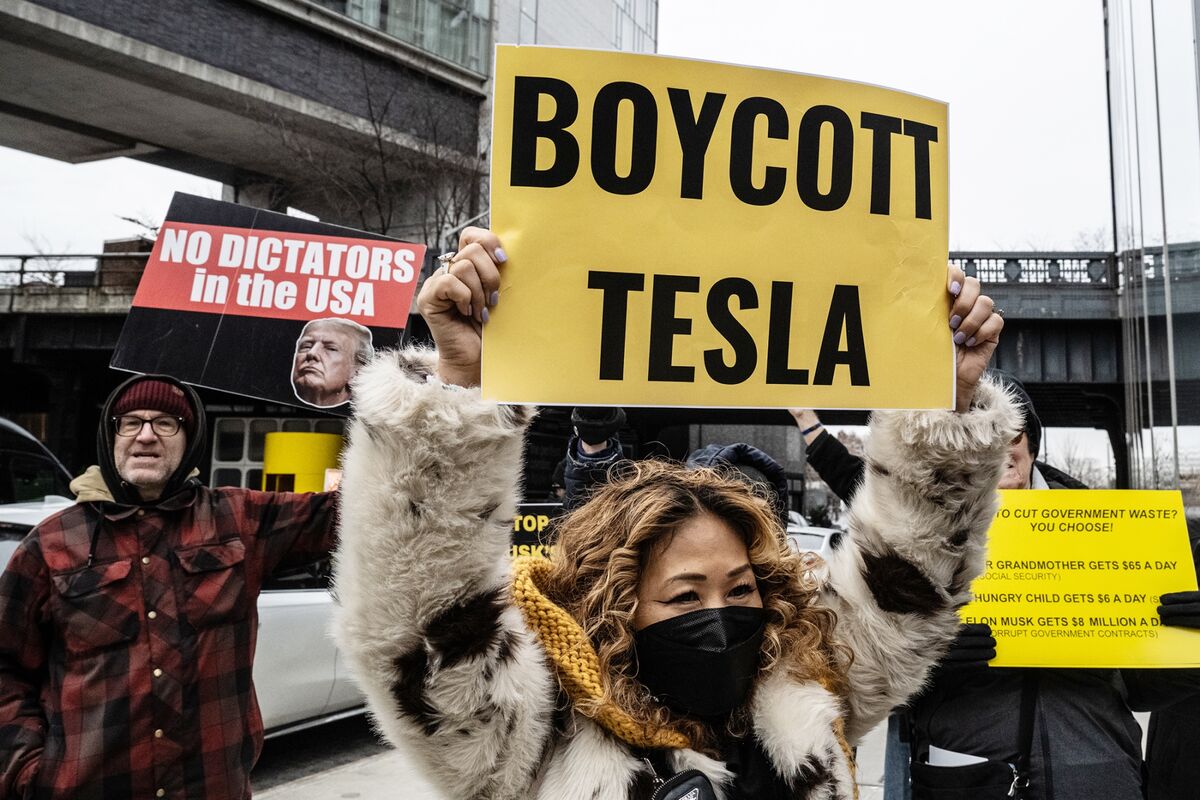
        Group of Tesla protestesters gathered at more than 50 Tesla showrooms across the United States on Saturday to protest CEO Elon Musk’s leadership of the newly established Department of Government Efficiency (DOGE), a federal agency created by President Donald Trump.

        The protests, part of the “Tesla Takedown” movement, urge Tesla owners to sell their vehicles, divest from the company, and join picket lines. According to the movement’s website, the campaign aims to push back against Musk’s influence over government agencies.

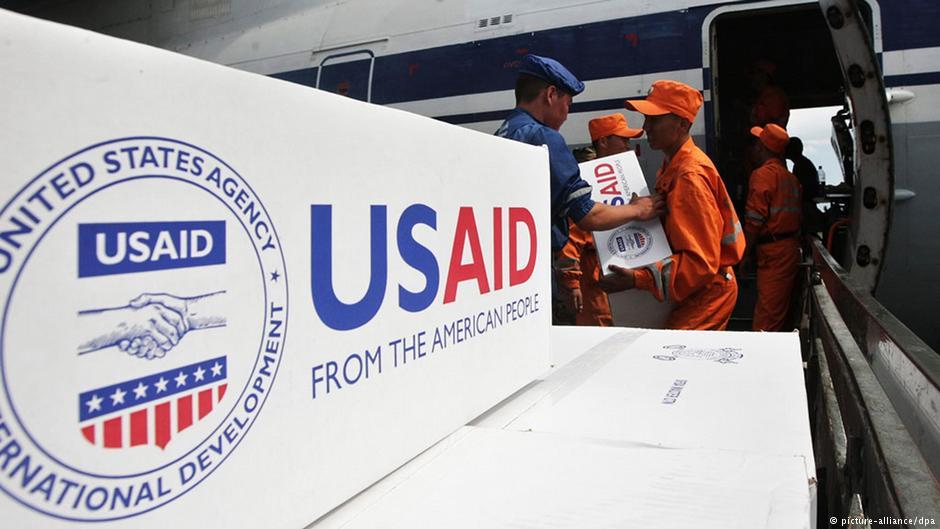
        President Donald Trump appointed Musk, the world’s richest person, to lead DOGE on January 20, a decision that has sparked controversy.His tenure has been marked by widespread layoffs in federal agencies, buyout offers to government employees, the dismantling of the U.S. Agency for International Development (USAID), and efforts to gain access to sensitive financial systems.

        Protests Gain Global Momentum

        The Tesla Takedown movement has begun expanding internationally. Actor and filmmaker Alex Winter, one of the main organizers, confirmed demonstrations have already taken place in Barcelona, with additional protests planned for London, Lisbon, and Reykjavik over the weekend.

        “I am very satisfied, even with where we are now,” Winter said. “We provided people an easy way to protest during a very difficult time.”

        The size of protests has varied, with some of the largest demonstrations occurring in Boston, Portland, California, and Florida. In Tucson, Arizona, around 1,000 protesters gathered with signs on Saturday, while in Washington, D.C., an initial group of just two demonstrators outside a Tesla showroom in Georgetown grew to about 20 within an hour.

        Chants of “Elon Musk has got to go” rang out at various locations, with passing drivers honking in support.

        Impact on Tesla and Investor Sentiment

        Some protesters hope their actions will have financial consequences for Tesla and Musk.

        “Tesla stock has been going down, and we want to see that continue. We want to see Musk hurt,” said one protester, identified only as Powell. “We also hope that Congress will grow a spine and do what they’re elected to do.”

        Musk, who in December became the first person with a net worth exceeding $400 billion, has since lost $52 billion as Tesla shares (TSLA) have fallen by 27.6% in February.

        Despite the demonstrations, it remains unclear whether the Tesla Takedown movement will significantly impact the company’s sales. Jessica Caldwell, head of insights at automotive research site Edmunds, noted that Tesla owners have not yet shown an uptick in appraising their used vehicles.

        “Selling a car depends on several factors, including the cost of purchasing a new vehicle, especially with high interest rates,” Caldwell said. She also pointed out that Tesla’s lower prices could discourage some owners from selling.

        While Musk’s leadership of DOGE may lead to backlash, some consumers continue to separate the company from its controversial CEO, she added.

        “When you look at other car companies, most people couldn’t name another automotive CEO, much less their opinion on politics,” Caldwell told CNN.

        Tesla’s Sales Slump Due to Protests

        Tesla reported global sales of 1.79 million vehicles in 2024, a 1.1% decline from the 1.81 million sold in 2023—marking the company’s first annual sales drop in 12 years.

        Tesla’s sales dropped 16% between December and January, improving from the 24% decline recorded between December 2023 and January 2024.

        Caldwell suggested that a lack of new models may also be contributing to declining sales. With few major updates aside from the Cybertruck release and minor refreshes to existing models, Tesla faces growing competition from automakers such as General Motors, Ford, and Volkswagen, which are expanding their electric vehicle offerings.

        Despite these challenges, Tesla remains a dominant force in the EV market. However, with increasing political scrutiny and intensifying competition, the company’s future may depend on how it navigates both business and public perception.

      3. Apple’s $500 Billion US Investment: New Jobs, AI Expansion, and Manufacturing Plans

        Apple’s $500 Billion US Investment: New Jobs, AI Expansion, and Manufacturing Plans

        Apple’s $500 billion US investment over the next four years will fuel job creation, AI advancements, and manufacturing expansion, the company announced on Monday. The tech giant plans to hire 20,000 new employees and establish a new manufacturing facility in Houston, Texas, this move aligns with President Donald Trump’s push for US-based manufacturing and technological expansion.

        “Apple today announced its largest-ever spend commitment, with plans to spend and invest more than $500 billion in the US over the next four years,” the company stated.

        Apple Expands AI, Manufacturing, and R&D in the US

        CEO Tim Cook emphasized the company’s commitment to American innovation, stating:

        “We are bullish on the future of American innovation, and we’re proud to build on our long-standing US investments with this $500 billion commitment to our country’s future.”

        Apple’s investment will primarily focus on:

        • Research & Development
        • Silicon Engineering
        • Software Development
        • AI & Machine Learning

        New Manufacturing Facility in Texas

        A new manufacturing facility will open in Houston, Texas, in 2026, creating thousands of jobs. This facility will assemble servers that power Apple Intelligence, the company’s AI-driven ecosystem.

        Additionally, Apple plans to establish an Apple Manufacturing Academy in Detroit, designed to help companies transition to advanced manufacturing technologies.

        Apple’s $500 Billion US Investment

        Apple’s $500 Billion US Investment Ties to Tariff Policies

        This announcement comes days after Trump praised Apple’s commitment to investing “hundreds of billions of dollars” in the US. His tariff policies, including 10% levies on Chinese goods, aim to encourage US manufacturing—though critics argue they could increase consumer prices.

        Apple’s Current US Manufacturing Footprint

        Apple’s suppliers already manufacture silicon in 24 factories across 12 states, including:

        • Arizona
        • Colorado
        • Oregon
        • Utah

        With Apple’s $500 billion US investment, the company is reinforcing its commitment to American jobs, AI advancements, and domestic production.

      4. Zelensky Celebrates Ukraine’s Resilience on War Anniversary

        Zelensky Celebrates Ukraine’s Resilience on War Anniversary

        On the Ukraine War Anniversary, President Volodymyr Zelensky praised the “absolute heroism” of Ukrainians in their fight against Russia’s full-scale invasion. As the country marked three years of war, European leaders arrived in Kyiv to show solidarity.

        “Three years of resistance, Three years of gratitude, Three years of absolute heroism of Ukrainians. I am proud of Ukraine!” Zelensky wrote on X, sharing a video featuring frontline battle scenes and civilians aiding war efforts.

        “I thank everyone who defends and supports it. Everyone who works for Ukraine. And may the memory of all those who gave their lives for our state and people be eternal,” he added.

        Ukraine war anniversary

        European Leaders Arrive in Kyiv

        As the war enters its fourth year, uncertainty looms over Ukraine’s future, particularly following U.S. political shifts and warnings that Europe can no longer fully rely on Washington for defense support.

        Images from Ukraine’s public broadcaster Suspilne showed European leaders arriving in Kyiv on Monday. Authorities blocked roads in the city center, with police officers deployed to ensure security.

        Von der Leyen: ‘Ukraine Is Europe’

        European Commission President Ursula von der Leyen emphasized Ukraine’s significance in a message on X:

        “On the 3rd anniversary of Russia’s brutal invasion, Europe is in Kyiv,” she said. “In this fight for survival, it is not only the destiny of Ukraine that is at stake.”

        Von der Leyen was joined by European Council President Antonio Costa, while Canada’s Prime Minister Justin Trudeau was also spotted arriving in Kyiv, as shown in images shared on Suspilne’s Telegram channel.

        Russia Launches New Drone Attacks

        As Ukraine marked this solemn occasion, Russia launched a massive drone attack overnight, targeting multiple regions across the country.

        According to Ukraine’s Air Force, Moscow launched 185 drones, with 113 intercepted and another 71 lost from radar after being jammed. The attack affected Dnipropetrovsk, Odesa, Kyiv, and Khmelnytsky regions, though damage and casualty details remain undisclosed.

        Ukraine Faces Largest Drone Assault Since Invasion

        The latest strikes followed a record-breaking drone assault on Sunday, when Russia launched 267 drones, the largest attack since the war began. Ukrainian authorities confirmed that 138 drones were intercepted in that assault.

        Ukraine’s Military Vows to Keep Fighting

        Ukraine’s armed forces commander-in-chief, Oleksandr Syrskyi, honored Ukrainian troops on the invasion anniversary.

        “The world did not believe that we would survive, but the Ukrainian people withstood the enemy’s attacks with dignity,” Syrskyi wrote on Telegram.

        With European leaders standing by Ukraine and Kyiv’s defenses remaining strong, the fight for Ukraine’s sovereignty continues—three years since the invasion that reshaped global geopolitics.

      5. USAID Places 1,600 Employees on Administrative Leave Amid Workforce Reduction

        USAID Places 1,600 Employees on Administrative Leave Amid Workforce Reduction

        The United States Agency for International Development (USAID) has placed at least 1,600 employees worldwide on administrative leave, as the agency begins a Reduction-in-Force (RIF) initiative affecting its workforce.

        The move, which took effect at 11:59 p.m. EST on Sunday, February 23, 2025, was confirmed in an official statement titled “Notification of Administrative Leave” posted on USAID’s website.

        USAID Layoffs Target U.S.-Based Personnel

        According to the agency, all direct hire personnel, except those in mission-critical roles, core leadership, or specially designated programs, were affected.

        “Concurrently, USAID is beginning to implement a Reduction-in-Force that will affect approximately 1,600 personnel with duty stations in the United States,” the agency stated.

        Employees impacted by the decision have received direct notifications detailing next steps, including information about their employment status, benefits, and future options.

        USAID workforce reduction

        Essential Personnel to Continue Operations

        While the sweeping changes impact much of USAID’s workforce, a select group of essential personnel has been tasked with continuing operations.

        “Designated essential personnel who are expected to continue working will be informed by Agency leadership on February 23, 2025, by 5 p.m. EST,” the statement read.

        USAID Overseas Personnel Offered Return Travel Program

        The impact of the restructuring is particularly significant for USAID’s overseas personnel. To support affected employees, the agency announced a voluntary, agency-funded return travel program aimed at facilitating their transition back home.

        “Until they return home, personnel will retain access to agency systems, diplomatic support, and other resources,” USAID confirmed.

        Next Steps for Employees

        USAID has pledged to provide further details in the coming week, including instructions on retrieving personal belongings from former workspaces and the return of government-issued devices.

        For employees without access to USAID systems, the agency directed them to check USAID.gov for ongoing updates.

        “Additional guidance is forthcoming. All future updates and notices will be communicated through official USAID channels and posted on USAID.gov,” the statement concluded.

        With the USAID workforce reduction now underway, employees and stakeholders will be closely watching for further developments as the agency navigates this major restructuring.

      6. Japan and Philippines Strengthen Security Ties

        Japan and Philippines Strengthen Security Ties

        Japan’s defense chief emphasized the need for stronger security cooperation with the Philippines on Monday, citing an “increasingly severe” security environment in the Indo-Pacific region.

        Defense Secretary Gen Nakatani made the remarks at the conclusion of a two-day visit to Manila, where he met with Philippine counterpart Gilberto Teodoro Jr. and toured key air bases.

        “Secretary Teodoro and I firmly concurred that the security environment surrounding us is becoming increasingly severe, and it is necessary to further enhance defense cooperation,” Nakatani said in a joint press briefing.

        The two countries agreed to establish a “strategic dialogue between high-level operational officers” to boost coordination in regional security efforts.

        China’s Actions Fuel Japan-Philippines Security Ties

        Nakatani’s visit follows a January meeting between the two nations’ foreign ministers, where Tokyo and Manila pledged to strengthen security cooperation to counter China’s expanding presence in key sea trade routes, including the disputed South China Sea.

        The Philippines has repeatedly clashed with China over territorial disputes. In December, the Philippine government accused the Chinese coast guard of using a water cannon and “sideswiping” a government fisheries vessel.

        Tensions escalated further last week when a Chinese Navy helicopter came within 10 feet (three meters) of a Philippine surveillance plane carrying journalists over the contested Scarborough Shoal.

        Japan Supports Philippine Defense Modernization Amid South China Sea Disputes

        Japan plays a crucial role in financing the Philippines’ efforts to modernize its maritime surveillance and South China Sea patrol craft. Tokyo has provided funding for radar installations and other defense infrastructure aimed at bolstering Manila’s capabilities.

        China, which claims nearly the entire South China Sea despite an international tribunal ruling rejecting its claim, has deployed naval and coast guard vessels to restrict Philippine access to strategic reefs and islands in the region.

        Japan and Philippines Strengthen Defense Pact as U.S. Allies

        Japan and the Philippines, both close allies of the United States, are working within a broader strategy to counter China’s expanding influence in the Indo-Pacific.

        Last year, the Philippine Senate ratified a key defense agreement with Japan, allowing troops from both nations to be deployed on each other’s soil and enabling increased joint military drills. The agreement is now pending ratification in Tokyo.

        Meanwhile, Japan has its own territorial dispute with China over the uninhabited Senkaku Islands (known as Diaoyu in China) in the East China Sea. The islands are claimed by Beijing but administered by Tokyo, adding another layer to Japan’s security concerns.

        With geopolitical tensions rising, Japan-Philippines security ties are expected to continue expanding, reinforcing a regional alliance that seeks to uphold international law and deter unilateral actions in the Indo-Pacific.

      7. American Airlines Flight Diverts to Rome Following Bomb Threat, Escorted by Italian Fighter Jets

        American Airlines Flight Diverts to Rome Following Bomb Threat, Escorted by Italian Fighter Jets

        An American Airlines flight traveling from New York’s John F. Kennedy International Airport to Delhi, India, was forced to make an emergency diversion to Rome on Sunday after a bomb threat was reported on board.

        The Boeing 787-9 Dreamliner, carrying 199 passengers and 15 crew members, was just two hours away from its intended destination when authorities instructed the aircraft to change course over Turkmenistan. According to a report from the New York Post, American Airlines confirmed that the decision to divert was made due to a “possible security issue.”

        Panic and Uncertainty During American Airlines Bomb Threat

        Neeraj Chopra, a passenger on board who was en route to visit his family in India, described the tense moments when the flight crew announced the abrupt change in course.

        “I felt a little panic of, OK, what’s going on here?” he recalled.

        As the aircraft continued its journey, two Italian Air Force Eurofighter Typhoon jets were dispatched to escort the plane safely to Rome’s Leonardo da Vinci Airport. Italian authorities later confirmed that the security threat was linked to a possible bomb on board, prompting the swift intervention and rerouting of the flight.

        crowd coming down from a flight

        Emergency Landing in Rome After American Airlines Bomb Threat

        After nearly 15 hours in the air, the flight finally touched down in Rome at approximately 11:15 a.m. Eastern Time. Upon arrival, passengers were transported via buses for further security screenings, adding another layer of scrutiny to the already tense situation. Travelers reportedly endured an additional two-hour wait to retrieve their checked luggage as officials thoroughly examined the aircraft and cargo.

        American Airlines swiftly issued a statement reaffirming its commitment to passenger safety.

        “Safety and security are our top priorities, and we thank our customers for their understanding,” the airline stated. “We are working closely with local authorities and will provide updates as the situation develops.”

        Authorities have yet to disclose whether any suspicious items were found on board or whether any arrests were made in connection to the bomb threat. Investigations are ongoing as officials work to determine the credibility of the threat and identify its source.

        Recent Security Incidents Involving American Airlines Bomb Threats

        This latest bomb scare comes just two weeks after another security incident involving American Airlines. In that case, a flight bound for Texas was delayed for several hours following a bomb threat linked to a suspicious Wi-Fi hotspot name. The incident prompted extensive security measures, adding to growing concerns over aviation safety and the increasing frequency of in-flight security threats.

        American Airlines Bomb Threats

        While security officials stress that commercial aviation remains one of the safest modes of transportation, such incidents highlight the need for constant vigilance. Airline carriers, regulatory agencies, and law enforcement authorities continue to refine protocols aimed at preventing and swiftly addressing threats to ensure the safety of passengers and crew.

        As investigations into Sunday’s bomb threat continue, passengers on the affected flight are being rerouted to their final destinations. American Airlines is reportedly working with local authorities and Italian aviation officials to assess the incident and implement any necessary follow-up measures.

        While the specifics of the threat remain unclear, aviation experts emphasize that diverting flights in response to security threats is a standard precautionary measure aimed at minimizing risk and ensuring passenger safety.

        Travelers scheduled to fly on American Airlines in the coming days are encouraged to check for any updates regarding security measures and possible delays. Authorities continue to urge vigilance, reminding the public that aviation security is a collective effort requiring cooperation from passengers, airline staff, and law enforcement alike.

        For now, American Airlines and aviation security officials are working diligently to ensure that flights operate smoothly and safely in the wake of this latest security scare.

      8. Elon Musk IRS Access Sparks Privacy Concerns Over Taxpayer Data

        Elon Musk IRS Access Sparks Privacy Concerns Over Taxpayer Data

        Elon Musk’s Department of Government Efficiency (DOGE) is under scrutiny for seeking access to the Internal Revenue Service (IRS) system containing detailed financial data on millions of Americans. The request, which has not yet been granted, has raised significant privacy concerns among government officials and experts.

        According to reports from The Washington Post and other sources, DOGE officials want broad access to IRS systems, including the Integrated Data Retrieval System (IDRS), which allows instant visual access to taxpayer accounts. Access to this system is typically restricted due to the sensitive nature of the data.

        How Much Access Is Too Much? The Privacy Debate Intensifies

        The potential implications of granting Elon Musk IRS access have alarmed privacy advocates. Elizabeth Laird, a former state privacy officer now with the Center for Democracy and Technology, told ABC News, “People share their most sensitive information with the federal government under the assumption that it will be handled securely and in a way that minimizes risks such as identity theft and personal invasion. This request calls that into serious question.”

        Despite concerns, the White House has defended DOGE’s request, stating that combating waste, fraud, and abuse within the system requires direct access to IRS data. White House spokesperson Harrison Fields commented, “DOGE will continue to shine a light on the fraud they uncover. The American people deserve to know what their government has been spending their hard-earned tax dollars on.”

        As debates continue over the balance between government efficiency and personal privacy, the decision on whether to grant Elon Musk IRS access remains uncertain. The controversy highlights broader concerns about data security and transparency in government oversight.

      9. South Korean Actress Kim Sae-ron Found Dead in Seoul Apartment at 24

        South Korean Actress Kim Sae-ron Found Dead in Seoul Apartment at 24

        South Korean actress Kim Sae-ron was found dead in her Seoul apartment on Sunday, nearly two years after she withdrew from the public eye following a drunk driving conviction. She was 24.

        Police Investigating the South Korean Actress Cause of Death

        According to the Seoul Metropolitan Police, a friend discovered Kim’s body at approximately 4:55 p.m. local time (07:55 GMT). And immediately alerted authorities. Investigators said there were no signs of foul play, but needs official autopsy to determine the exact cause of death.

        Police sources told local media that Kim had not been in regular contact with many people recently, and her reclusive lifestyle had raised concerns among those close to her. Authorities have not confirmed whether she left behind any notes or messages.

        A Promising Career Cut Short

        Born in Seoul in 2000, the South Korean Actress made her acting debut at the age of nine and quickly gained recognition. As one of South Korea’s most talented young stars, she first rose to international prominence with her role in A Brand New Life (2009), which premiered at the Cannes Film Festival.

        She later starred alongside Won Bin in The Man from Nowhere (2010), South Korea’s highest-grossing film that year, cementing her status as a rising star. Kim’s other acclaimed performances included roles in The Neighbour (2012), A Girl at My Door (2014), and the fantasy drama Mirror of the Witch (2016).

        Kim’s career took a hit in May 2022 when she was arrested for drunk driving in Seoul. Surveillance footage from the incident showed her crashing her vehicle into a transformer box, causing a power outage in the area. In April 2023, she was fined 20 million won ($15,000) by the court.

        Following the controversy, Kim largely retreated from the public eye. Netflix edited out much of her performance in the 2023 drama Bloodhounds, and she struggled to regain her footing in the entertainment industry.

        Industry and Fans React

        News of Kim’s passing has sent shockwaves through South Korea’s entertainment industry. Tributes have poured in from fellow actors, filmmakers, and fans who remember her as a gifted performer with immense potential.

        Her management agency has not yet released an official statement, and funeral arrangements have not been disclosed.

        The investigation into her death remains ongoing.

      10. President Biden Issues Preemptive Pardons for Fauci, Milley, and January 6 Committee Members

        President Biden Issues Preemptive Pardons for Fauci, Milley, and January 6 Committee Members

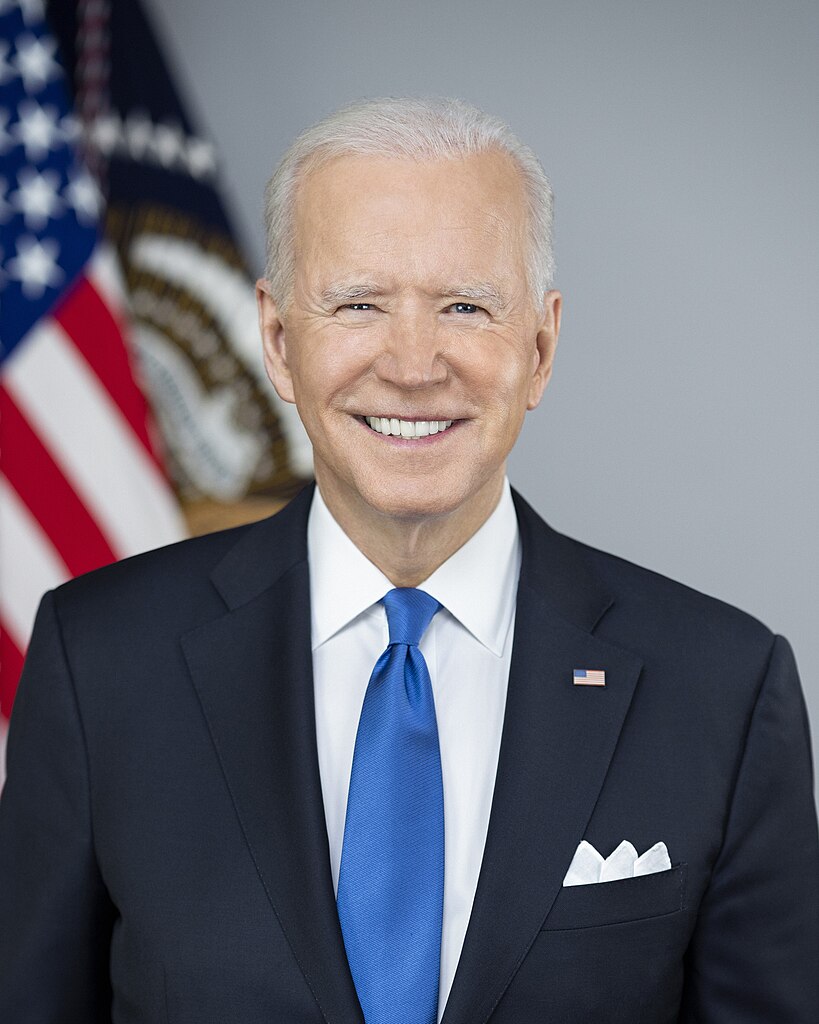
        In an extraordinary move on his final day in office, President Joe Biden issues preemptive pardons to key public figures, including former COVID-19 adviser Dr. Anthony Fauci and retired General Mark Milley. The pardons aim to shield them from what Biden described as potential “politically motivated prosecutions” under the administration of President-elect Donald Trump.

        The pardons were also extended to members, staff, and witnesses involved in the investigation into the January 6, 2021, Capitol riot, an event that remains a flashpoint in U.S. politics.

        “These individuals have served our country with integrity and do not deserve to face baseless legal actions driven by political agendas,” Biden said in a formal statement. He added, “This is an exceptional situation that calls for decisive action to uphold fairness and justice.”

        Fauci and Milley: At the Center of Political Disputes

        Biden issues preemptive pardons

        Dr. Anthony Fauci became a household name during the pandemic, leading the nation’s public health response with frequent media appearances. His recommendations often clashed with Republican leaders, including Trump, and turned him into a divisive figure. Critics from the political right accused Fauci of mishandling the pandemic and even called for his prosecution, a narrative amplified by Trump allies.

        General Mark Milley, who served as chairman of the Joint Chiefs of Staff, faced criticism after reportedly contacting Chinese military officials following the Capitol riot to reassure them of U.S. stability. His actions were revealed in a high-profile book and were condemned by Trump, who accused Milley of treason.

        Biden Issues Preemptive Pardons for January 6 Investigators

        The pardons also cover individuals connected to the bipartisan House committee that investigated the January 6 attack. The committee, which included prominent figures like former Congresswoman Liz Cheney, faced sharp criticism from Trump and his supporters for its inquiry into the riot and the broader efforts to challenge the 2020 election results.

        Biden emphasized that the pardons should not be seen as an indication of guilt or wrongdoing. “This decision is about protecting individuals from undue legal harassment, not about assigning blame or absolving anyone of accountability,” he clarified.

        A Preemptive Strike Against Political Retaliation

        Biden issues preemptive pardons

        The pardons reflect growing concerns over the potential for politically charged prosecutions as Trump prepares to take office again. Biden’s statement highlighted the dangers of using the legal system as a tool for political retaliation, warning that such actions could harm public servants and undermine democratic institutions.

        Trump, who has frequently alleged that legal actions against him are politically driven, has faced numerous criminal charges in recent months, including accusations of attempting to overturn the 2020 election.

        Biden’s decision to issue preemptive pardons underscores the heightened political tensions in the United States. While the move may provide legal protection for individuals at the center of heated partisan debates, it is certain to provoke further scrutiny and debate over the boundaries of presidential power and the role of justice in a deeply divided nation.

      11. World Bank Projection of Top Ten Fastest Growing Countries in Africa in 2025

        World Bank Projection of Top Ten Fastest Growing Countries in Africa in 2025

        African economies in the past few years have been blighted by geopolitical, climatic and macroeconomic shocks resulting in a tepid post pandemic recovery curtailing growth of the fastest growing countries in the region.

        These shocks resulting in supply chain disruptions have led to high food and energy prices and worsened standards of living across the continent.

        Elevated food and energy inflation exacerbated by currency weaknesses in many countries has pushed more people into hunger and worsened the humanitarian situation in Africa most especially in West and Central Africa where an estimated 55 million people are expected to go hungry in 2024. 

        However, the tide of inflation seems to be turning in 2024 compared to 2023 where average inflation in the continent stood at 17% according to the African Development Bank (AfDB). The World Bank projects that 70% of African countries are set to register lower inflation figures in 2024 compared to the past year. Although, 13 countries including Nigeria, Ethiopia and others have rising inflation. 

        Also, exchange rate pressures have propelled Central Banks of many countries in Africa to embark on a hawkish monetary policy stance. This was due to tighter financial conditions, a strong U.S. dollar, and foreign exchange market reforms. The Nigerian Naira led the pack of worst performing currencies in Africa in 2024 so far losing almost 50% of its value followed by the Ethiopian Birr and the Kenyan shilling losing 30% and 21% respectively. 

        There has been a mixed reaction to the twin threats of inflation and currency weakness in Africa- while some Central Banks have joined the global wave of easing interest rates, others have taken a more cautious approach- and continue to tighten MPR as inflation remains stubborn.

        fastest growing countries in Africa

        Despite these macroeconomic malaises, Africa remains the second fastest growing continent in the world- only trailing Asia. In 2023, growth in Sub-Saharan Africa stood at 2.4% and rose to 3% in 2024. The World Bank projects growth to reach 4% in 2025 and 2026. Growth in the region was largely impacted by the collapse of the Sudanese economy over the raging civil war in the country which when excluded will put the regions GDP growth at 3.5% in 2024.

        In the East and Southern Africa region economic growth is expected to rise to 3.9% in 2025- 2.2% in 2024. However, South Africa and Angola seems to be dragging the regions down as the region is projected to grow by 5.3% excluding these two countries.

        Rwanda, Kenya, Tanzania and Uganda contributed significantly to making East Africa the best performing region in the continent.

        West and Central Africa’s biggest economy poses a lag to the region’s growth which is projected at 4.2% in 2025 mainly propelled by fast growth in Niger, Benin and Cote d’Ivoire. However, excluding Nigeria’s the region will is forecast to grow by 5.1% in 2025-2026.

        The World Bank in its Africa Pulse for 2024 and Middle East and North Africa (MENA) update projected growth of African countries in 2025. This article looks at the top ten fastest growing countries by GDP in Africa in 2025. 

        10. Zambia

        This Southern African country is projected to grow at 6.1% in 2025- a sharp spike considering the country’s 2.0% growth in 2024. Risk to the outlook stems from significantly high inflation projected to decelerate to 12.1% in 2025 from 15% this year.

        The country’s currency- the Zambian Kwacha is one of the worst performing currencies in the continent losing over 30% of its value in 2024 so far after the Central Bank notified the public of moving to a market driven exchange rate system.

        09. Zimbabwe

        Fastest Growing Countries

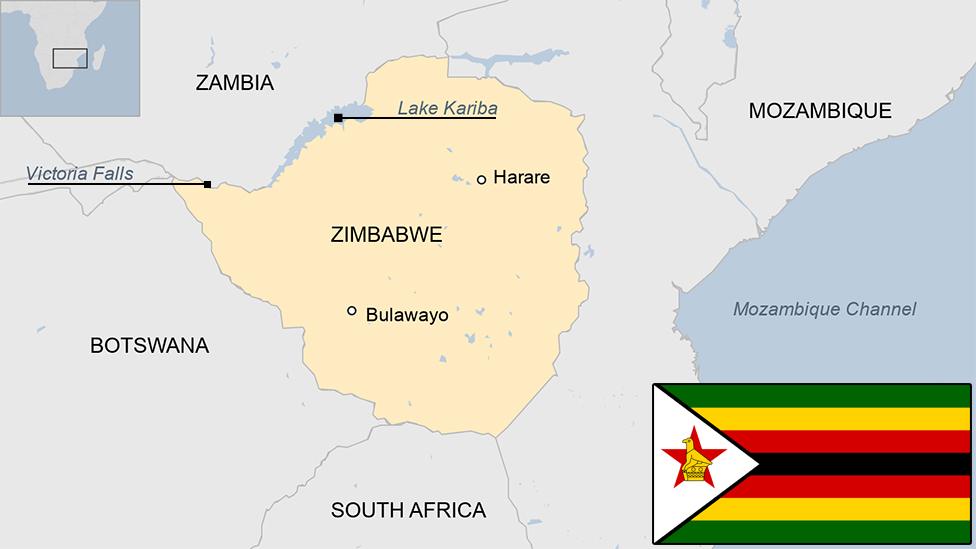
        This country’s economy is projected by the World Bank to grow at 6.2% in 2025- an increase from the projection of 2.0% in 2024. The country’s inflation is projected to accelerate to 8.4% in the coming year from 6.0% in 2024. In the past few years, inflation in this country reached over 200% on the back of severe depreciation of its local currency- the Zimbabwean dollar.

        Risk to the outlook include the effect of climate change induced El Nino which affects production of key staple such as maize. Also, the country has also seen natural disasters such as flooding like its other Southern African counterpart in 2024 so far.

        08. Uganda

        The World Bank provided the same economic growth projection for both Zimbabwe and Uganda at 6.2% in 2025. The country’s GDP growth projection for 2025 represents a 0.2 percentage points increase compared to its projection for 2024. GDP growth in Uganda is one of the highest across the East Africa region.

        The country in the past 18 months has seen inflation fall to stable levels resulting in monetary policy authorities to begin the easing cycle with a 25 basis points cut in MPR. In 2023, inflation in the country stood at 8.8%- this dropped to 3.2% in 2024 and consumer prices in the coming year is projected to remain stable at 4.6%.

        07. Republic of Benin

        This West African nation is forecast to see 6.4% GDP growth in 2025 which has helped in no small measure to boost economic expansion in the West African region.

        In the past five years, the country has posted GDP growth above 5% whilst maintaining inflation under 3% dating back to 2020.

        06. Cote D’Ivoire

        Fastest Growing Countries

        The World Bank projects growth in this West African country to reach 6.4% in 2025- one of the strongest performers in the West African region. This growth is underpinned by strong private consumption and capita deepening as well as exploitation of recent oil discoveries in the country.

        In the past four years, the country has seen GDP growth above 6% and barring the pandemic in 2020, growth has average 7.5% dating as far as 2010.

        Inflation in the country is projected to decline by 0.6 percentage points to 3% next year from 3.6% in 2024.

        05. Ethiopia

        with GDP growth at 6.5% in 2024 according to the World Bank projection, Ethiopia is the fifth fastest growing economy in Africa. The country has been a consistent performer in the region recording over 6% growth in the last five years including during the pandemic in 2020.

        The major risk to the currency outlook is severe currency weakness- the Ethiopian Birr is among the worst performing currencies in the continent losing 30% of its value as of August 2024 and would likely have a pass-through effect on inflation.

        Also, natural disasters such as droughts and floods have negatively impacted agricultural output in the past few years with crop failure in some years hovering around 50% to 90%.

        04. Rwanda

        this country sits joint third with Mauritania as the third fastest growing economy in the Africa with the World Bank projecting its GDP to grow by 7.8% in 2024.

        The GDP growth projection for 2025 is an improvement from 7.6% recorded in 2024. Inflation in the country for 2025 is projected to decelerate to 5.0% in 2025 from the projected 6.8% this year.

        03. Mauritania

        the World Bank puts the country’s economic growth for 2025 at 7.8%- making her the joint third fastest growing economy on the continent. The projection represents an increase of 1.3 percentage points from the 2024 forecast of 6.5%.


        Inflation in the country is forecast to decline to 2% from 2.7% in 2024.

        02. Niger

        despite a coup and severing of its membership of the ECOWAS in the year, Nigeria is on track to become the second fastest growing economy in the continent in 2025 with the World Bank putting GDP growth at 8.5% in 2025.

        This is an improvement from the 5.7% projected GDP growth in 2024 which has strengthened economic activities in the West African region.

        01.Libya

        the fastest growing economy in Africa in 2025 according to the World Bank is conflict and unstable Libya projected to grow at 10.7% in 2025. The impressive GDD growth projection is underpinned by recovery from the contraction of 10.1% in 2024.

        The outlook for Libya is a downgrade compared to the Bretton Wood institute projection earlier in the year.

        The outlook for Libya is marred by conflict and political instability which has severely affected oil production in the country. Further distabilisation in the Middle East with the toppling of the Assad led Syrian regime and uncertainties in the conflict between Israel and Hamas could potentially upend the potential recovery. 

      12. Germany Unveiled a €120 Million Initiative to Attract Foreign Students for the Workforce

        Germany Unveiled a €120 Million Initiative to Attract Foreign Students for the Workforce

        In a bold step to tackle its severe shortage of skilled workers, Germany has unveiled a €120 million initiative aimed at preparing international students for the labor market. The program, announced by the German Academic Exchange Service (DAAD) on Thursday, will fund universities across the country to help integrate foreign talent into Germany’s workforce.

        The initiative, named the “Campus Initiative for International Talents,” will run until 2028 and will support 114 projects at 104 universities. The program will provide the necessary funding to enable universities to equip international students with the skills and knowledge needed to thrive in Germany’s dynamic job market.

        As noted on DAAD’s website, the funding, which starts in April, will focus on the qualification of international students as future specialists to address the growing demand for skilled labor. DAAD President Joybrato Mukherjee highlighted the critical need for skilled workers, pointing out that the shortage has reached “dramatic proportions.”

        “German universities want to be a driving force in attracting international skilled workers. This is also reflected in the high level of participation in the calls for proposals for the ‘Campus Initiative’. From April, we will therefore be funding a total of 114 projects at 104 universities in all federal states in order to better pave the way for international talent from university to the German labor market,” Mukherjee explained.

        How the Program Works: FIT and Pro Plus

        The program is divided into two key components: the FIT program and the Pro Plus program.

        The FIT program is designed to provide comprehensive support to international students throughout their studies. This includes career counseling and opportunities for networking with businesses, allowing students to build valuable connections and better prepare for their transition into the workforce.

        The Pro Plus program focuses on graduates who hold foreign degrees. It offers education tailored to the German labor market, alongside essential language and social skill development. This dual approach ensures that both current international students and foreign graduates are equipped with the necessary tools to succeed in the competitive German job market.

        Germany’s commitment to attracting and retaining global talent through this €120 million initiative is a promising move that not only strengthens its economy but also solidifies its position as a key destination for international students seeking to build successful careers.

      13. Los Angeles Wildfire Rages Out of Control, Casualties Reported

        Los Angeles Wildfire Rages Out of Control, Casualties Reported

        A catastrophic wildfire erupted in Los Angeles on Tuesday evening, tearing through the inland foothills northeast of the city and leaving widespread destruction in its path. Casualties have been reported as the fast-moving flames engulfed homes, vehicles, and vegetation, forcing over 30,000 residents to evacuate in a desperate rush to safety.

        The Los Angeles Fire Department Chief, Kristin Crowley, confirmed the devastating toll while hundreds of firefighters battled the blaze from both air and ground. Crews worked tirelessly in steep terrain to carve firebreaks and slow the fire’s relentless advance.

        Families Recount Their Journey to Safety in the Los Angeles Wildfire

        Witnesses described terrifying moments as embers rained down, turning neighborhoods into fiery infernos. “It looked far away—then suddenly, it was upon us,” Gary, a resident of Sea Ridge, told KTLA. Roads turned into gridlocks with flames on both sides, leaving some evacuees to flee on foot.

        Despite the chaos, stories of resilience have emerged. Families helped each other escape, and communities are rallying together to support those displaced. “In times like this, we see the best of humanity,” said Pacific Palisades resident Andrew Hires, who helped neighbors pack their belongings before fleeing the flames.

        For those who have made it to safety, what comes next? This is a time to lean on community resources and support systems. Local shelters are offering temporary housing, while aid groups are mobilizing to provide food, water, and clothing.

        Have you checked in with loved ones or reached out to friends who may be affected? Even a small act of kindness can make a significant difference in moments like these. Survivors are encouraged to access counseling services to process the trauma and take small, hopeful steps toward rebuilding.

        Steps to Protect Yourself Against Wildfires

        Wildfires are a harsh reminder of the importance of preparedness and proactive measures. Here’s a step-by-step guide to help communities and individuals protect themselves and minimize risks:

        1. Create Fire-Safe Zones Around Your Home

        • Clear Vegetation: Remove dry leaves, branches, and dead plants near your home to reduce fire fuel.
        • Plant Fire-Resistant Vegetation: Opt for plants with high moisture content and low resin.
        • Maintain Defensible Space: Keep at least 30 feet of clear space around your home to act as a buffer.
        • Store Combustible Materials Safely: Keep firewood and flammable items far from your house.

        2. Prepare Your Home for Wildfire Resistance

        • Install Ember-Resistant Vents: Prevent embers from entering your home through openings.
        • Install Smart Smoke Alarms: The best smart smoke alarms for modern homes offer real-time notifications and alerts directly to your phone, allowing you to take immediate action no matter where you are. These alarms can detect smoke, fire, and carbon monoxide, giving you an early warning to evacuate or take safety measures.
        • Upgrade Windows: Use tempered glass windows that are more resistant to heat.
        • Seal Gaps: Ensure roofs, gutters, and eaves are sealed to avoid ember penetration.
        • Use Fire-Resistant Materials: Consider metal roofs or fiber-cement siding for extra protection.

        3. Develop an Emergency Plan

        • Identify Safe Exits: Know multiple evacuation routes in case of emergencies.
        • Pack Emergency Kits: Include essentials like water, non-perishable food, medications, important documents, and flashlights.
        • Establish a Communication Plan: Ensure all family members know how to stay in touch during emergencies.
        • Practice Evacuations: Regularly rehearse evacuation plans with your household.

        4. Stay Informed and Alert

        • Sign Up for Alerts: Subscribe to local emergency alert systems for real-time updates.
        • Monitor Weather Conditions: Stay aware of red flag warnings and high-wind advisories.
        • Listen to Authorities: Follow instructions from emergency services promptly during a wildfire.

        5. Collaborate as a Community

        • Participate in Fire Safety Programs: Join or organize local fire-prevention initiatives.
        • Support Local Firefighters: Advocate for funding and resources for fire departments.
        • Create Firebreaks Together: Work with neighbors to clear vegetation and create communal safety zones.

        6. Advocate for Government Action

        • Strengthen Emergency Systems: Push for improved wildfire alert systems and response mechanisms.
        • Promote Policy Changes: Support legislation that prioritizes wildfire prevention and management.
        • Invest in Research: Encourage investments in technology and strategies to predict and control wildfires effectively.

        By taking these steps, we can collectively reduce the risk of wildfires and ensure that future disasters cause less destruction and loss. Let’s commit to learning from this tragedy and building a safer tomorrow.

        We stand with the survivors and all affected by this tragedy, offering our deepest empathy and support as they navigate the road to recovery.

      14. HMPV Outbreak in China: Are We Facing Another COVID-19-like Crisis?

        HMPV Outbreak in China: Are We Facing Another COVID-19-like Crisis?

        Five years after the initial Covid-19 pandemic, China is now facing an outbreak of a new respiratory virus: Human Metapneumovirus (HMPV). This emerging pandemic has raised global concerns, prompting countries like India to closely monitor its spread and impact. In Asia, countries like Malaysia are also witnessing a rise in HMPV cases, adding to the urgency of controlling its transmission.

        Rising Concerns Over HMPV Outbreak in China

        Recent reports and social media videos depict overwhelmed hospitals, raising fears of multiple concurrent infections, including HMPV, influenza A, Mycoplasma pneumoniae, and even Covid-19. These concerns highlight the ongoing challenges in managing respiratory outbreaks.

        Symptoms of HMPV

        According to the Centers for Disease Control and Prevention (CDC), common symptoms of HMPV include:

        • Coughing
        • Runny nose
        • Fever
        • Sore throat

        In severe cases, HMPV can lead to conditions like bronchitis, pneumonia, or worsening asthma symptoms.

        How HMPV Spreads

        HMPV spreads primarily through:

        • Coughing and sneezing
        • Close contact (handshakes, touching surfaces, then the face)
        • Contaminated surfaces

        The virus tends to follow a seasonal pattern, typically spreading during late winter and spring in temperate regions.

        Who Is Most At Risk in the HMPV Outbreak in China?

        Certain populations are more vulnerable to HMPV:

        • Young children under 5 years old, especially infants
        • Older adults (ages 65 and above)
        • Individuals with weakened immune systems or chronic respiratory conditions, such as asthma or COPD

        Preventing HMPV Transmission

        While no specific antiviral therapies or vaccines currently exist for HMPV, preventive measures can help reduce its spread:

        1. Regular handwashing with soap and water for at least 20 seconds
        2. Covering the mouth and nose when coughing or sneezing
        3. Wearing face masks and avoiding contact with those showing symptoms
        4. Refraining from touching the eyes, nose, and mouth with unwashed hands

        Global Health Monitoring of HMPV Outbreak in China

        As HMPV continues to spread, global health authorities are working to assess its potential impact and devise strategies to prevent widespread outbreaks. Stay informed through trusted sources and follow public health guidelines to protect yourself and those around you.

      15. Walmart Job Benefits: What You Need to Know Before Applying

        Walmart Job Benefits: What You Need to Know Before Applying

        When considering a career with one of the world’s largest retailers, Walmart job benefits play a key role in making it a top employer. Beyond a competitive paycheck, Walmart offers a robust benefits package that includes comprehensive health plans, career growth opportunities, retirement savings, and exclusive employee discounts. These Walmart job benefits are designed to support the well-being and development of employees at every stage of their career.

        Whether you’re looking for a flexible part-time position or aiming for long-term career growth, Walmart provides not just a job, but a pathway to success. Curious to know what makes working at Walmart stand out? Keep reading to explore the full range of benefits that could make this retail giant your next career destination.

        Why Work at Walmart?

        Walmart has built a reputation for being a reliable and inclusive employer. Whether you’re starting your career, looking for a part-time job, or aiming for management, Walmart has a range of opportunities to match your goals. Beyond competitive salaries, Walmart employees enjoy numerous benefits designed to enhance their quality of life.

        What Are the Benefits of Working at Walmart?

        Walmart is committed to supporting its associates through competitive pay, health and wellness programs, career development opportunities, and exclusive perks. Here’s an overview:

        Top Walmart Job Benefits You Should Know

        1. Health and Wellness Benefits

        Walmart offers affordable and accessible health plans to support employees and their families.

        • Wellness Programs: Discounts on gym memberships and access to fitness challenges encourage employees to stay healthy and active.
        • Medical, Dental, and Vision Coverage: Employees can choose from several plans to suit their needs, covering preventive care, major medical expenses, prescriptions, routine checkups, and more.
        • Mental Health Support: Associates have access to free counseling, therapy sessions, and stress management resources.

        2. Financial Security and Rewards

        Walmart’s financial benefits ensure employees are rewarded for their hard work and prepared for the future.

        • Live Better U Program: Associates can earn college degrees for just $1 a day in fields like business and technology.
        • 401(k) Retirement Plan: Walmart matches employee contributions to help build long-term savings.
        • Stock Purchase Program: Associates can invest in Walmart stock at discounted rates, sharing in the company’s success.
        • Bonuses and Incentives: Employees are eligible for performance-based bonuses and annual raises.

        3. Work-Life Balance

        Balancing personal and professional life is a priority at Walmart.

        • Paid Time Off (PTO): Employees earn PTO based on the number of hours worked, which can be used for vacations, personal days, or sick leave.
        • Parental Leave: Walmart provides paid parental leave for childbirth, adoption, or foster care placement.
        • Flexible Schedules: With a wide range of shifts available, employees can create schedules that fit their lifestyles.

        4. Career Development Opportunities

        Walmart invests heavily in training and education to ensure its associates can grow within the company.

        • Specialized Roles: Opportunities in pharmacy, e-commerce, and technology offer pathways to unique and rewarding careers.
        • Walmart Academy: A training program designed to help employees develop leadership, customer service, and technical skills.
        • Promotion from Within: Many of Walmart’s managers and executives began in entry-level roles.

        5. Exclusive Employee Perks

        In addition to core benefits, Walmart provides perks that save employees money and enhance their quality of life.

        • Partner Discounts: Deals on travel, entertainment, cell phone plans, and more through Walmart’s partner companies.
        • Walmart Associate Discount: A 10% discount on general merchandise and fresh produce.
        • Seasonal Discounts: Additional discounts during the holidays.

        How to Apply for a Job at Walmart

        If these benefits sound appealing, you might be ready to start your Walmart journey. Applying for a job is straightforward:

        1. Visit the Walmart Careers Website: Go to Walmart Careers and search for roles that match your skills and interests.
        2. Submit an Online Application: Fill out your details and upload your resume.
        3. Prepare for an Interview: If shortlisted, you may be invited to a phone or in-person interview.
        4. Get Hired: Once you pass the selection process, you’ll receive an offer to join the Walmart team.

        A job at Walmart is more than just a paycheck. With extensive health benefits, financial perks, and opportunities for career growth, Walmart provides a well-rounded employment package that caters to employees’ personal and professional needs. Whether you’re seeking a flexible part-time job or a long-term career, Walmart’s commitment to its workforce makes it a great place to work.

        Start your journey today by exploring open positions on the Walmart Careers website.

        Frequently Asked Questions About Walmart Job Benefits

        1. Does Walmart offer health insurance to part-time employees?
        Yes, Walmart provides health insurance to both part-time and full-time employees, with multiple plans to choose from.
        2. What is the starting pay at Walmart?
        Starting pay varies based on the role and location, but Walmart has increased its minimum wage in recent years to ensure competitive compensation.
        3. Can I grow my career at Walmart?
        Absolutely. Walmart offers numerous training and development programs, making it possible for employees to progress from entry-level positions to management.
        4. How does the Walmart discount card work?
        The discount card provides a 10% discount on general merchandise and fresh produce, with additional seasonal offers.
      16. Nigerian Government Drops Money Laundering Charges Against US Binance Executive

        Nigerian Government Drops Money Laundering Charges Against US Binance Executive

        In a major development, the Federal Government of Nigeria has officially dropped money laundering charges against Tigran Gambaryan, a Binance executive and former U.S. IRS investigator, after months of international scrutiny and diplomatic pressure.

        Gambaryan, who joined Binance in 2021 as part of its compliance and investigations team, was arrested earlier this year in Nigeria as part of the government’s broader efforts to combat cryptocurrency-related financial crimes. His arrest stemmed from accusations that Binance had facilitated illegal money laundering transactions through its platform. Gambaryan’s role at Binance involved ensuring that the company adhered to anti-money laundering (AML) and know-your-customer (KYC) compliance regulations, making the charges against him particularly controversial. His previous career with the U.S. government made him a high-profile figure in this case.

        Before joining Binance, Gambaryan spent over a decade working for the IRS Criminal Investigation Division, where he became renowned for his efforts in uncovering major crypto-related crimes, including dark web drug markets like Silk Road and AlphaBay. He was credited with helping track down billions of dollars in stolen cryptocurrency and bringing major criminal networks to justice. Given his distinguished record, many were shocked by his detention.

        Reports indicate that Gambaryan was arrested in a raid that targeted Binance’s operations in Nigeria. He was initially accused of conspiring to launder money through cryptocurrency transactions, which were allegedly facilitated by Binance’s platform. Nigerian authorities claimed that the exchange had not done enough to prevent illicit transactions. Gambaryan, however, maintained that his work focused on preventing money laundering, not enabling it.

        After his arrest, Gambaryan’s health rapidly declined while in custody. Images of him attending court hearings in a wheelchair and, later, using a crutch due to mobility issues sparked concern globally. His detention became a diplomatic issue, with calls from U.S. lawmakers and advocacy groups urging the Nigerian government to release him. A group of 16 U.S. Congress members signed a letter to the White House, urging the U.S. government to treat his case as a hostage situation. State attorneys general also joined the campaign, advocating for his immediate release and pointing to his contributions to global financial crime investigations as reasons for leniency.

        The case drew significant international attention, not just because of Gambaryan’s high-profile career, but also due to its implications for the global cryptocurrency industry. Binance has been under scrutiny by regulators worldwide, with many accusing the platform of failing to enforce strict anti-money laundering measures. Gambaryan’s arrest intensified concerns about the risks of working in the cryptocurrency space, where regulatory frameworks are still evolving.

        Despite the severity of the charges, Gambaryan’s legal team continued to push for his release, arguing that the charges were baseless and that he was being wrongfully detained. International pressure and diplomatic efforts finally led to the Nigerian government dropping the charges.

        Gambaryan’s supporters have hailed the decision as a victory for justice and transparency, though his ordeal has cast a shadow over the relationship between Binance and international regulators. Binance continues to face challenges as it strives to navigate the complex legal landscape surrounding cryptocurrency.

        Possible Reinstatement of Naira Feature on Binance P2P

        The dismissal of money laundering charges against Binance executive Tigran Gambaryan could have significant implications for Binance’s decision to disable the naira feature on its P2P market. Binance suspended naira transactions following increased scrutiny and regulatory pressures from Nigerian authorities. With the charges now dropped, it may create an opportunity for Binance to re-evaluate its stance on naira transactions in the region.

        If Binance feels that the regulatory environment has become more favorable or stable, it might reconsider the suspension and re-enable naira functionality on its P2P platform. This could restore confidence among Nigerian users who rely heavily on P2P trading due to the central bank’s restrictions on crypto-related transactions within the formal banking sector.

        The demand for P2P trading in Nigeria remains high, as many citizens use cryptocurrency as a hedge against inflation and currency devaluation. Enabling the naira feature again would facilitate easier access for users and may drive up transaction volumes, benefiting both the exchange and its customers.

        However, this potential restoration would also depend on how Nigerian regulators respond post-Gambaryan’s case. The legal environment surrounding cryptocurrencies in Nigeria remains uncertain, and Binance may still face challenges if authorities maintain strict control over crypto activities. Nonetheless, the dismissal of such a high-profile case might encourage Binance to take steps toward resuming full operations, including reactivating naira trading on its P2P platform.

      17. Is Population Collapse Coming? A Global Decline in Birth Rates Sparks Concern

        Is Population Collapse Coming? A Global Decline in Birth Rates Sparks Concern

        Across the globe, fertility rates are dropping, leading to pressing questions about the future of population growth. In many developed nations, birth rates have dipped below the replacement level of 2.1 children per woman—the rate necessary to sustain a population without migration. This trend has ignited discussions among demographers, economists, and policymakers about whether we are on the brink of a population collapse and the potential consequences it might bring.

        Elon Musk, the CEO of Tesla and SpaceX, has been particularly vocal about the implications of declining birth rates. He has raised concerns about the long-term consequences of a shrinking population, warning that it could lead to labor shortages and hinder economic growth. Musk emphasizes that without a stable or growing population, societies may face challenges in sustaining technological advancements and infrastructure, ultimately impacting our quality of life.

        Musk’s insights align with broader discussions among experts who argue that declining fertility rates could create a ripple effect across various sectors, from healthcare to housing. A reduced working-age population may strain social security systems, as fewer workers support an increasing number of retirees. This demographic imbalance raises questions about the sustainability of current economic models and the welfare of future generations.

        Australia’s Fertility Decline

        Australia, with a fertility rate of just 1.5 children per woman, exemplifies the broader pattern seen in developed countries. This figure marks a significant decline from earlier in the 2000s, when fertility rates hovered around 1.8. According to the Australian Bureau of Statistics, this drop, coupled with an aging population, is putting immense pressure on the country’s social services, pension systems, and healthcare infrastructure. Without sustained immigration, Australia’s population could begin to shrink in the coming decades.

        The Global Fertility Decline

        Australia’s declining birth rate is part of a global demographic shift. Many countries, particularly developed ones, are experiencing historically low fertility rates:

        • Japan: The fertility rate stands at 1.3 children per woman. Japan’s population is already contracting, with an annual decline of around 500,000 people. Despite various government incentives aimed at encouraging childbearing, such as subsidies and work-life balance policies, Japan faces an uphill battle to reverse the trend. The United Nations predicts further population decreases, which could lead to a shrinking workforce and increased burden on the elderly.
        • South Korea: With an unprecedented fertility rate of 0.8 children per woman, South Korea holds the lowest rate in the world. This demographic crisis has been exacerbated by economic uncertainty, high housing costs, and a growing disinterest in traditional family structures. Experts warn that, without intervention, South Korea could see its population halved by the end of the century Statistics Korea.
        • Italy: The fertility rate in Italy is 1.2, placing it among the lowest in Europe. Like Japan, Italy’s population is aging rapidly. With fewer young people entering the workforce, the country’s pension system is under immense strain. A declining workforce combined with increasing numbers of retirees raises concerns about Italy’s economic future Istituto Nazionale di Statistica.
        • China: Despite decades of strict population control measures, China is now grappling with its own fertility crisis. The current fertility rate is 1.2, and although the government has relaxed the one-child policy to allow families to have up to three children, the rising cost of living has deterred many couples from expanding their families. The National Bureau of Statistics of China has noted that China’s population is expected to decline for the first time in modern history.

        Why Are Fertility Rates Falling?

        Several key factors are driving the global fertility decline:

        1. Economic Pressures: Rising living costs, particularly in urban areas, have made starting and raising a family prohibitively expensive for many. In countries like South Korea, Japan, and Italy, high housing costs and job insecurity lead young couples to delay or even forgo having children altogether.
        2. Career Prioritization: Women, in particular, are prioritizing higher education and career advancement, often choosing to delay marriage and childbearing. By the time many feel financially stable enough to start a family, fertility rates naturally decline due to age.
        3. Shifting Social Norms: Cultural changes in attitudes toward family size and marriage have also contributed. Many couples today prefer smaller families or opt out of having children entirely. Increased access to contraception has further enabled this shift, as individuals now have greater control over their reproductive choices.
        4. Environmental Concerns: With growing awareness of climate change, some individuals are choosing to have fewer or no children out of concern for the planet’s future. Environmental considerations are becoming a more common factor in reproductive decisions.

        Are We on the Verge of a Population Collapse?

        As fertility rates continue to fall below replacement levels, the question arises: are we heading toward a global population collapse?

        Population collapse is defined as a rapid and significant decrease in population size, which can result in a society with an unsustainable number of elderly people relative to the working-age population. While a shrinking population might alleviate some environmental concerns, it also presents serious economic challenges. Countries with declining birth rates may face reduced productivity, slower economic growth, and a higher dependency ratio—meaning fewer workers to support an increasing number of retirees.

        Japan, South Korea, and Italy are already facing the first stages of population collapse. Their shrinking workforces, combined with a growing elderly population, are creating economic challenges that are difficult to overcome. The strain on social services, healthcare systems, and pension funds will only worsen unless birth rates rebound or alternative solutions are found.

        The Role of Immigration

        Many countries, including Australia, have relied on immigration to bolster their populations in the face of declining birth rates. While immigration can help sustain population levels in the short term, it is not a long-term solution. As more countries experience low fertility rates, the global pool of potential migrants may diminish, leading to competition for skilled workers. Additionally, social and political resistance to high levels of immigration could create tensions in certain regions.

        Environmental Implications of Population Decline

        While fewer people could mean less strain on natural resources, a shrinking population also has downsides for environmental sustainability. Fewer workers may hinder technological and industrial innovation, which are critical for developing sustainable solutions to global challenges like climate change. Furthermore, as populations age, fewer young people will be available to drive the green economy, potentially slowing progress toward environmental goals.

        What Can Be Done?

        Governments around the world are exploring various policies to address declining fertility rates. Financial incentives for families, affordable childcare, and flexible parental leave are some measures already being implemented. Countries like France and Sweden, which offer generous family support programs, have seen some success in stabilizing fertility rates at around 1.8 children per woman.

        However, experts caution that policy interventions alone may not be enough. Cultural attitudes toward family size, career, and childbearing need to shift in parallel with policy reforms to make meaningful impacts.

        The global fertility decline presents both challenges and opportunities. While a smaller population could ease environmental pressure, it poses serious economic risks, including shrinking workforces and the unsustainability of pension systems. Countries already grappling with low birth rates, like Japan and South Korea, offer a glimpse into the potential future for many nations.

        The world now faces a demographic crossroads. The decisions made by governments, individuals, and institutions in the coming years will shape the future of global populations. Will the global population stabilize, or is population collapse inevitable?

      18. Potential Israel-Iran Conflict and Its Impact on Nigeria’s Exchange Rates and Petrol Prices

        Potential Israel-Iran Conflict and Its Impact on Nigeria’s Exchange Rates and Petrol Prices

        Just over one year ago, Hamas terrorists launched arguably the most brutal attack on Israeli civilians since the Holocaust resulting in death of over 1000 people.

        In the past year, the Israel Defence Force (IDF) has been involved in a brutal conflict with Hamas in Gaza which has spilled over to Lebanon where Hezbollah has a significant presence.

        The onslaught of the Israeli military pushed oil prices up by as much as 4% after Yemeni Houthi rebels in solidarity with Hamas began attacking ships in the Red sea.

        In the past few weeks, we’ve seen Israel come on the brink of full-blown conflict with Iran after attacks on Iran-backed Hezbollah militants by Israel and assignation of top Iranian military commanders.

        Just one week ago, Iran fired over 180 missiles inside Israel in escalation of the ongoing conflict, the Prime Minister of Israel had promised to retaliate and analyst are saying Israel plans to attack Iran’s oil facilities.

        In the wake of this current attack, oil prices have shot up to $80 per barrel and there are projections of nearly reaching $100 if Israel attacks Iran’s oil facilities as predicted. Conflicts in major oil producing regions has always resulted in higher oil prices and going back to the 1970s oil crisis caused by the Yom Kippur war in Israel and the Iranian revolution.

        The most recent scenario occurred in 2022 after Russia invaded Ukraine where crude oil prices closed the year at $97 per barrel compared to $69 in the previous year. In fact, the post pandemic recovery of oil prices stems from the Russia-Ukraine war.

        For countries like Nigeria whose economy is heavily influenced by the swing in oil prices especially in the post-subsidy era, oil prices could be a double-edge sword.

        Crude oil does two things to Nigeria’s government finances- provides revenue for government and foreign exchange for the CBN’s external reserves which is used to back the Naira.

        However, in this post-subsidy era we are moving into, swinging crude oil prices could now mean higher petrol prices for Nigeria even when the petrol is produced locally and the raw crude even sold in Naira. Before now, the federal government through the Nigeria National Petroleum Company (NNPC) Limited pays a fraction of petrol cost of petrol to keep it low and fixed. This enabled Nigerians to not just enjoy low PMS prices but keep petrol prices immune from the vagaries of the international oil market.

        However, in the past years, the cost of this subsidy has become unbearable for the federal government. Attempts have been made by different administrations in the past to end petrol subsidies but was met with stiff resistance by civil society groups with the greatest being the Occupy Nigeria protest in 2012 after President Jonathan removed petrol subsidy. This pushed the then President to reintroduce the subsidy where it remained until President Tinubu announced the removal on his first speech as President.

        What Does Projected Rise In Oil Prices Mean For Petrol Price

        In simple terms, Nigerians are going to pay higher PMS prices at the pump if the Iran-Israel conflicts escalates and pushes petrol prices above the current $80 per barrel. This is irrespective of where the crude oil is sourced and where or who refines it either locally or abroad. For example, the NNPC has declared it would supply 17.6 million barrels of crude oil to the Dangote refinery in Naira.

        However, it will be dependent on the price of crude oil in the international market. If the price increase, Dangote and other local refineries would have to cough more Naira to settle the NNPC and this cost will be passed on to consumers. This is because crude oil as an international commodity is priced in U.S dollars.

        Rising Oil Prices and Exchange Rate

        In the face of rising oil prices, it is expected that the Naira strengthens against the dollar but that is dependent on the decisions of the United States Federal Reserve Bank and Central Bank of Nigeria (CBN).

        The Naira has witnessed the worst volatility in history this year becoming at one time the best performing currency before a 180 degrees reversal of fortunes to become the worst performing currency. The strengthening of the Naira in March stems from the action of the CBN selling forex to BDCs at rates below the official market rate but there is a problem with such is that it is not sustainable- there is a limit to how much forex the apex bank can burn.

        The Naira currently trades in the region of N1,550/$ to N1,660/$ in the official NAFEM window. This represents a depreciation of over 100% compared to the rates before the unification of all segments of the FX market by the CBN.

        Rising oil prices could help shore up the country’s foreign reserve which has been seen rising in the past few months. In September 2023, the country’s foreign reserve stood at $33.23 billion- this has increase to $38 billion by the end of September 2024.

        The CBN is presented with two choices with potential increase in foreign reserves- either to sell FX to BDCs like it did earlier in the year when the Naira became the best performing currency in the world or to allow the forces of demand and supply determine the value of the Naira as it currently does with the exchange rate reaching N1,600/$.

        Hence, the value of the Naira with the potential increase in oil prices would be dependent on the decision of the CBN.

        Most Ideal Scenario For Nigeria

        From the foregoing, it seems the potential war between Israel and Iran and the ripple effects on crude oil prices means Nigeria would likely face another round of petrol price increase in the event the NNPC continues on its post-subsidy policy.

        There is also uncertainty on the decision of the apex bank on either backing the Naira or allowing market forces determine the exchange rate.

        Furthermore, Nigeria has been unable to since the beginning of the year to significantly increase oil prices. According to OPEC’s records, Nigeria has not met its crude oil production quota of 1.5 million barrels daily since January, despite calls to ramp up production.

        For Nigerians, the best case scenario in the wake of potential increase in oil prices would be for low crude oil prices to keep petrol prices low and high crude oil production to increase forex supply to the CBN’s foreign reserves.