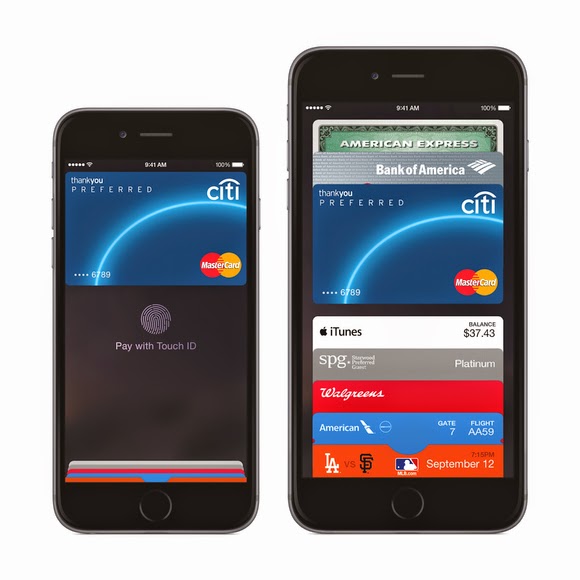
This evening at a Wall Street Journal technology conference, Apple CEO Tim Cook said that in its first 72 hours, Apple Pay activated 1 million cards.
That figure indicates that Apple Pay is picking up traction outside of the technology, early-adopter set. Apple Pay competes with rival offerings from Google, among others, alongside traditional payment methods. Paying for goods with your smartphone, still nascent in the Western market, could grow quickly: Given smartphone penetration in the United States and other developed nations where this sort of transaction system remains new, Apple has the potential to quickly scale its new product.
The possible revenue for Apple is not trivial. The company picks up 0.15 percent of transactions, or 15 cents per $100 dollars in payments. That isn’t much on a per-transaction basis, but it could quickly add up for the company worth more than $600 billion. If its smartphone userbase adopts its Pay technology, the product could bring in fresh top line for Apple, a company looking for a new hit.
Of course, 1 million cards is a fraction of the total number of saved credit cards that Apple has via its iTunes and long-standing app businesses, implying that it could enjoy continued quick growth. How large its payment volume will grow in the meatspace remains to be seen.
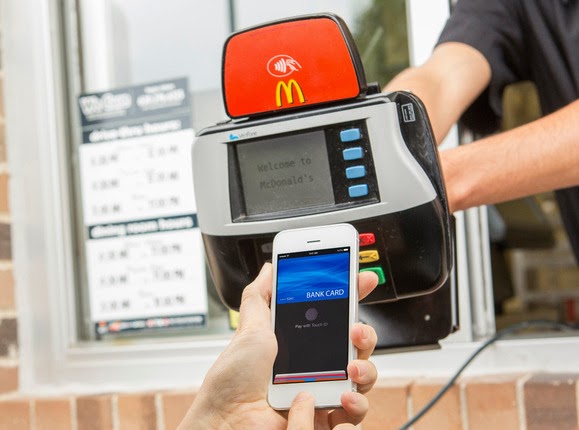
The launch of Apple Pay this week is giving many people their first taste of NFC payment technology, which allows them to buy things in a store by bringing an iPhone 6 close to a compatible terminal.
But the NFC standard also allows payments to be made directly between smartphones. Apple and its competitors, such as Google Wallet, don’t offer support for that part of the standard, but the technology already exists inside many of today’s NFC-equipped phones and could one day allow retailers to accept NFC payment using smartphones. It would also be technically possible for individuals to exchange money with their friends through the same system.
The first, and most simple, is for reading small snippets of information such as phone numbers or Web addresses from wireless tags. The second, used by Apple Pay and Google Wallet, involves the phone emulating an NFC payment card. The third allows the NFC chip to function as a card reader.
It’s this third mode, if enabled by Apple or Google, that would allow a smartphone to accept payments.
Smartphone payment systems are already common in some countries. Perhaps the most famous and recognizable is the Square system, which uses a small magnetic stripe reader that plugs into a phone’s headphone jack. In Europe, some companies offer card readers for more secure chip-based payment cards, but nothing exists yet for NFC.
“We’ve been working on it at Mastercard for a little while,” said James Anderson, the company’s senior vice president of emerging payments. “We’re interested in turning every phone into a payment acceptance device.”
But while many of the NFC chips used in smartphones support it, not every phone could necessarily be used to accept payments.
There are a number of requirements for NFC payments, such as the minimum and maximum distance over which the NFC transaction can take place and the speed with which it happens. Terminal manufacturers design for these requirements, but not all smartphones have necessarily been built with these in mind.
“There may be situations in which the two devices may technically be capable of exchanging data for payment, but may not be able to achieve the read ranges and/or response times required for them to be certified as contactless payment capable,” said Sam Shrauger, senior vice president of digital solutions at Visa.
For now, the industry is watching closely to see consumer reaction to Apple Pay. If it takes off, competitors such as Google would probably step up their offerings and the NFC payments field would become a lot more competitive. That might bring new features such as phone-to-phone payments into play.
Roughly 1000 transactions were made with Apple. Some Bank of America customers have been double-charged for purchases made with Apple Pay, the payment system Apple launched on Monday.
Roughly 1,000 transactions made with Apple Pay were logged twice in customer accounts, said Tara Burke, a spokeswoman with Bank of America, which is one of the largest U.S. banks and was an Apple Pay launch partner.
“We apologize for the inconvenience and are correcting the problem,” said Burke.
The duplicate transactions should be removed by the end of Wednesday.
Apple Pay utilizes a secure chip inside Apple’s new iPhone 6 that enables the phone to emulate an NFC (near field communications) payment card. When the Apple Pay app is loaded with a customer’s credit or debit card, payments can be made at NFC terminals by bringing the phone close to the terminal.
Roughly 1000 Transactions. The system is being positioned as easier and more secure than current payment cards because the card number is not passed to the retailer’s terminal. Instead, a substitute number called a token is offered to the merchant, which sends it on to the card issuer for approval.
The token can only be used once, so if it’s stolen it should prove useless to cyberattackers. It’s tied to the actual card number deeper in the financial services network, further away from the retailer terminals that have been the target of so much hacking recently.
Apple Pay is compatible with existing NFC payment terminals, which can be found in around 200,000 shops and taxis across the U.S.
Apple’s new payment system is live, and Apple Pay purchase have already garnered more attention than most mobile payment efforts to date. It also have a new ad, which aired yesterday during the opening game of the 2014 World Series, from payment partner MasterCard.
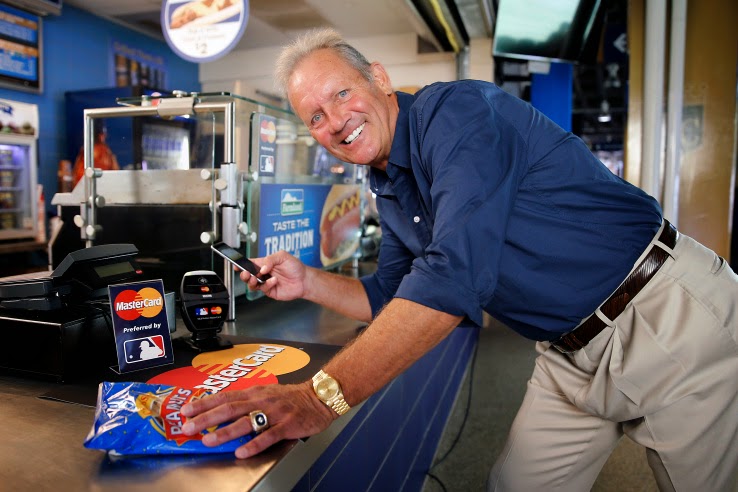
MasterCard’s ad accompanies its new rollout of contactless payments at food and beverage purchase points in MLB ballparks across the U.S. The program supports a range of NFC-powered mobile payment options, but MasterCard is pushing the Apple Pay angle specifically, touting the fact that it brings Apple Pay to pro sports facilities for the first time, at ballparks in both Kansas City and San Francisco.
MasterCard says that the Apple Pay system works well in the ballpark setting basically because people want their franks fast. Apple Pay/MLB partnerships don’t end there, however – the company is also offering in-app purchase support for Apple Pay users for single-game tickets once those start going on sale in November, via the MLB.com At the Ballpark app.
The first ad features MBL Hall of Famer George Brett making an Apple Pay purchase. Remember, this is a MasterCard ad, not an Apple ad, meaning this is yet another sign that payments providers think Apple could be the company to make mobile payments really take off, and are investing resources and backing accordingly.