Category: Business

  • Ten Countries Account for 70% of IMF’s Total Outstanding Debt

    Ten Countries Account for 70% of IMF’s Total Outstanding Debt

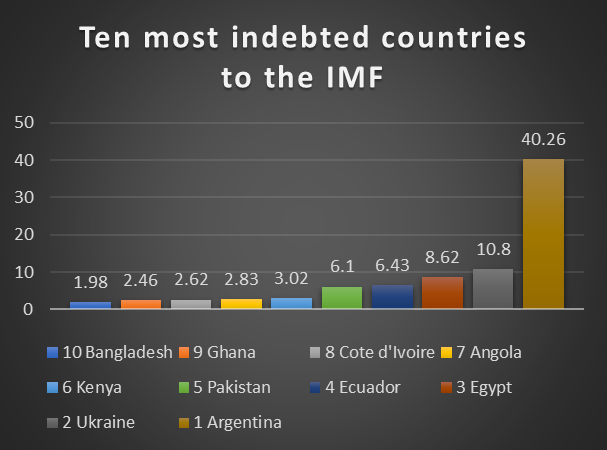
    A review of the International Monetary Fund (IMF) recent debt profile reveals that 70% of the total of $117.6 billion in outstanding debt obligation is owed by the top ten countries. The report reveals that 91 countries have outstanding debt obligations to the IMF as of 8th May, 2025. 

    According to the report, the cumulative outstanding debt obligation of the top ten most indebted countries to the Fund totalled $82.44 billion. 

    The majority of countries featured were from low and emerging-market, mostly domiciled in Africa, South America, the Caribbean, and Asia. Less than 10 countries owing outstanding balances to the IMF were from Europe, and no G20 country had any balance with the Fund. 

    Of the top ten countries most indebted to the International Monetary Fund (IMF), five are from Africa, two from South America, two from Asia, and one from Europe, war-torn Ukraine.
    Source: IMF

    10. Bangladesh ($1.98 billion)

    In 2024, Bangladesh reached a staff-level agreement with the IMF where the fund agreed to provide $645 million comprising Standard Drawing Rights (SDR 325.2 million (about US$426 million) under the External Credit Facility (ECF) and External Fund Facility (EFF) and SDR 166.7 million (about US$219 million) under the Resilient and Sustainability Facility (RSF).

    Since 2020, the IMF has reached an agreement on support facilities totaling $4 billion but has only drawn around $355 million. In May 2020, the country reached a Rapid Financing Instrument (RCF) of $355.5 million. 

    Fast forward to January 2023, it agreed to three facilities with the IMF: an Extended Credit Facility (ECF) of $822 million, an Extended Credit Fund (ECF) of $1.6 billion, and a Resilience and Sustainability Facility (RSF) of $1 billion. All three facilities are yet to be drawn and are expected to expire by July 2026. 

    09. Ghana ($2.46 billion)

    This West African country has outstanding debt balances with the IMF totaling $2.46 billion. Since defaulting on its debt obligation in 2022, Ghana has borrowed up to $1.17 billion from the IMF under the Extended Credit Facility (ECF) initiative. 

    However, the country’s economy has been in turmoil since the COVID-19 pandemic, with inflation reaching over 50% in 2022. In April 2020, the country agreed $738 million which it has drawn but not repaid. 

    The oldest unpaid IMF credit facility to Ghana dates back to 2015- an Extended Credit Facility (ECF) of $664.2 million, of which $393.5 million remains as an outstanding balance. 

    08. Côte d’Ivoire ($2.62 billion)

    This country has outstanding balances with the IMF for credit facilities dating back to a decade ago in 2011. The country has drawn portions of its last three credit facilities from the IMF, which include: an $867.2 million ECF of 2023, a $1.73 billion ECF, and $975.6 million RSF of March 2024. All three are billed to expire by 23rd September, 2026. 

    07. Angola ($2.83 billion)

    This oil-dependent economy has outstanding balances with the IMF to the tune of $2.83 billion, which was a $3.2 billion Extended Fund Facility (EFF) approved in December 2018 and set to expire in December 2021. 

    Beyond the high outstanding debt to the IMF, the country continues to be weighed down by extreme poverty, a high debt-to-GDP ratio, low life expectancy, high infant mortality, and epidemic corruption levels.

    The situation appears gloomy for Angola in the coming years as the number of people living in the country is expected to climb to 16.3 million people. 

    06. Kenya ($3.02 billion)

    The country’s total outstanding obligation to the IMF came under four credit facility programs: Rapid Credit Facility, Extended Fund Facility, Extended Credit Facility, and Resilience and Sustainability. 

    It has an outstanding balance of $542.8 million under the (RCF), and $1.51 billion under the EFF—the loan initially totaled $1.8 billion. 

    The country’s economy has been resilient despite the harsh operating environment in the past years, especially debt. Efforts by the Ruto-led government to raise revenue in line with recommendations of the Fund were met with the most brutal protests in the region to date. 

    05. Pakistan ($6.10 billion)

    This country has received over $10 billion in credit facilities from the IMF since 2019. The latest of these facilities was the Extended Fund Facility of $5.32 billion, agreed in September 2024 and set to expire in 2027. Others include a $2.25 billion iStandby Agreement, which has been fully drawn by Pakistan, and EFF of $4.98 billion, of which $3.03 billion has been drawn. 

    Last week, the IMF’s Board completed its first review of the 37-month EFF and noted that the government’s effort under the EFF has delivered economic stability in terms of surplus, inflation reduction, and increase in the country’s gross external reserve. 

    The IMF Board, in its review of the country’s performance, further approved a request to access the $1.4 billion Resilience and Sustainability Facility (RSF), which aims to strengthen resilience to natural disasters and federal and provincial responses to natural disasters, among others. 

    04. Ecuador ($6.43 billion)

    Aside from Argentina, Ecuador is the only South American country on the list. The latest of the IMF’s facilities comes amidst a significant fiscal deficit in the country, financial and fiscal instability, coupled with illiquidity problems. 

    In May 2024, the Board of the Fund approved a 48-month Extended Fund Facility (EFF) for Ecuador of $4 billion, of which $1 billion was immediately disbursed. This follows a September 2020 EFF of $4.61 billion, which has been completely drawn. Another Rapid Financing Instrument of $461.7 million was approved by the Fund in May of 2020, which was geared to help the country meet immediate balance of payment obligations in light of the shocks necessitated by the COVID-19 pandemic. 

    03. Egypt ($8.62 billion)

    The economy of Egypt faced severe challenges in 2023 and 2024, necessitating the IMF to approve significant EFF. Among these challenges are disruption of trade through the Suez Canal owing to violence orchestrated by Yemeni Houthis in the Red Sea, significant refugee inflow from the war in Sudan and Gaza. Egypt’s economy faced significant economic shocks and pressures in 2023 and 2024 owing to insecurity, which disrupted trade volume in the Suez Canal and tourism, a vital source of forex for Egypt.

    Beyond that, reforms in the foreign exchange market executed by the administration of President Sisi further encouraged support financing from the IMF. The Fund noted that these reforms are already bearing fruit for the country’s fiscal position. 

    02. Ukraine ($10.8 billion)

    This country’s presence on the list should not surprise anybody, as the reason is obvious. In the last three years, Ukraine has engaged in a war with Russia, which has defied every move to resolve it. 

    Since Russia’s invasion of Ukraine in February 2022, the country has agreed to up to $12.6 billion in Rapid Finance Instrument and Extended Fund Facility with the IMF. However, the Fund has only been able to disburse around $9.6 billion. 

    01. Argentina ($40.26 billion)

    Argentina topped the list of most indebted countries to the IMF due to the stabilization policies of the President Javier Milei administration, which inherited an economy on the brink of a balance of payments crisis.

    In the past few years, no country has received more monetary support from the IMF than Argentina. Argentina’s economy prior to President Milei had already crashed—inflation reached 211%, but has declined, significant budget deficits, and a rapidly declining foreign exchange reserve meant that only an economic surgery could see the country through. 

    Last month, the IMF reached a staff-level agreement with Argentina, which could see the country receive up to $20 billion in credit facilities-—a further boost if eventually approved by the board. This is aside from the country’s $40 billion outstanding payment. 

  • Apple’s $500 Billion US Investment: New Jobs, AI Expansion, and Manufacturing Plans

    Apple’s $500 Billion US Investment: New Jobs, AI Expansion, and Manufacturing Plans

    Apple’s $500 billion US investment over the next four years will fuel job creation, AI advancements, and manufacturing expansion, the company announced on Monday. The tech giant plans to hire 20,000 new employees and establish a new manufacturing facility in Houston, Texas, this move aligns with President Donald Trump’s push for US-based manufacturing and technological expansion.

    “Apple today announced its largest-ever spend commitment, with plans to spend and invest more than $500 billion in the US over the next four years,” the company stated.

    Apple Expands AI, Manufacturing, and R&D in the US

    CEO Tim Cook emphasized the company’s commitment to American innovation, stating:

    “We are bullish on the future of American innovation, and we’re proud to build on our long-standing US investments with this $500 billion commitment to our country’s future.”

    Apple’s investment will primarily focus on:

    • Research & Development
    • Silicon Engineering
    • Software Development
    • AI & Machine Learning

    New Manufacturing Facility in Texas

    A new manufacturing facility will open in Houston, Texas, in 2026, creating thousands of jobs. This facility will assemble servers that power Apple Intelligence, the company’s AI-driven ecosystem.

    Additionally, Apple plans to establish an Apple Manufacturing Academy in Detroit, designed to help companies transition to advanced manufacturing technologies.

    Apple’s $500 Billion US Investment

    Apple’s $500 Billion US Investment Ties to Tariff Policies

    This announcement comes days after Trump praised Apple’s commitment to investing “hundreds of billions of dollars” in the US. His tariff policies, including 10% levies on Chinese goods, aim to encourage US manufacturing—though critics argue they could increase consumer prices.

    Apple’s Current US Manufacturing Footprint

    Apple’s suppliers already manufacture silicon in 24 factories across 12 states, including:

    • Arizona
    • Colorado
    • Oregon
    • Utah

    With Apple’s $500 billion US investment, the company is reinforcing its commitment to American jobs, AI advancements, and domestic production.

  • How Green Fintech Solutions Promote Environmental Sustainability

    How Green Fintech Solutions Promote Environmental Sustainability

    If money really made the world go round, then perhaps it’s time to question whether that rotation is powered by solar energy. After all, we’re facing an environmental issue that even the richest among us can’t buy their way out of. 

    With the rate of problems brought about by climate change, it’s no longer enough for financial institutions to sit on their green laurels. 

    In this regard, let’s talk about green fintech, a booming industry that blends finance and technology to build solutions that address disturbing environmental matters, including the statistics that speak volumes. 

    In fiscal year 2024, the World Bank Group allocated $42.6 billion to climate finance, a 10% increase from the previous year. Meanwhile, the global green fintech market is projected to grow at a compound annual growth rate (CAGR) of 22.4% between 2024 and 2029

    With total green project funding expected to rise from $495 billion in 2023 to $700 billion by 2029, the marriage of finance and sustainability is definitely ready to bolster industries worldwide.

    A Greener Approach to Finance

    Green fintech companies are leveraging innovative tools to create resilient environmental solutions. These include:

    • Carbon Tracking: Companies like Ecolytiq in Germany are providing carbon tracking technology that helps financial institutions monitor and reduce emissions. Adoption of such tools will surely enhance environmental sustainability.
    • Digital Payments: The transition towards cashless transactions, driven by platforms like Paystack and Flutterwave, is greatly reducing paper waste, with a projected 4% drop in cash usage per year.
    • Green Loans: Financial giants like African Development Bank (AfDB), HSBC, Lloyds, and Barclays are developing loan products that incentivize sustainability. These green loans are expected to double from $150 billion in 2023 to $300 billion by 2029.
    • Blockchain Technology: In Nigeria and beyond, blockchain is being used for everything from document verification to supply chain management, promoting transparency and efficiency.

    Venture Capital for Climate Action

    European venture capital firm Satgana tells us how funding can drive climate innovation. With a €30 million fund targeting startups tackling climate change in Africa and Europe, Satgana has already invested in promising initiatives:

    • Orbio Earth: This German startup uses satellites to monitor and reduce methane emissions.
    • Mazi Mobility: Based in Kenya, it’s building a network of electric motorbikes and battery-swapping stations in East Africa.
    • Yeasty: A French company using beer yeast to create sustainable protein alternatives.

    Satgana’s investments focus on food, agriculture, energy, mobility, and more, emphasizing circular economies and climate resilience. In Africa, where 7 of the 10 most climate-vulnerable countries are located, such initiatives are important.

    How Green Fintech Solutions Promote Environmental Sustainability

    Sustainable Startups: A Dual Mandate

    Startups like Moove, Uber, Moniepoint, Veridaq, ekko, Sugi, Tomorrow, and TreeCard are blending technology with environmental goals:

    • Moove is a Lagos-based company that has facilitated the integration of electric vehicles into ride-hailing services, reducing urban emissions through the adoption of eco-friendly vehicles in urban areas.
    • Moniepoint also raised $110 million in Series C funding, expanding financial inclusion while supporting green fintech initiatives in Africa.
    • Veridaq is leveraging blockchain for document verification and supply chain management to enhance transparency while promoting sustainable procedures.
    • ekko provides digital banking solutions that allow users to track their carbon footprint while supporting sustainability projects.
    • Sugi provides carbon impact data for investment decisions, ensuring transparency and responsibility in financial markets.
    • Tomorrow funds climate initiatives like biogas plants in Vietnam and clean water projects in Uganda.
    • TreeCard contributes 80% of its profits to reforestation, ascertaining that small actions can have a massive impact.

    Africa’s Green Growth

    With abundant solar, wind, and geothermal resources, Africa is capable of stimulating the global green transition. Yet, the continent is challenged with systemic risks from climate change, including floods, droughts, and food insecurity. 

    Investments in climate resilience—such as vertical farming, early warning systems, and microgrids—are urgently needed.

    Though producing less than 3% of global greenhouse gases, Africa still has issues of climate disasters. In 2021 alone, 2.6 million people in sub-Saharan Africa were displaced due to environmental factors, with that number projected to reach 700 million by 2030.

    The Role of Green Fintech in Promoting Sustainability

    Green fintech integrates sustainability into innovative financial solutions, and this approach creates opportunities for businesses and individuals to contribute to a better and greener environment. 

    • Digital Banking: Digital banking has reduced the need for physical branches and paper-based processes. In transitioning to virtual platforms, financial institutions have minimized their carbon footprint, cutting down emissions associated with traditional infrastructure.
    • Sustainable Investment Platforms: Fintech platforms now empower individuals and organizations to channel investments into environmentally friendly projects and companies. Simplifying access to sustainable investment opportunities has ensured that more capital is directed toward initiatives that prioritize the planet.
    • Blockchain and Transparency: Blockchain technology is also greatly promoting sustainable initiatives. Its uniqueness of providing traceability and transparency in supply chains ensures that products are ethically sourced and produced. This innovation reduces fraud and increases accountability, thereby enhancing trust and supporting reliable business operations.

    Challenges and Opportunities

    While green fintech has good prospects, it cannot single-handedly achieve net-zero emissions. Collaboration among governments, corporations, and startups is highly essential. 

    Funding gaps are wide; however, the increasing leverage of environmental, social, and governance (ESG) factors in finance brings good expectations for a greener environment.

    Green fintech solutions go beyond technological advancements, and addressing climate change, promoting sustainable practices, and supporting innovative startups will ensure these solutions bring a more resilient, equitable, and sustainable environment. As the world turns, let’s hope it’s turning green.

  • Melania Trump Announces Launch of Her Cryptocurrency, $MELANIA

    Melania Trump Announces Launch of Her Cryptocurrency, $MELANIA

    Melania Trump has officially launched her own cryptocurrency, $MELANIA, just one day before her husband’s inauguration as the 47th President of the United States. This announcement follows the introduction of the $TRUMP cryptocurrency, both of which have already begun to gain significant attention and traction.

    Launch of $MELANIA Coin

    On Sunday, Melania took to her X page, announcing,

    “The Official Melania Meme is live! You can buy $MELANIA now.”

    The cryptocurrency is based on the Solana blockchain, renowned for its scalability and speed, and is clearly positioned as a part of the growing digital asset ecosystem. The $MELANIA website states, however, that the coin is “not intended to be, or the subject of, an investment opportunity or a security,” providing important disclaimers similar to those seen on her husband’s $TRUMP cryptocurrency platform.

    Donald Trump’s Shift in Stance on Cryptocurrencies

    Melania Trump Cryptocurrency

    Donald Trump, who previously referred to cryptocurrencies as a “scam,” notably changed his stance during the 2024 presidential election. By embracing digital assets, Trump became the first presidential candidate to accept cryptocurrency donations and promised a drastic overhaul of financial regulations, especially regarding cryptocurrencies.

    Trump’s campaign proposal to build a Bitcoin stockpile and appoint crypto-friendly financial regulators fueled optimism within the crypto market, which was already preparing for a shift in policy under his administration. As a result, the market responded positively, and Bitcoin reached an all-time high of $107,000 following Trump’s victory. In addition, other cryptocurrencies, including Dogecoin—which has been promoted by Trump ally Elon Musk—saw significant growth in 2024 and early 2025.

    Cryptocurrency Market Performance and Regulation Under Trump

    As of now, $TRUMP boasts a market valuation of approximately $12 billion (£9.8 billion), while $MELANIA has already achieved a valuation of around $1.7 billion, according to CoinMarketCap. This growth marks a stark contrast to the regulatory approach seen under the previous administration. Under President Joe Biden, the crypto industry faced tighter regulations, with increased scrutiny on exchanges and ongoing concerns about fraud and money laundering.

    Melania Trump Cryptocurrency Policies and User Requirements

    The $MELANIA website has specific policies in place for potential users, with access limited to those who can legally enter into binding contracts. To comply with these regulations, users must be at least 18 years old or the age of majority in their jurisdiction to access the services. Additionally, the website reserves the right to terminate access for individuals who fail to meet these criteria.

    The Future of $MELANIA and Digital Assets

    Melania Trump’s launch of the $MELANIA cryptocurrency highlights the growing importance of digital currencies in today’s economy. With strong market performance and continued interest from digital asset enthusiasts, both the $TRUMP and $MELANIA cryptocurrencies are expected to play an influential role in the broader cryptocurrency space in the years to come. As these initiatives evolve, all eyes will be on the potential regulatory changes under the new administration and how they might shape the future of digital currencies.

  • World Bank Projection of Top Ten Fastest Growing Countries in Africa in 2025

    World Bank Projection of Top Ten Fastest Growing Countries in Africa in 2025

    African economies in the past few years have been blighted by geopolitical, climatic and macroeconomic shocks resulting in a tepid post pandemic recovery curtailing growth of the fastest growing countries in the region.

    These shocks resulting in supply chain disruptions have led to high food and energy prices and worsened standards of living across the continent.

    Elevated food and energy inflation exacerbated by currency weaknesses in many countries has pushed more people into hunger and worsened the humanitarian situation in Africa most especially in West and Central Africa where an estimated 55 million people are expected to go hungry in 2024. 

    However, the tide of inflation seems to be turning in 2024 compared to 2023 where average inflation in the continent stood at 17% according to the African Development Bank (AfDB). The World Bank projects that 70% of African countries are set to register lower inflation figures in 2024 compared to the past year. Although, 13 countries including Nigeria, Ethiopia and others have rising inflation. 

    Also, exchange rate pressures have propelled Central Banks of many countries in Africa to embark on a hawkish monetary policy stance. This was due to tighter financial conditions, a strong U.S. dollar, and foreign exchange market reforms. The Nigerian Naira led the pack of worst performing currencies in Africa in 2024 so far losing almost 50% of its value followed by the Ethiopian Birr and the Kenyan shilling losing 30% and 21% respectively. 

    There has been a mixed reaction to the twin threats of inflation and currency weakness in Africa- while some Central Banks have joined the global wave of easing interest rates, others have taken a more cautious approach- and continue to tighten MPR as inflation remains stubborn.

    fastest growing countries in Africa

    Despite these macroeconomic malaises, Africa remains the second fastest growing continent in the world- only trailing Asia. In 2023, growth in Sub-Saharan Africa stood at 2.4% and rose to 3% in 2024. The World Bank projects growth to reach 4% in 2025 and 2026. Growth in the region was largely impacted by the collapse of the Sudanese economy over the raging civil war in the country which when excluded will put the regions GDP growth at 3.5% in 2024.

    In the East and Southern Africa region economic growth is expected to rise to 3.9% in 2025- 2.2% in 2024. However, South Africa and Angola seems to be dragging the regions down as the region is projected to grow by 5.3% excluding these two countries.

    Rwanda, Kenya, Tanzania and Uganda contributed significantly to making East Africa the best performing region in the continent.

    West and Central Africa’s biggest economy poses a lag to the region’s growth which is projected at 4.2% in 2025 mainly propelled by fast growth in Niger, Benin and Cote d’Ivoire. However, excluding Nigeria’s the region will is forecast to grow by 5.1% in 2025-2026.

    The World Bank in its Africa Pulse for 2024 and Middle East and North Africa (MENA) update projected growth of African countries in 2025. This article looks at the top ten fastest growing countries by GDP in Africa in 2025. 

    10. Zambia

    This Southern African country is projected to grow at 6.1% in 2025- a sharp spike considering the country’s 2.0% growth in 2024. Risk to the outlook stems from significantly high inflation projected to decelerate to 12.1% in 2025 from 15% this year.

    The country’s currency- the Zambian Kwacha is one of the worst performing currencies in the continent losing over 30% of its value in 2024 so far after the Central Bank notified the public of moving to a market driven exchange rate system.

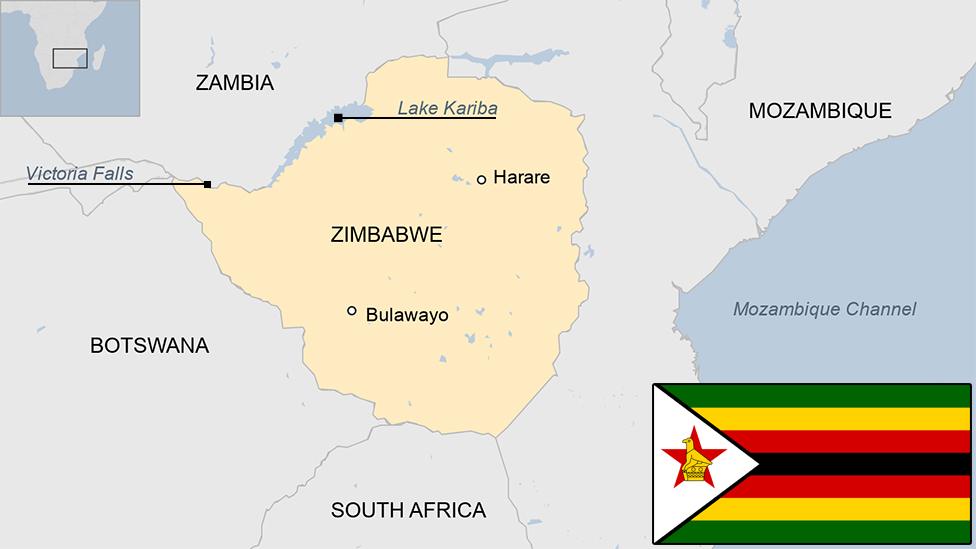
    09. Zimbabwe

    Fastest Growing Countries

    This country’s economy is projected by the World Bank to grow at 6.2% in 2025- an increase from the projection of 2.0% in 2024. The country’s inflation is projected to accelerate to 8.4% in the coming year from 6.0% in 2024. In the past few years, inflation in this country reached over 200% on the back of severe depreciation of its local currency- the Zimbabwean dollar.

    Risk to the outlook include the effect of climate change induced El Nino which affects production of key staple such as maize. Also, the country has also seen natural disasters such as flooding like its other Southern African counterpart in 2024 so far.

    08. Uganda

    The World Bank provided the same economic growth projection for both Zimbabwe and Uganda at 6.2% in 2025. The country’s GDP growth projection for 2025 represents a 0.2 percentage points increase compared to its projection for 2024. GDP growth in Uganda is one of the highest across the East Africa region.

    The country in the past 18 months has seen inflation fall to stable levels resulting in monetary policy authorities to begin the easing cycle with a 25 basis points cut in MPR. In 2023, inflation in the country stood at 8.8%- this dropped to 3.2% in 2024 and consumer prices in the coming year is projected to remain stable at 4.6%.

    07. Republic of Benin

    This West African nation is forecast to see 6.4% GDP growth in 2025 which has helped in no small measure to boost economic expansion in the West African region.

    In the past five years, the country has posted GDP growth above 5% whilst maintaining inflation under 3% dating back to 2020.

    06. Cote D’Ivoire

    Fastest Growing Countries

    The World Bank projects growth in this West African country to reach 6.4% in 2025- one of the strongest performers in the West African region. This growth is underpinned by strong private consumption and capita deepening as well as exploitation of recent oil discoveries in the country.

    In the past four years, the country has seen GDP growth above 6% and barring the pandemic in 2020, growth has average 7.5% dating as far as 2010.

    Inflation in the country is projected to decline by 0.6 percentage points to 3% next year from 3.6% in 2024.

    05. Ethiopia

    with GDP growth at 6.5% in 2024 according to the World Bank projection, Ethiopia is the fifth fastest growing economy in Africa. The country has been a consistent performer in the region recording over 6% growth in the last five years including during the pandemic in 2020.

    The major risk to the currency outlook is severe currency weakness- the Ethiopian Birr is among the worst performing currencies in the continent losing 30% of its value as of August 2024 and would likely have a pass-through effect on inflation.

    Also, natural disasters such as droughts and floods have negatively impacted agricultural output in the past few years with crop failure in some years hovering around 50% to 90%.

    04. Rwanda

    this country sits joint third with Mauritania as the third fastest growing economy in the Africa with the World Bank projecting its GDP to grow by 7.8% in 2024.

    The GDP growth projection for 2025 is an improvement from 7.6% recorded in 2024. Inflation in the country for 2025 is projected to decelerate to 5.0% in 2025 from the projected 6.8% this year.

    03. Mauritania

    the World Bank puts the country’s economic growth for 2025 at 7.8%- making her the joint third fastest growing economy on the continent. The projection represents an increase of 1.3 percentage points from the 2024 forecast of 6.5%.

    Inflation in the country is forecast to decline to 2% from 2.7% in 2024.

    02. Niger

    despite a coup and severing of its membership of the ECOWAS in the year, Nigeria is on track to become the second fastest growing economy in the continent in 2025 with the World Bank putting GDP growth at 8.5% in 2025.

    This is an improvement from the 5.7% projected GDP growth in 2024 which has strengthened economic activities in the West African region.

    01.Libya

    the fastest growing economy in Africa in 2025 according to the World Bank is conflict and unstable Libya projected to grow at 10.7% in 2025. The impressive GDD growth projection is underpinned by recovery from the contraction of 10.1% in 2024.

    The outlook for Libya is a downgrade compared to the Bretton Wood institute projection earlier in the year.

    The outlook for Libya is marred by conflict and political instability which has severely affected oil production in the country. Further distabilisation in the Middle East with the toppling of the Assad led Syrian regime and uncertainties in the conflict between Israel and Hamas could potentially upend the potential recovery. 

  • Dangote Refinery Adds Eight New Tanks for Imported Crude Oil

    Dangote Refinery Adds Eight New Tanks for Imported Crude Oil

    In a strategic move to ensure sustainable operations, the Dangote Petroleum Refinery is constructing eight additional crude oil storage tanks. This expansion is part of the refinery’s comprehensive $20 billion investment to increase its storage capacity and meet growing demand for refined products.

    The new tanks, expected to raise the refinery’s storage capacity by 6.29 million barrels (approximately 1 billion litres), are being built in response to the increasing reliance on imported crude oil, driven by irregular local supply deliveries from the Nigerian National Petroleum Company Limited (NNPCL).

    With the expansion, Dangote Refinery’s total crude oil storage capacity will grow by 41.67%, reaching a remarkable 3.4 billion litres, further solidifying the refinery’s pivotal role in Nigeria’s oil and gas industry. According to Devakumar Edwin, Vice President overseeing oil and gas operations at Dangote Industries, the decision to import crude from other nations has made it crucial to stockpile larger volumes of crude oil.

    “The construction of these additional tanks is vital to maintaining a steady supply of refined products for the Nigerian market, as we strive to reduce the nation’s dependence on imported fuel and ensure an uninterrupted flow of gasoline for local consumption,” Edwin explained. “Four of the eight tanks are nearing completion, and once finished, they will bolster our refinery’s capability to meet the growing demand for petroleum products.”

    Currently, the Dangote Refinery houses 20 crude storage tanks, each with a capacity of 120 million litres, amounting to 2.4 billion litres. The refinery’s refined product tanks add a further 2.34 billion litres of capacity, positioning Dangote Refinery as a leading player in the Nigerian oil and gas sector.

    How Many Barrels Will Dangote Refinery Produce?

    With the expansion, Dangote Refinery’s capacity will increase to 3.4 billion litres, which is equivalent to approximately 21.3 million barrels. This substantial increase in storage and production capacity enables the refinery to meet both local and international demands, positioning it as a key player in the global oil market.

    As the refinery continues to ramp up production, it is gaining recognition among Nigerian vehicle owners, who are already benefitting from the increased availability of high-quality, locally refined petrol. This move highlights Dangote Refinery’s commitment to contributing to Nigeria’s economic growth, creating jobs, and ensuring energy security for the future.

    This expansion not only signifies progress for Nigeria but also demonstrates Dangote Refinery’s global competitiveness in the ever-evolving energy landscape.

  • Top 10 Most Valuable Startups in Nigeria as Moniepoint Hits $1 Billion Valuation

    Top 10 Most Valuable Startups in Nigeria as Moniepoint Hits $1 Billion Valuation

    The Nigerian startup space has witnessed tremendous growth in the last decade, transitioning from relative obscurity to becoming a force to reckon with, not just in Africa but across the globe.

    The Nigerian government has not failed to notice this growth trajectory and its impact on the Nigerian economy. In 2022, the National Assembly passed the Nigerian Startup Act, which was eventually signed into law by former President Buhari.

    Beyond the passage of the Startup Act, the federal government is also providing the necessary support, despite the harsh business environment, to allow these startups to scale.

    Despite a series of economic challenges in Nigeria since 2014, including two recessions, the COVID-19 pandemic, issues in the foreign exchange market, and others, the tech ecosystem has weathered these storms. In the process, it has birthed up to four (4) unicorns—the latest being Moniepoint. However, some have seen their valuations decline in recent years.

    Nigerian startups received the largest share of the international funding pie for Africa in the years prior to 2023. Of the $2.9 billion raised by startups in Africa in 2023, Nigerian startups secured $410 million, with Kenya taking the biggest slice of the pie, followed by Egypt and South Africa.

    However, in the past five years, from 2019 to 2023, Nigerian startups captured the largest share of funding raised by African startups, accounting for 29% of the total $15 billion in investments.

    The startup ecosystem in Nigeria is dominated by e-commerce, fintech, and edtech startups, leveraging the country’s burgeoning youth population and the large number of unbanked individuals in Nigeria.

    10. Konga and Paystack

    Retail giant Konga and the fintech startup Paystack rank together as the ninth most valuable startups in Nigeria, with a market valuation of $200 million each. Paystack was sold to Stripe in 2020 for a whopping $200 million, which remains its current valuation.

    Konga was founded in 2012 as a Nigerian e-commerce firm that provides direct online retail and also serves as a third-party marketplace. Amid a dire situation in 2017 and severe cost-cutting measures, including significant downsizing, the company was sold to Zinox Technologies in 2018 for an undisclosed amount.

    08. Paga

    This mobile payment platform was established by Tayo Oviosu in 2009 but eventually launched to the public in 2011. It offers a range of services, including money transfers, bill payments, retail payments, data and airtime top-ups, as well as banking services.

    It is reportedly valued at $300 million, with investors including Global Innovation Fund, Goodwell Investments, Unreasonable Capital, and others. Since its founding, it has raised up to $35 million in funding.

    07. Jumia

    Africa’s first startup to achieve unicorn status and list on the New York Stock Exchange now ranks seventh among the most valuable startups in Nigeria. The e-commerce giant has, in recent times, seen its valuation nosedive to $450 million as it struggles to achieve profitability and revenue growth amidst operational challenges.

    So far, the startup has raised up to $750 million in funding since its establishment in 2012.

    06. Kuda

    Dubbed “Africa’s bank for the free” for its near-zero fees and charges, Kuda is the sixth most valuable startup in Nigeria, with a market valuation of $500 million. Founded in 2018, the company has raised around $90 million in funding from investors, with the latest funding round occurring in August 2021, where it raised $55 million led by Valar Ventures, Target Global, and other angel investors.

    05. Moove

    This fintech startup offers financial services specifically to drivers, focusing on helping them acquire vehicles through a revenue-based financing model. The startup is barely four years old, having been established in 2020.

    Since its inception, Moove has raised a total of $447.2 million in funding from up to 33 investors, including SpeedInvest, Left Lane Capital, Tekton Ventures, Class 5 Global, and others. These funding rounds include debt financing and private equity.

    Moove operates in Nigeria, South Africa, and several other African countries. Its latest funding round occurred in February 2024, when it raised $10 million in debt financing from India’s Stride Ventures.

    Following its latest funding raise, Moove’s valuation rose to $750 million, making it one of the most valuable startups in Nigeria.

    04. Moniepoint (formerly TeamApt)

    The latest entrant into the unicorn rank boasts a market valuation of over $1 billion.

    Its recent status came after raising $110 million in its latest Series C funding round, led by Development Partners International’s African Development Partners III (ADP III) fund. Other investors included Google’s Africa Investment Fund, Verod Capital, and Lightrock.

    03. Andela

    The second of Iyin Aboyeji’s unicorns, Andela is the third most valuable startup in Nigeria, with a market valuation of $1.5 billion.

    Andela helps companies build remote teams quickly and cost-effectively and rose to prominence during the pandemic when the demand for remote workers surged.

    Since its establishment in 2014, the company has raised up to $340 million in funding, with the latest being a $200 million Series E funding round in 2021 led by SoftBank Vision Fund 2, Whale Rock, Generation Investment Management, the Chan Zuckerberg Initiative, and Spark Capital.

    02. Opay

    The second most valuable startup in Nigeria transitioned from a mobility firm to a fintech and has recorded tremendous success since the shift.

    The company is valued at a staggering $2.7 billion and has so far received $540 million in funding across several rounds.

    Opay facilitates money transfers and various types of payments. Its prominence peaked during the cash scarcity in Nigeria in early 2023, when demand for online payments soared, and traditional banks’ digital banking infrastructure became overwhelmed.

    01. Flutterwave

    The most valuable startup in Nigeria is a fintech company that helps businesses and banks process seamless and secure payments to clients and customers worldwide.

    The company is currently valued at over $3 billion and has floated plans to list on the New York Stock Exchange (NYSE).

    Its backers include Y Combinator Continuity Fund, Greycroft, Greenvisor Capital, Omidyar Network, and Glynn Capital, which collectively have invested over $445 million in the startup.

  • Nigerian Government Drops Money Laundering Charges Against US Binance Executive

    Nigerian Government Drops Money Laundering Charges Against US Binance Executive

    In a major development, the Federal Government of Nigeria has officially dropped money laundering charges against Tigran Gambaryan, a Binance executive and former U.S. IRS investigator, after months of international scrutiny and diplomatic pressure.

    Gambaryan, who joined Binance in 2021 as part of its compliance and investigations team, was arrested earlier this year in Nigeria as part of the government’s broader efforts to combat cryptocurrency-related financial crimes. His arrest stemmed from accusations that Binance had facilitated illegal money laundering transactions through its platform. Gambaryan’s role at Binance involved ensuring that the company adhered to anti-money laundering (AML) and know-your-customer (KYC) compliance regulations, making the charges against him particularly controversial. His previous career with the U.S. government made him a high-profile figure in this case.

    Before joining Binance, Gambaryan spent over a decade working for the IRS Criminal Investigation Division, where he became renowned for his efforts in uncovering major crypto-related crimes, including dark web drug markets like Silk Road and AlphaBay. He was credited with helping track down billions of dollars in stolen cryptocurrency and bringing major criminal networks to justice. Given his distinguished record, many were shocked by his detention.

    Reports indicate that Gambaryan was arrested in a raid that targeted Binance’s operations in Nigeria. He was initially accused of conspiring to launder money through cryptocurrency transactions, which were allegedly facilitated by Binance’s platform. Nigerian authorities claimed that the exchange had not done enough to prevent illicit transactions. Gambaryan, however, maintained that his work focused on preventing money laundering, not enabling it.

    After his arrest, Gambaryan’s health rapidly declined while in custody. Images of him attending court hearings in a wheelchair and, later, using a crutch due to mobility issues sparked concern globally. His detention became a diplomatic issue, with calls from U.S. lawmakers and advocacy groups urging the Nigerian government to release him. A group of 16 U.S. Congress members signed a letter to the White House, urging the U.S. government to treat his case as a hostage situation. State attorneys general also joined the campaign, advocating for his immediate release and pointing to his contributions to global financial crime investigations as reasons for leniency.

    The case drew significant international attention, not just because of Gambaryan’s high-profile career, but also due to its implications for the global cryptocurrency industry. Binance has been under scrutiny by regulators worldwide, with many accusing the platform of failing to enforce strict anti-money laundering measures. Gambaryan’s arrest intensified concerns about the risks of working in the cryptocurrency space, where regulatory frameworks are still evolving.

    Despite the severity of the charges, Gambaryan’s legal team continued to push for his release, arguing that the charges were baseless and that he was being wrongfully detained. International pressure and diplomatic efforts finally led to the Nigerian government dropping the charges.

    Gambaryan’s supporters have hailed the decision as a victory for justice and transparency, though his ordeal has cast a shadow over the relationship between Binance and international regulators. Binance continues to face challenges as it strives to navigate the complex legal landscape surrounding cryptocurrency.

    Possible Reinstatement of Naira Feature on Binance P2P

    The dismissal of money laundering charges against Binance executive Tigran Gambaryan could have significant implications for Binance’s decision to disable the naira feature on its P2P market. Binance suspended naira transactions following increased scrutiny and regulatory pressures from Nigerian authorities. With the charges now dropped, it may create an opportunity for Binance to re-evaluate its stance on naira transactions in the region.

    If Binance feels that the regulatory environment has become more favorable or stable, it might reconsider the suspension and re-enable naira functionality on its P2P platform. This could restore confidence among Nigerian users who rely heavily on P2P trading due to the central bank’s restrictions on crypto-related transactions within the formal banking sector.

    The demand for P2P trading in Nigeria remains high, as many citizens use cryptocurrency as a hedge against inflation and currency devaluation. Enabling the naira feature again would facilitate easier access for users and may drive up transaction volumes, benefiting both the exchange and its customers.

    However, this potential restoration would also depend on how Nigerian regulators respond post-Gambaryan’s case. The legal environment surrounding cryptocurrencies in Nigeria remains uncertain, and Binance may still face challenges if authorities maintain strict control over crypto activities. Nonetheless, the dismissal of such a high-profile case might encourage Binance to take steps toward resuming full operations, including reactivating naira trading on its P2P platform.

  • Potential Israel-Iran Conflict and Its Impact on Nigeria’s Exchange Rates and Petrol Prices

    Potential Israel-Iran Conflict and Its Impact on Nigeria’s Exchange Rates and Petrol Prices

    Just over one year ago, Hamas terrorists launched arguably the most brutal attack on Israeli civilians since the Holocaust resulting in death of over 1000 people.

    In the past year, the Israel Defence Force (IDF) has been involved in a brutal conflict with Hamas in Gaza which has spilled over to Lebanon where Hezbollah has a significant presence.

    The onslaught of the Israeli military pushed oil prices up by as much as 4% after Yemeni Houthi rebels in solidarity with Hamas began attacking ships in the Red sea.

    In the past few weeks, we’ve seen Israel come on the brink of full-blown conflict with Iran after attacks on Iran-backed Hezbollah militants by Israel and assignation of top Iranian military commanders.

    Just one week ago, Iran fired over 180 missiles inside Israel in escalation of the ongoing conflict, the Prime Minister of Israel had promised to retaliate and analyst are saying Israel plans to attack Iran’s oil facilities.

    In the wake of this current attack, oil prices have shot up to $80 per barrel and there are projections of nearly reaching $100 if Israel attacks Iran’s oil facilities as predicted. Conflicts in major oil producing regions has always resulted in higher oil prices and going back to the 1970s oil crisis caused by the Yom Kippur war in Israel and the Iranian revolution.

    The most recent scenario occurred in 2022 after Russia invaded Ukraine where crude oil prices closed the year at $97 per barrel compared to $69 in the previous year. In fact, the post pandemic recovery of oil prices stems from the Russia-Ukraine war.

    For countries like Nigeria whose economy is heavily influenced by the swing in oil prices especially in the post-subsidy era, oil prices could be a double-edge sword.

    Crude oil does two things to Nigeria’s government finances- provides revenue for government and foreign exchange for the CBN’s external reserves which is used to back the Naira.

    However, in this post-subsidy era we are moving into, swinging crude oil prices could now mean higher petrol prices for Nigeria even when the petrol is produced locally and the raw crude even sold in Naira. Before now, the federal government through the Nigeria National Petroleum Company (NNPC) Limited pays a fraction of petrol cost of petrol to keep it low and fixed. This enabled Nigerians to not just enjoy low PMS prices but keep petrol prices immune from the vagaries of the international oil market.

    However, in the past years, the cost of this subsidy has become unbearable for the federal government. Attempts have been made by different administrations in the past to end petrol subsidies but was met with stiff resistance by civil society groups with the greatest being the Occupy Nigeria protest in 2012 after President Jonathan removed petrol subsidy. This pushed the then President to reintroduce the subsidy where it remained until President Tinubu announced the removal on his first speech as President.

    What Does Projected Rise In Oil Prices Mean For Petrol Price

    In simple terms, Nigerians are going to pay higher PMS prices at the pump if the Iran-Israel conflicts escalates and pushes petrol prices above the current $80 per barrel. This is irrespective of where the crude oil is sourced and where or who refines it either locally or abroad. For example, the NNPC has declared it would supply 17.6 million barrels of crude oil to the Dangote refinery in Naira.

    However, it will be dependent on the price of crude oil in the international market. If the price increase, Dangote and other local refineries would have to cough more Naira to settle the NNPC and this cost will be passed on to consumers. This is because crude oil as an international commodity is priced in U.S dollars.

    Rising Oil Prices and Exchange Rate

    In the face of rising oil prices, it is expected that the Naira strengthens against the dollar but that is dependent on the decisions of the United States Federal Reserve Bank and Central Bank of Nigeria (CBN).

    The Naira has witnessed the worst volatility in history this year becoming at one time the best performing currency before a 180 degrees reversal of fortunes to become the worst performing currency. The strengthening of the Naira in March stems from the action of the CBN selling forex to BDCs at rates below the official market rate but there is a problem with such is that it is not sustainable- there is a limit to how much forex the apex bank can burn.

    The Naira currently trades in the region of N1,550/$ to N1,660/$ in the official NAFEM window. This represents a depreciation of over 100% compared to the rates before the unification of all segments of the FX market by the CBN.

    Rising oil prices could help shore up the country’s foreign reserve which has been seen rising in the past few months. In September 2023, the country’s foreign reserve stood at $33.23 billion- this has increase to $38 billion by the end of September 2024.

    The CBN is presented with two choices with potential increase in foreign reserves- either to sell FX to BDCs like it did earlier in the year when the Naira became the best performing currency in the world or to allow the forces of demand and supply determine the value of the Naira as it currently does with the exchange rate reaching N1,600/$.

    Hence, the value of the Naira with the potential increase in oil prices would be dependent on the decision of the CBN.

    Most Ideal Scenario For Nigeria

    From the foregoing, it seems the potential war between Israel and Iran and the ripple effects on crude oil prices means Nigeria would likely face another round of petrol price increase in the event the NNPC continues on its post-subsidy policy.

    There is also uncertainty on the decision of the apex bank on either backing the Naira or allowing market forces determine the exchange rate.

    Furthermore, Nigeria has been unable to since the beginning of the year to significantly increase oil prices. According to OPEC’s records, Nigeria has not met its crude oil production quota of 1.5 million barrels daily since January, despite calls to ramp up production.

    For Nigerians, the best case scenario in the wake of potential increase in oil prices would be for low crude oil prices to keep petrol prices low and high crude oil production to increase forex supply to the CBN’s foreign reserves. 

  • How to Become a Social Media Manager Professionally

    How to Become a Social Media Manager Professionally

    The role of a Social Media Manager is important for businesses aiming to thrive. Corporate enterprises, celebrities, influential personalities, and high-growth startups have all realized how social media management can boost brand presence, convert leads to sales, and build relationships.

    Understanding the Role of a Social Media Manager

    How to Become a Social Media Manager Professionally - Understanding the role of social media manager

    According to a report by Statista, social media ad spending is projected to reach $358 billion by 2027, indicating the critical role social media plays in modern business marketing strategies. As businesses prioritize digital presence, skilled Social Media Managers are in demand across all industries.

    A Social Media Manager is responsible for the planning, development, and execution of social media strategies across platforms such as Facebook, Instagram, Twitter, LinkedIn, TikTok, and more. 

    This role is not only about content creation. As digital marketing becomes more data-driven, the Social Media Manager role has transformed from simply posting content to a strategic field.

    A Social Media Manager is also responsible for analyzing metrics, engaging with followers, and building community. 

    How Much Does a Social Media Manager Earn?

    how much does social media manager get paid? How to Become a Social Media Manager Professionally

    The salary of a Social Media Manager varies depending on location, experience, industry, and the size of the organization. According to the latest reports, in the U.S, Social Media Managers earn an average salary of $56,000 to $72,000 per year. However, compensation can rise for professionals with advanced skills, and, or those managing social media for large brands or high-profile clients.

    Many companies, especially larger organizations, offer bonuses, stock options, and other perks such as flexible work hours, remote work opportunities, and healthcare benefits, which significantly increase the total compensation package for a Social Media Manager.

    How to Become a Freelance Social Media Manager

    How to Become a Social Media Manager Professionally - how to become a freelance social media manager

    Many Social Media Managers opt to work as freelancers or consultants. Rates for freelance Social Media Managers typically range between $25 and $100 per hour, depending on experience, specialization, and project scope. For instance, a freelancer managing social media for a small business may charge less than someone managing digital strategies for a Fortune 500 company or a celebrity brand.

    According to Upwork, a popular freelancing platform, top-tier freelancers in social media management can earn up to $120 per hour, especially if they bring additional expertise in areas like SEO, content strategy, or paid advertising.

    Skills Needed to Become a Social Media Manager

    How to Become a Social Media Manager Professionally

    Strategic Planning
    Successful Social Media Managers are adept at crafting comprehensive social media strategies that align with broader business goals. This requires understanding market trends, audience segmentation, and platform algorithms.

    Content Creation & Curation
    With over 4.9 billion social media users globally, the ability to create engaging, relevant content is important. From written posts to video storytelling, content needs to resonate with target audiences.

    Data Analysis & Reporting
    Social media is driven by data, from tracking engagement metrics to monitoring ROI. Proficiency in platforms like Google Analytics, Hootsuite Insights, and native tools such as Facebook Insights is essential.

    As HubSpot reports, a lot of marketers say they use data to drive their social media campaigns, showing the importance of this skill.

    Community Management & Customer Service
    Managing a brand’s reputation online involves nurturing relationships with followers, responding to comments, and ensuring customer satisfaction. Social media is often the first point of contact for customers, requiring a combination of empathy and professionalism.

    SEO & Digital Marketing Knowledge
    While SEO may seem separate from social media, search engines index public posts from platforms like Twitter, LinkedIn, and YouTube. Optimizing social content using SEO best practices—such as keyword integration, hashtags, and backlinks—can boost visibility.

    Backlinko has shown that posts with relevant keywords tend to have a higher chance of appearing on search engine results pages (SERPs).

    How to Become a Social Media Manager Professionally

    How to Become a Social Media Manager Professionally

    Breaking into social media management without prior experience may seem daunting, but it’s entirely achievable. Here’s a step-by-step guide to becoming a Social Media Manager with no experience.

    1. Build a Solid Foundation in Digital Marketing

    Social media management is closely tied to broader digital marketing strategies. Learning digital marketing fundamentals, including SEO, email marketing, and paid social advertising, will give you a competitive edge.

    A comprehensive digital marketing course can be beneficial here. According to a report by LinkedIn, top digital marketers possess at least some background in formal education in digital marketing.

    2. Master Platform-Specific Skills

    Different social media platforms cater to different audiences. For instance, LinkedIn is more professional and B2B-focused, while Instagram and TikTok cater to younger, B2C audiences.

    Social Media Managers must understand the nuances of each platform. This involves knowing the best content formats, posting schedules, and engagement tactics.

    Key Insights:

    • Facebook remains the largest social platform with over 2.9 billion monthly active users. Knowing its advertising model and algorithm updates is crucial.
    • Instagram’s Reels and YouTube’s Shorts are growing as video content becomes increasingly important, with video marketing predicted to represent 82% of all online traffic by 2025.

    3. Develop Your Personal Brand

    To showcase your expertise, build your personal brand on platforms such as LinkedIn and Twitter.

    Regularly share valuable insights, participate in industry discussions, and connect with professionals in your field. This will position you as a thought leader in social media management.

    4. Gain Experience and Build a Portfolio

    Start by managing the social media accounts of smaller brands or personal projects. Document your work, including engagement statistics, follower growth, and successful campaigns. A well-rounded portfolio with proven results is key when applying for more prestigious roles.

    5. Stay Updated on Trends & Tools

    Social media is an ever-evolving landscape. Staying current on trends, new platforms, and tools like Buffer, Hootsuite, Sprout Social, and Canva is essential.

    Following top digital marketing blogs such as Neil Patel’s blog or the HubSpot Marketing Blog can provide valuable insights into emerging strategies.

    6. Network and Collaborate

    Building a strong network of industry peers, influencers, and marketers can lead to valuable opportunities. Attend conferences, webinars, and workshops, both in-person and online. Collaborating with other marketers on projects can also expand your experience and visibility.

    Tips on How to Become a Social Media Manager With No Experience

    Tips on How to Become a Social Media Manager With No Experience
    • The first step is to familiarize yourself with social media platforms. Use your own social media profiles or create mock accounts to experiment with different content formats, posting strategies, and engagement tactics.
    • Understanding what type of content works best on each platform is important. Each platform has unique features, algorithms, and audience demographics.
    • Stay updated by reading blogs, watching tutorials, and subscribing to newsletters from sources like Hootsuite, Buffer, and Sprout Social.
    • Analyze what successful brands in your target industry are doing on social media. Observe their strategies for audience engagement, content types, and tone of voice.
    • Take free online courses on the fundamentals of social media management, digital marketing, and content strategy. Many of these courses provide certifications that you can add to your resume.
    • Choose a topic you are passionate about or have some expertise in, whether it’s fitness, personal finance, fashion, or tech. Share valuable content within that niche to attract an audience.
    • Develop a consistent posting schedule that aligns with your audience’s preferences. Use tools like Hootsuite or Buffer to schedule your posts.
    • Respond to comments, participate in discussions, and collaborate with others in your niche to grow your online presence organically.
    • One of the best ways to build a portfolio without experience is by offering your services for free or interning with small businesses, startups, non-profits, or local organizations.
    • After gaining some initial experience, either through internships or free services, you can start offering your skills as a freelancer. Platforms like Upwork, Fiverr, and Freelancer are great for connecting with clients in need of social media management.

    Trends in Social Media Management

    Trends in Social Media Management

    1. AI-Driven Social Media Tools

    Artificial Intelligence (AI) is revolutionizing how we manage social media. AI-powered tools for scheduling posts, creating content, and analyzing data help optimize social media strategies.

    ChatGPT and Jasper.ai are examples of AI-driven content tools that can generate high-quality copy for social media posts.

    2. Increased Focus on Video and Interactive Content

    With 85% of internet users in the U.S. watching online video content monthly, the demand for video-focused content managers is high. Interactive features, such as polls and live streaming, are also growing in popularity, enhancing user engagement.

    3. Social Commerce Growth

    Social media platforms are evolving into shopping destinations. As per Statista, global social commerce sales are projected to reach $1.3 trillion by 2025. Social Media Managers will need to understand this shift and create strategies that integrate e-commerce functionalities seamlessly.

    4. Data Privacy and Compliance

    In light of growing privacy concerns and regulations such as the General Data Protection Regulation (GDPR) and California Consumer Privacy Act (CCPA), Social Media Managers must be knowledgeable about compliance. Ensuring that social media campaigns respect user privacy is essential for legal protection and maintaining customer trust.

    Becoming a Social Media Manager is more than just understanding social media platforms—it requires strategic thinking, content creativity, data analytics, and a deep understanding of digital marketing. Mastering these key areas can help you establish yourself as a successful Social Media Manager even without a degree.

  • 7 Best Project Management Tools

    7 Best Project Management Tools

    Most companies, with their complex workflows, remote teams, and innovative projects, need strong tools to keep everything on track. Whether you are leading a small startup or managing projects in a large enterprise, here’s a comprehensive look at the best project management tools you should consider in 2024.

    Before we begin, it’s important to note that choosing the right project management tool depends on your team’s specific needs, the complexity of your projects, and your budget. Jira and Trello are excellent for software development teams, while Asana and Monday.com offer versatile solutions for various project types. ClickUp provides an all-in-one solution with extensive features, and Basecamp offers simplicity and ease of use. Smartsheet stands out for teams that prefer a spreadsheet-like interface with advanced capabilities.

    Jira Project Management Tools

    Developed by Atlassian, Jira is a favorite among software development teams. It is great for tracking issues, bugs, and tasks, making it an essential tool for Agile methodologies.

    Key Features:

    • Customizable Workflows: Tailor workflows to fit the needs of your team.
    • Scrum and Kanban Boards: Visualize and manage work in real time.
    • Advanced Reporting: Gain insights with real-time reporting and dashboards.
    • Integration: Seamlessly integrates with other Atlassian products like Confluence, Bitbucket, and more.

    Best For: Software development teams looking for a powerful issue and project tracking tool.

    Pros:

    • Highly customizable
    • Extensive third-party integrations
    • Strong Agile and DevOps support

    Cons:

    • It can be complex to set up
    • The higher learning curve for new users

    Trello Project Management Tools

    Trello - best Project Management Tools

    Also an Atlassian product, Trello is known for its simplicity and visual approach to project management. Its card and board system makes it easy to organize tasks and collaborate with team members.

    Key Features:

    • Boards, Lists, and Cards: Organize tasks and projects visually.
    • Power-Ups: Enhance functionality with Slack, Google Drive, and more integrations.
    • Automation: Use Butler to automate repetitive tasks.
    • Collaboration: Real-time collaboration features for team interaction.

    Best For: Small to medium-sized teams looking for a simple and intuitive project management tool.

    Pros:

    • User-friendly and intuitive interface
    • Flexible and versatile
    • Free version available

    Cons:

    • Limited advanced features compared to other tools
    • Can become cluttered with large projects

    Asana Project Management Tools

    Asana is a versatile project management tool that supports various project types and team sizes. It’s particularly strong in task management and team collaboration.

    Key Features:

    • Task Management: Create and assign tasks, set deadlines, and track progress.
    • Timeline View: Visualize project timelines and dependencies.
    • Workload Management: Balance team workload with real-time insights.
    • Integration: Connects with Slack, Microsoft Teams, and other tools.

    Best For: Teams of all sizes looking for a comprehensive task and project management solution.

    Pros:

    • Easy to use with a clean interface
    • Strong task management capabilities
    • Versatile for different types of projects

    Cons:

    • Some advanced features are only available in the premium version
    • Can be overwhelming for tiny projects

    Monday.com Project Management Tools

    Monday.com is known for its flexibility and customizability, making it suitable for various industries and team needs. It provides a visual and intuitive way to manage projects and workflows.

    Key Features:

    • Customizable Workflows: Design workflows that fit your team’s processes.
    • Visual Dashboards: Get an overview of project status and team performance.
    • Automation: Automate routine tasks to save time.
    • Integrations: Connect with tools like Slack, Zoom, and Google Workspace.

    Best For: Teams that need a highly customizable and visual project management solution.

    Pros:

    • Highly customizable and flexible
    • Visual and intuitive interface
    • Strong integration options

    Cons:

    • Can be expensive for smaller teams
    • Some users find it too complex initially

    ClickUp Project Management Tools

    ClickUp aims to be an all-in-one project management solution, offering a wide range of features to manage tasks, documents, goals, and more. It’s highly customizable and supports multiple views.

    Key Features:

    • Task Management: Manage tasks with lists, boards, and calendars.
    • Time Tracking: Built-in time tracking and time estimates.
    • Goals and OKRs: Set and track goals to ensure alignment with business objectives.
    • Integrations: Connect with tools like Slack, Zapier, and Google Drive.

    Best For: Teams looking for a comprehensive, all-in-one project management solution.

    Pros:

    • Extensive features and customization options
    • Competitive Pricing
    • Suitable for various project types

    Cons:

    • Steeper learning curve due to feature-rich environment
    • Can feel overwhelming for simple projects

    Basecamp Project Management Tools

    Basecamp is designed to simplify project management and team collaboration. It offers an all-in-one toolkit for managing projects, communicating with teams, and sharing files.

    Key Features:

    • Message Boards: Centralized place for team discussions.
    • To-Do Lists: Simple task management with due dates and assignments.
    • Schedules: Calendar view for project timelines.
    • Docs & Files: Organize project documents and files.

    Best For: Teams looking for a straightforward and user-friendly project management tool.

    Pros:

    • Simple and easy to use
    • All-in-one toolkit for project management
    • Flat-rate pricing

    Cons:

    • Limited advanced features
    • Not ideal for very complex projects

    Smartsheet Project Management Tools

    Smartsheet combines the familiar interface of spreadsheets with advanced project management features. It’s ideal for teams that prefer working in a grid-like environment.

    Key Features:

    • Grid, Card, Gantt, and Calendar Views: Multiple ways to visualize projects.
    • Automations: Automate workflows and repetitive tasks.
    • Reports and Dashboards: Gain insights with customizable reports.
    • Integrations: Connects with tools like Microsoft Office, Google Workspace, and more.

    Best For: Teams that prefer a spreadsheet-like interface with advanced project management capabilities.

    Pros:

    • Familiar and flexible interface
    • Strong automation features
    • Suitable for various project types

    Cons:

    • It can be complex to set up initially
    • Higher cost compared to some other tools
  • SEO Best Practices for Small Businesses: Comprehensive Guide

    SEO Best Practices for Small Businesses: Comprehensive Guide

    Unlike large corporations with massive marketing budgets, small businesses must leverage smart, cost-effective strategies to increase visibility and attract customers. Mastering SEO (Search Engine Optimization) is crucial for small businesses aiming to do this.

    SEO involves optimizing your website to rank higher on search engine results pages (SERPs), making it easier for potential customers to find you. With more than 90% of online experiences starting with a search engine, being visible is important.

    Implementing the following effective SEO best practices for small businesses can help your business dominate search engine rankings, drive traffic to your website, and increase revenue.

    Keyword Research

    Start with thorough keyword research to identify the terms your potential customers are using to search for your products or services.

    Use Tools: Utilize keyword research tools like Google Keyword Planner, Ahrefs, or SEMrush to find high-volume, low-competition keywords relevant to your business.

    Long-Tail Keywords: Focus on long-tail keywords—specific, longer phrases that visitors are more likely to use when they’re closer to making a purchase. These are less competitive and can drive highly targeted traffic.

    Analyzing Competitor Keywords

    Identify keywords your competitors are ranking for to find gaps in your strategy. Tools like SpyFu and Moz can help you analyze competitor keywords and refine your own strategy accordingly.

    On-Page SEO

    SEO Best Practices for Small Businesses -  Quality Content and Keyword research

    Quality Content Creation

    On-page SEO involves optimizing individual pages to improve their search engine rankings and content is king in the SEO world. Your content should be:

    • Relevant and Valuable: Provide useful information that addresses the needs and answers the questions of your target audience.
    • Well-written and Engaging: Keep your readers engaged with clear, concise, and well-structured content. Regularly update your blog with informative articles, how-to guides, and industry news. Google rewards websites that provide a great user experience, so focus on writing content that keeps visitors on your site longer.
    • Original: Avoid duplicate content, which can harm your rankings.

    Keyword Optimization

    Incorporate these keywords naturally into your website content, including titles, headings, meta descriptions, and throughout the body text. Avoid keyword stuffing, which can lead to penalties from search engines. Focus on including keywords in:

    • Title Tags and Meta Descriptions: Craft compelling and keyword-rich title tags and meta descriptions that accurately describe your content and entice users to click.
    • Header Tags (H1, H2, H3): Use header tags to structure your content, making it easier for search engines and users to read.
    • URL Structure: Create clean, keyword-rich URLs that are easy for users and search engines to understand.

    Optimizing Images

    Images can enhance user experience but also need to be optimized for SEO:

    • Alt Text: Use descriptive alt text for all images, incorporating relevant keywords.
    • File Names: Name your image files descriptively rather than using generic names like “image1.jpg.”
    • File Size: Compress images to reduce loading times without compromising quality.

    Technical SEO

    SEO Best Practices for Small Businesses - Technical SEO

    Mobile Optimization

    With mobile devices accounting for over half of all web traffic, ensuring your website is mobile-friendly is crucial. Google uses mobile-first indexing, meaning it predominantly uses the mobile version of your site for ranking and indexing. Use responsive design to ensure your site looks and functions well on all devices. Test your website’s mobile-friendliness with Google’s Mobile-Friendly Test tool and make necessary adjustments.

    Page Speed and Performance

    A fast-loading website enhances user experience and improves rankings. Use tools like Google PageSpeed Insights to test your website’s speed and get recommendations for improvement.

    Secure Your Website

    Security is a ranking factor. Ensure your site uses HTTPS instead of HTTP by obtaining an SSL certificate. This not only helps with rankings but also builds trust with your visitors.

    Fix Broken Links

    Regularly check for and fix broken links on your website. Tools like Screaming Frog can help identify 404 errors and other broken links that need attention.

    Local SEO: Capturing Nearby Customers

    SEO Best Practices for Small Businesses - Local SEO: Capturing Nearby Customers
    Local SEO: Capturing Nearby Customers

    For small businesses, local SEO is essential to attract nearby customers.

    Google My Business

    Claim and optimize your Google My Business listing:

    • Complete Your Profile: Fill out all fields, including your business name, address, phone number, and hours of operation.
    • Add Photos: Include high-quality photos of your business, products, and services.
    • Collect Reviews: Encourage satisfied customers to leave positive reviews.

    Local Keywords

    Incorporate local keywords into your content, such as “best pizza in [city]” or “top-rated salon in [neighborhood].” This helps you appear in local searches and attract nearby customers.

    Local Citations

    Ensure your business information is consistent across all online directories and citation sites. Inconsistent information can confuse search engines and hurt your rankings.

    Off-Page SEO: Building Authority

    Off-Page SEO: Building Authority

    Backlinks

    Building high-quality backlinks from reputable sites is vital for SEO. Consider these strategies:

    • Guest Blogging: Write guest posts for industry blogs to gain exposure and backlinks.
    • Content Marketing: Create shareable content, such as infographics or in-depth guides, that others will want to link to.
    • Networking: Build relationships with industry influencers who can link to your site.

    Social Media

    While social media signals don’t directly impact rankings, having an active social media presence can drive traffic to your site, increase brand awareness, and indirectly benefit your SEO efforts.

    Monitoring and Analytics

    Google Analytics

    Use Google Analytics to track your site’s performance. Monitor metrics like organic traffic, bounce rate, and conversion rate to understand how your SEO efforts are paying off.

    Google Search Console

    Google Search Console provides insights into how Google views your site. Use it to monitor your search performance, fix issues, and understand your keyword rankings.

    Regular Audits

    Conduct regular SEO audits to identify and fix issues that could be affecting your rankings. Use tools like Ahrefs, SEMrush, or Moz to perform comprehensive audits.

    SEO is a critical component of a successful digital marketing strategy for small businesses. By implementing these best practices—ranging from keyword research and on-page optimization to local SEO and building backlinks—you can enhance your online presence, attract more customers, and grow your business.

  • Best Crypto to Buy Now Ranked by Market Analysts

    Best Crypto to Buy Now Ranked by Market Analysts

    There are opportunities to make money quickly through cryptocurrencies. While most of these profits from trading and investing in cryptocurrencies might be the singular lens of view for many, cryptocurrencies have the potential for long-term value and utility beyond speculative investment.

    We ranked these cryptocurrencies based on their market capitalization, trading volume, prices, adoption rate, and contribution to the global blockchain ecosystem. From real-time data and detailed information on market trends​ of hundreds of digital assets, we were able to handpick a select few of the best cryptocurrencies to buy now.

    These digital assets include established cryptos like Bitcoin and Ethereum, and promising newcomers like Solana and Polkadot. They are not just the best cryptocurrencies for making profits from short-term price changes, but the best investment opportunities in the cryptocurrency space.

    Best Crypto to Buy Now

    Bitcoin (BTC)

    Bitcoin, created in 2009 by the pseudonymous Satoshi Nakamoto, is the cornerstone of the cryptocurrency market. Like most cryptocurrencies, Bitcoin operates on a blockchain—a decentralized ledger that records transactions across a vast network of computers.

    As the first and most widely recognized cryptocurrency, Bitcoin is seen as a haven in the volatile crypto market. Analysts and aggregators recommend Bitcoin as the best crypto to buy now or in the foreseeable future due to its strong network security, widespread adoption, and status as digital gold. As well as the ongoing institutional interest and increasing acceptance as a payment method.

    The value of Bitcoin has surged dramatically as it gained widespread recognition. In May 2016, the cost of a single Bitcoin was roughly $500. By June 2024, its price had soared to approximately $71,033, marking an impressive increase of 14,107%.

    Ethereum (ETH)

    Created by Vitalik Buterin in 2015, it has become one of the most prominent cryptocurrencies after Bitcoin. ETH is used as “gas” to power transactions and execute smart contracts on the Ethereum network. Its versatility and programmability have led to a dynamic ecosystem of projects, ranging from decentralized finance (DeFi) to non-fungible tokens (NFTs).

    The surge in Ethereum’s price from approximately $11 in April 2016 to roughly $3,833 by the end of June 2024 speaks volumes about its potential for substantial returns on investment. This growth reflects a staggering increase of 34,742%, highlighting the immense value that Ethereum has generated for early adopters and investors over the years.

    Tether (USDT)

    Tether is one of the most widely used stablecoins in the cryptocurrency ecosystem, partly due to its liquidity and integration into many cryptocurrency exchanges and trading platforms.

    Currently, Tether has a market capitalization of $112.4 billion with a year-over-year return of 0%. This designation indicates that it is backed by fiat currencies such as the U.S. dollar and the Euro, aiming to maintain a value equivalent to one of these denominations.

    This stability feature makes Tether a more reliable asset compared to other cryptocurrencies, which is particularly appealing to investors seeking to mitigate the substantial volatility associated with alternative coins.

    Binance Coin (BNB)

    This is the native cryptocurrency of the Binance exchange, one of the largest cryptocurrency exchanges in the world. Initially launched as an ERC-20 token on the Ethereum blockchain, BNB has since migrated to Binance’s blockchain, Binance Chain.

    BNB is one of the most valuable cryptocurrencies in terms of market capitalization and serves several purposes within the Binance ecosystem. It can be used to pay for trading fees on the Binance exchange, offering users discounts when using BNB to cover trading fees.

    Since its inception in 2017 at $0.10, BNB’s price surged to approximately $709 by late June 2024; an astounding gain of 709,093%. With a market capitalization of $104.5 billion and a year-over-year return of 162%, Binance Coin is one of the best crypto to buy now.

    Also, BNB is used in various Binance-related services and products, such as Binance Launchpad, which is a platform for launching new token sales, and Binance Smart Chain, a blockchain platform that supports smart contracts and decentralized applications (dApps).

    Solana (SOL)

    Launched in March 2020 by the Solana Foundation, Solana is one of the best crypto in the market addressing the scalability issues faced by many blockchain networks, and allowing for high-speed transactions at low costs.

    Since its launch, Solana has gained massive adoption within the crypto community, with a growing number of projects and developers building on its platform. Its performance, scalability, and developer-friendly features have contributed to its rising prominence.

    SOL began trading at $0.77, but as of late June 2024, its price has surged to approximately $172.78, reflecting an impressive gain of 22,340%. With a market capitalization of $79.5 billion and a remarkable year-over-year return of 773%, it is one of the best crypto to buy now.

    One of Solana’s key features is its innovative proof-of-history (PoH) and proof-of-stake (PoS) consensus mechanism, which timestamps transactions before they are added to the blockchain. This helps to enhance the network’s throughput, enabling it to process thousands of transactions per second, far exceeding the capacity of many other blockchain platforms.

    U.S. Dollar Coin (USDC)

    USDC, introduced in September 2018 by CENTRE, a consortium co-founded by Circle and Coinbase, operates as a stablecoin pegged to the value of the U.S. dollar. With a current market cap of $32.6 billion and a year-over-year return of 0%, USDC offers stability and liquidity in the cryptocurrency market. Built on the Ethereum blockchain, USDC facilitates seamless global transactions, providing a reliable bridge between traditional finance and the digital asset space.

    XRP (XRP)

    Launched in 2012 by Ripple Labs, XRP is one of the oldest cryptocurrencies in the market. With a market cap of $29.1 billion and a slight year-over-year return decline of -1%, XRP operates within the Ripple network as a bridge currency.

    Its primary function is to facilitate efficient cross-border payments and remittances. Unlike Bitcoin and Ethereum, XRP transactions are processed quickly and at a fraction of the cost, making it an attractive option for financial institutions seeking efficient payment solutions.

    Dogecoin (DOGE)

    Introduced in December 2013 by software engineers Billy Markus and Jackson Palmer, Dogecoin started as a light-hearted parody of the cryptocurrency craze but quickly gained popularity due to its viral meme culture.

    With a market cap of $23.5 billion and significant growth of 138% year-over-year, Dogecoin has found utility in tipping content creators and charitable fundraising. Despite its unlimited supply and low transaction fees, Dogecoin embodies the whimsical side of the crypto world.

    Cardano (ADA)

    Founded in 2017 by Ethereum co-founder Charles Hoskinson, Cardano took a research-driven approach to development. With a market cap of $16.4 billion and steady growth of 36% year-over-year, Cardano provides a secure and scalable platform for decentralized applications and smart contracts.

    Also utilizing a proof-of-stake consensus mechanism, Cardano reduces energy consumption while maintaining high levels of security and decentralization. ADA, the native cryptocurrency of the Cardano platform, powers transactions and governance within the ecosystem.

    Toncoin (TON)

    Originally conceived as the native token for the Telegram Open Network (TON), Toncoin (formerly known as Gram) transformed the TON Foundation. With a market cap of $17.6 billion and impressive growth of 343% year-over-year, Toncoin remains one of the best cryptos in the cryptocurrency market.

  • Meta Quest 3 Complete Beginner’s Guide

    Meta Quest 3 Complete Beginner’s Guide


    Just like was hinted at in Meta Quest 3 Most Anticipated Games for 2024, Meta Quest 3 has the potential to be a highly sought-after and powerful VR headset to buy in 2024, similar to its predecessor, the Quest 2. Compared to the Meta Quest 2, it boasts a better display with higher resolution, a faster processor, and even more advanced passthrough capabilities. However, it comes with a higher price tag.

    The base model with 128GB storage is priced at $500, while the 512GB version is priced at $649. Additionally, there are bundles available for the Quest, such as the comfort bundle which includes an advanced head strap, and the “Power” bundle featuring an elite strap with an extra battery.

    What is Meta Quest 3?

    Imagine wearing a set of glasses and suddenly finding yourself immersed in a digital world, whether it’s exploring the depths of the ocean, battling on the front lines of a war, diving into action-packed adventures, or even engaging in fitness activities. Virtual Reality VR headsets make you feel like you’re there. The Quest 3, as the successor to the widely acclaimed Meta Quest 2, takes this experience to the next level with improved features. A standalone VR headset, meaning you don’t need any cables or a high-powered computer to use it. Think of it as a gateway to extraordinary virtual adventures, all from the comfort of your own home.

    The Meta Quest 3 has high-resolution screens that show you amazing pictures, making it feel like you’re really there. It also has cameras that track your movements, so when you move your head or hands in real life, your avatar (your character) in VR moves too! You also get two wireless controllers that act like your hands in the virtual world, letting you interact with everything you see.

    Getting Started with Your Meta headset

    Meta Quest 3: Your Complete Beginner's Guide 

    Setting up your Meta Quest 3 is super easy. Here’s what you need to do:

    1. Download the Meta app: This app is available for free on both Android and iOS phones and will be your control center for the Quest

    Setting up your headset and controllers

    1. Turn on your Quest 3:
    2. To start using your Meta Quest 3 headset and controllers, follow these steps:
    3. Take everything out of the box.
    4. Charge your headset with the charger and cable provided until it’s fully charged.
    5. Once charged, do the following:
    6. Take off the protective paper from the headset strap and lens.
    7. Hold down the power button on the left side of the headset until you hear a sound and see the Meta symbol.
    8. Remove the battery blockers from the controllers.
    9. Put the controllers on your wrists using the straps.
    10. Turn on each controller by pressing and holding the buttons on them.
    11. After a few seconds, you should see a blinking light and feel a vibration, showing that the controllers are ready.
    12. Follow the instructions on the screen in your headset to set up language and Wi-Fi.
    13. After that, you can adjust the headset’s fit.

    However, Before you update any software, be sure to plug your headset into a charger.

    How to Download Meta app

    To download the Meta Quest mobile app, you can go to the Google Play Store or the Apple App Store. Search for “Meta Quest” and you should find the app. Then, just follow the prompts to download and install it on your device.

    However, to use the Meta Quest mobile app for setting up your Meta Quest Pro, Meta Quest 2, or Meta Quest, make sure your phone is connected to Wi-Fi and has Bluetooth turned on. If you install the app on a device it doesn’t support, you might have trouble setting up your headset.

    Once you’ve activated your headset with the app, you can complete the setup process in virtual reality.

    Pair your Headset With the Meta Quest Mobile App

    The Meta Quest mobile app works with your Meta Quest 3 headset. It helps you do things like shop in the Store, buy and download apps, adjust settings, and share what you’re seeing with your phone or a Chromecast device.

    You don’t have to use the Meta Quest mobile app every time you use your headset, but you’ll need it when you first set up and pair your headset.

    Here’s how to pair your headset with the app:

    1. Get the Meta Quest mobile app from the Google Play or Apple App store.
    2. Open the app and sign in or make a new account.
    3. Tap Menu, then Devices.
    4. Your headset and controllers should pair automatically. If not:
    • Put on your headset and look for a 5-digit code.
    • In the Meta Quest mobile app, enter the 5-digit code from your headset.
    • Once the code is entered, your headset should start pairing with the app.

    Make sure your app is updated. If you can’t find the option to add a Quest headset, update and restart the app. You need Bluetooth and sharing with nearby devices turned on to connect your phone and headset. Once your Meta Quest 3 is set up with the app, you can connect it to your PC using Quest Link or Air Link.

    That said, If you’re still stuck, contact Meta Store Support.

    How to set Set your play area:

    Hover over the clock on the left side of the universal menu. When Quick Settings appears, select it to open the Quick Settings panel. Select Boundary.

    When you’re setting up your boundary, you can pick from these modes:

    1. Stationary: This is for when you’re using your headset while sitting or standing still. It sets up a default boundary area of 3 feet by 3 feet (1 meter by 1 meter) centered on where you are.
    2. Roomscale: This mode is for when you want to move around in your play area. With Roomscale, you can use your Touch controller to draw the boundaries in your physical space. It’s best to have a safe and clear area that’s at least 6.5 feet by 6.5 feet (2 meters by 2 meters).
    set your play area
    Set your play area:
    1. Explore the Meta Quest App Store: This is an online store full of VR games, apps, and experiences. You can browse by category, search for specific things, and download whatever you want.

    Tips To Finding The Best Apps and Games on Meta Quest 3

    Meta Quest 3 has a huge library of VR games and apps for everyone. No matter what you like, there’s something for you! Here are some tips to find the best ones:

    • Think about what you enjoy: Do you like action-packed adventures, challenging puzzles, or hanging out with friends? Knowing what types of games you usually play can help you narrow down your search.
    • Read reviews and watch videos: There are websites and videos online that review VR games and apps. This can help you see what other people think and decide if something is worth your time.
    • Check out user ratings and recommendations: Other VR users can leave reviews and recommend games they like. This is a great way to find hidden gems and see what other people are enjoying.
    • Start with free experiences: There are several free VR games and apps available.  Press / on your right controller to pull up your toolbar menu.

    Navigate Store .

    select what you want to download.

    choose the price to buy it, or tap Free if it’s a free download.

    Trying these out can be a good way to get used to VR and see what types of experiences you like.

    Here are Some Popular Meta Quest 3 Games

     meta quest 3 games
    meta quest 3 games

    Games: There are several types of games on meta quest 3 here are some 

    • Assassin’s Creed Nexus. …
    • Pistol Whip. …
    • Walkabout Mini Golf. …
    • Eye of the Temple
    • The Walking Dead: Saints & Sinners, 
    • Arizona Sunshine, 
    • Dungeons of Eternity,  exploring more 

    Social experiences: Want to hang out with friends in VR? There are apps where you can chat, play games together, or even watch movies in virtual spaces.

    Educational experiences: meta quest 3 can also be a powerful tool for learning. Here are some examples: 

    • Visiting historical sites
    • Taking a virtual tour of the human body 
    • Visiting the bottom of the ocean
    • Learn to play the piano without needing to buy an actual piano.
    • Meditate without any distractions to find inner peace.
    • Enjoy concerts from your favourite artists without leaving your living room.
    • Work together smoothly with your colleagues in a virtual environment.

    How to use your Quest 3 for work and productivity

    Meta Quest 3 isn’t just for entertainment. Businesses are starting to use VR in creative ways to enhance communication, training, and even design processes. Here are some ways your work might benefit from VR:

    • Remote collaboration and meetings: Imagine holding meetings with colleagues who appear virtually present in the same room, even if they’re miles apart. VR can facilitate collaboration and communication by offering a more immersive and engaging experience compared to traditional video conferencing.
    • Training and simulations: VR allows companies to create realistic and safe training simulations. This can be especially beneficial for industries like healthcare, engineering, and manufacturing, where employees can practise procedures or learn new skills in a controlled virtual environment.
    • Product design and prototyping: VR can be used to design and test products in a virtual space before actually manufacturing them. This can save companies time and money by allowing them to identify and address any design flaws before production begins.
    • Brainstorming and creative thinking: VR can provide a unique and inspiring environment for brainstorming sessions and creative problem-solving. The immersive nature of VR can help teams think outside the box and come up with innovative ideas.

    Meta Quest 3 for work

    While VR technology is still evolving, it holds immense potential for various industries. If you’re curious about leveraging the Meta Quest 3 for work, here are some resources to get you started:

    • Meta Workplace: This platform allows businesses to create virtual workspaces where employees can collaborate, meet, and socialise in VR.
    • VR training platforms: Several companies offer VR training solutions for various industries. Explore these platforms to see if one aligns with your company’s needs.
    • VR design software: There are software tools specifically designed for creating and prototyping products in VR. These tools can be a valuable asset for companies looking to explore the benefits of VR design.

    Troubleshooting Common Meta Quest 3 Issues

    Troubleshooting Common Meta Quest 3 Issues
    troubleshooting meta quest 3

    As with any technology, you might encounter occasional issues with your Meta Quest 3. Here are some common problems and their potential solutions:

    • Connection problems: Ensure your Wi-Fi connection is stable and that your headset is properly paired with your smartphone. If issues persist, try restarting your devices or resetting the network connection.
    • Tracking problems: Make sure your play area is well-lit and free of obstructions. If tracking issues persist, consult the official Meta Quest 3 troubleshooting guide for further steps.
    • Battery issues: The Quest 3 offers 2-3 hours of playtime on a single charge. If you plan on longer VR sessions, consider investing in an external battery pack.
    • App crashes: Close any unnecessary apps running in the background and ensure your Quest 3 software is up to date. If the issue persists, try reinstalling the problematic app.

    The best guide for augmented reality apps, is just a small peek into what the Meta Quest 3 can do. With the Quest 3, you can do many amazing things, like visiting stunning virtual places or working with others in exciting new worlds. Feel free to try new things, discover, and let your imagination run wild.

  • Buyer’s Journey Guide to Finding Sales Classes Near You

    Buyer’s Journey Guide to Finding Sales Classes Near You

    Are you ready to improve your sales game? Look no further! This guide will help you find top-notch sales classes near you. It doesn’t matter if you’re a seasoned sales professional aiming to sharpen your skills or looking to find sales classes online for beginners, as a newcomer eager to embark on a lucrative career path, we’ve got you covered.

    General sales training programs equip you with the knowledge, techniques, and strategies needed to excel in various sales environments. One of the important components of this training is a buyer’s journey. A salesperson may use the buyer’s journey as a framework but should focus on providing the right customer experience. This type of training emphasizes not being too intense or pushy. Every salesperson needs to examine their potential clients’ choices at each stage, to make the customer acquisition process smoother.

    How to Find Sales Classes Near You

    Follow these steps to find the best sales classes in your area:

    Online Courses

    Can I find sales classes near me? Yes, online courses are available for sales classes that fit any level of experience or industry. From entry-level virtual workshops to complete sales certification programs, you can train your team at a high level or get more detailed with learning modules like how to close the deal in complex situations. Some of these courses can also be woven into a more extensive curriculum, which includes foundational sales training and new approaches and mindsets to boost your team’s success.

    For example, this course helps participants understand how to sell value in a world where customers complete much of their initial research before picking up the phone. It explores a customer-centric mindset, unique selling proposition, relationship-selling techniques, and networking skills. It also covers sales call choreography, leveraging customer pain points, handling objections, and servicing relationships after the sale.

    Another option is a virtual workshop on creating a powerful product demo. It walks participants through the ins and outs of creating a solid demo. Which includes research, one-to-one, and one-to-many presentations, incorporating stories, and avoiding sales-killing mistakes. It also covers using evaluation checklists, comparison charts, 3rd-party advice, and proof-of-value trials to mitigate buyers’ concerns.

     Entry-level eLearning courses show new salespeople how to navigate the process smoothly, while more advanced workshops and labs teach them how to apply the sales methodology to specific scenarios.

    In-Person Courses

    Just as you have a vehicle and a road map for a trip, your CRM or sales process is your vehicle to navigate the sales journey. Each sale stage is a stop to your final destination of converting a deal into a customer.

    For example, qualifying a potential buyer is the first step in your sales process. It is when reps meet a new lead through an initial contact and determine whether they have the budget, authority, need, and timeline to buy your product or service. Qualifying a lead is an integral part of the sales process and helps your team focus on pursuing leads that are most likely to buy.

    If your lead meets your requirements, take them up on your offer and move the deal to quoted or closed. It would help if you continued working hard on this sale until it is closed or canceled.

    Regularly review your sales processes to see how well they align with the buyer’s journey. Examining the content you provide at each selling point can help you identify gaps and develop plans to address them. For instance, if your buyers need more information about product features and specifications, comparison charts, 3rd-party advice, or proof of value trials before making a purchase, it may be time to introduce some of these resources into your sales process.

    Corporate Courses

    Whether you’re looking to train an entire sales team or attend a course independently, various options are available. These courses typically follow a particular sales methodology and can be tailored to specific situations. For example, if your company sells SaaS software on a subscription basis, you should pursue courses that teach consultative selling techniques. These can help you build trust with customers and nurture long-term relationships.

    If your business operates on a B2B model, you might choose courses that help you navigate the challenges of selling to major accounts. These include training in strategic account management, which teaches you to identify the right decision-makers and develop a relationship that yields long-term sales success.

    General sales courses also cover the basics of building and delivering a sales pitch. These courses can benefit newer reps who need a comprehensive understanding of the field. Some of these programs follow the MEDDIC sales methodology. Like the other-centered selling approach, others emphasize influence and service over traditional selling strategies.

    Many of these programs are also offered as a part of a more extensive learning management system (LMS) provided by your sales training provider. It enables you to track your progress and receive feedback from your instructors.

    Continuing Education

    In the digitally influenced buyer’s journey, educating potential customers is paramount to earning their trust and ultimately converting them into paying clients. Companies are taking this seriously and investing in training opportunities for their employees. From one-time LinkedIn seminars to formal courses at accredited colleges, there are many ways to make learning a part of the workplace culture.

    Continuing education, also known as lifelong learning, is defined as the “ongoing, voluntary, and self-motivated pursuit of knowledge for personal or professional reasons. It can be anything from studying a subject that interests you to earning a degree at an accredited college. The benefit of this is that it’s a great way to sharpen your skills, learn new techniques, and stay up-to-date on industry best practices.

    How to Navigate the Buyer’s Journey

    Finding the ideal sales courses to enroll in is an exciting journey. To ensure you make informed decisions every step of the way, we will break down the buyer’s journey into four key stages:

    • Stage of Awareness: At this point, you learn how the lead begins to recognize a pain point. This initial point of contact between customers and your business is sometimes referred to as the “top of the funnel.
    • Consideration Stage: The goals of your leads shift as they enter the consideration stage. They are now weighing their options rather than attempting to become acquainted with the fundamentals of your products.
    • Decision Stage: In order to determine which good or service gives them the best value, people evaluate their options here. This is where all the effort you have put in throughout the customer journey will pay off. Individuals are aware of the value you have added by assisting them in understanding the features and learning about their subject.

    Benefits of Effective Sales Training Programs

    1. Improved Ability to Close Deals  Acquiring new sales skills is one of the main objectives of sales training. Members of the sales team will be introduced to tactics and procedures they are not familiar with through a sales training program. Effective sales training helps sales team members learn new skills to stay up-to-date with recent trends in the industry.
    1. Improved Customer Relationships: This benefit makes it easier to deliver a satisfactory customer service experience. An effective sales training program helps sales team members identify ways to improve the customer service experience. Sales training promotes attentive listening among sales team members by emphasizing interpersonal communication. Team members can then respond and take appropriate action on behalf of clients. This increased response will undoubtedly elicit good feedback from clients and customers.
    1. Revenue Boost: When sales team members participate in sales training, the organization benefits from an increase in the revenue it generates. Effective sales marketing strategies lead to higher sales, which translates to higher profits. To maximize sales, each salesperson needs to understand the best way to sell the products or services the company offers. Compared to an inexperienced agent, a well-trained salesperson will be able to close more deals faster.  

    Currently, with so many people looking for jobs, having a few extra qualifications can go a long way when landing that next position. It’s a great way to differentiate yourself from your competition. Even if the job isn’t directly related to your educational background, showing that you have a passion for learning and want to advance in your career can be what makes you stand out amongst the rest of the applicants.

  • Effect of Wage Garnishment on Finances

    Effect of Wage Garnishment on Finances

    When you owe a debt, wage garnishment is what allows a court to order your employer to withhold part of your paycheck. It can affect your budget and credit score, but there are ways to handle it. The amount garnished is based on your disposable income. Depending on the type of debt, you may have some options to avoid wage garnishment or reduce its impact.

    What is Wage Garnishment? 

    A wage garnishment is an official notice or a court order that directs an employer to withhold the earnings of an employee to fulfill certain financial obligations or debts, such as child support, student loans, tax levy, etc. It is a legal procedure in which a law enforcement agency requires your employer to withhold a certain amount of your earnings to settle a financial obligation. This is done by deducting money from your paychecks.

    Common Situations for Wage Garnishment

    The following are some of the most common situations in which the garnishment of wages is ordered:

    1. Debt
    2. Taxes
    3. Credit Score
    4. Insurance

    Debts

    When a debt becomes seriously overdue, the creditor may opt to involve a third-party debt collection agency. This agency can handle various types of debt, ranging from installment loans and credit card balances to child support and outstanding income taxes. Debt collection is done in various ways; including sending late notices and charging you interest on missed payments. It is typically one of the final steps in the debt collection process, and there are measures to prevent it from reaching that stage.

    The debt collectors are not permitted to garnish your wages immediately upon taking on your credit account. They can only initiate wage garnishment after they have taken legal action by suing you for non-payment. They do this by getting a court order to garnish your wages or salary until you pay what you owe. Wage garnishment is the most aggressive method of debt collection, and it can impact your finances.

    Following this, the collector will make repeated attempts to contact you, reminding you of the total debt owed. They may apply late fees, raise interest rates, and engage in persistent phone calls to get your attention. If the debt remains unpaid, these companies may proceed with a lawsuit against you. Only if the court judgment favors the creditor can the collector move forward with wage garnishment. Even then, most federal laws establish limitations on wage garnishment to ensure that the rights of the borrower are safeguarded.

    The amount of your paycheck that can be garnished is based on “disposable income,” which is left over from your regular salary after legally required deductions are taken. Voluntary wage assignment deductions, health or life insurance, and purchases of savings bonds are not included and cannot be garnished.

    Taxes

    Wage garnishment takes a significant chunk of your paycheck each pay period. And since wages are taxable, it affects your tax bill as well. It can make it even more difficult to pay your tax debts.

    Your disposable earnings—the money left over after legally mandated deductions from each paycheck. This is what determines how much of your income is subject to garnishment. Federal, state, and local taxes, as well as employee contributions to Medicare and Social Security, are included in these deductions.

    It’s possible to challenge a court ruling that orders a garnishment by filing an exemption claim with the court. In order to prove that the levy is causing undue hardship or that the tax debt was assessed incorrectly, you must present thorough financial documentation. By agreeing to an offer in compromise, which enables you to pay less for your tax debt than is owed, you can also bargain with the IRS to stop or lessen a levy.

    Credit Score

    Wage garnishment happens when a creditor obtains a court order that allows them to withhold a portion of disposable income from your paycheck. The creditor could be a private loan originator, your employer, or the government (for unpaid taxes, debts, and court-ordered child or spousal support). Usually, you’re given several opportunities to work out a repayment plan with a creditor before wage garnishment is enacted. If those attempts fail, filing an objection can stop the process.

    Fortunately, garnishment information doesn’t show up directly on your credit report. However, credit agencies are free to add any information related to your garnishment that they find in public records. As a result, lenders may see this information and decline to lend you money or approve credit cards.

    The best way to avoid wage garnishment is to stay on top of your debt payments and seek financial advice. If you are in a situation where wage garnishment is imminent, try to work with collection agents to set up a payment plan and pay down the debt. If it doesn’t work, filing for bankruptcy is one last resort that can help you repair your credit. But remember, it can also hurt your credit even further, so this should only be considered if it’s necessary and you’ve exhausted all other options.

    Insurance

    Creditors have the legal right to garnish wages or bank accounts for debt repayment. According to federal and state laws, there are restrictions on the amount of your income that can be withheld. It does not matter if you make money or help others. Wage garnishment generally does not apply to Social Security benefits.

    When you owe money for student loans, child support, or back taxes, for example, a creditor may file a lawsuit against you and obtain a judgment against you before garnishing your wages. After that, the creditor will ask the court to set aside a specific portion of your paycheck, and this withholding will go on until the debt is settled, along with any interest and court costs.

    Your finances and credit score may be impacted by wage garnishment, and the harm may not go away even if the debt is settled. For that reason, it’s important to prevent debt from reaching default. And to as well take proactive steps to improve your credit report and score, such as by paying bills on time and reducing outstanding debt balances.

  • Dyson Black Friday Deals for Hair 2023

    Dyson Black Friday Deals for Hair 2023

    Excited for jaw-dropping Dyson Black Friday deals ahead of the official sales kick-off? You’re in the right place. For those unfamiliar with the brand, here’s a quick rundown. Dyson crafts some of the most cherished home and beauty products, rarely ever seeing price drops. This year’s black Friday sales, Dyson vacuums, Dyson air purifiers, and even hair care tools, will be on sale. In terms of Black Friday deals, it’s hard to beat Dyson discounts which are mostly available on their website or through retailers like Amazon.

    From what we know, the yearly reductions on various gifts like kitchen gadgets, TVs, tech gizmos, vacuums, headphones, and gaming consoles make Black Friday a highly anticipated event. This includes discounts that are even better than Amazon’s much-hyped Prime Day deals or even Cyber Monday. Here’s a heads-up on Black Friday 2023. Trust us, items genuinely become more affordable on Black Friday, and this year will be no different. Black Friday falls on November 24 this year, but we foresee many stores granting early access to subscribers amid their ongoing holiday sales in the upcoming weeks. Expect a plethora of items to be on sale at significant markdowns in the lead-up to Black Friday.

    While Dyson hasn’t unveiled any official Black Friday deals just yet, it doesn’t hurt to make some guesses, does it?. If you presume we’re getting ahead of ourselves, think again. Remember, the most awaited shopping days of the year are swiftly approaching, so it’s time to get into the shopping spirit. And in the spirit of holiday shopping, we’ve curated a selection of our preferred Dyson products that we suggest tossing into your cart just in case they see a price drop.

    Dyson Airwrap Complete Long

    Dyson Airwrap Complete Long

    Dyson upgraded the original Airwrap Styler and introduced the updated Airwrap Complete sold at $599.99. This hot air multi-styler comes with specialized attachments for drying and smoothing hair. If you already own the older version, the new features may not justify the upgrade cost. Using the Dyson Airwrap Complete is still similar to the original Airwrap Styler. With basically the same key features and benefits. It just uses Coanda effect technology for simultaneous drying and styling, creating a spinning vortex of air for improved results. Heat regulation safeguards against hair damage.

    Features

    1. New and Improved Attachments: The Airwrap Complete has six attachments, plus a separately purchasable wide-tooth comb compatible with the old Airwrap Styler. While not all attachments are entirely new, they’ve undergone re-engineering. These include:
      • Smoothing Dryer: This dual-function tool dries and smooths flyaways, transforming from a blow dryer to a flat iron for a polished look.
      • Two Curling Barrels: These now have a nozzle allowing for easy switching between clockwise and anticlockwise curls without changing barrels. The length has been extended for longer styles.
      • Soft and Firm Smoothing Brushes: Made for fine and thick hair respectively, these brushes have been enhanced for better tension and airflow guidance.
      • Round Volumizing Brush: The coating has been upgraded for smoother usage.
      • Wide-Tooth Comb: Designed with curved tips for effortless use during drying, adding volume and length to curls.
    2. Improved Airflow: Dyson increased the airflow from 13 to 13.5 liters per second to speed up drying.
    3. Bonus Accessories: Optional additions include a display stand for the base unit and eight attachments and a heat-resistant velvet travel pouch for the base unit and three attachments.
    4. Cool-Shot Button: This addition helps seal the hair’s cuticle for a longer-lasting hold and added shine.
    5. New shades are available in nickel/copper and topaz.

    Dyson Supersonic Hair Dryer

    Dyson Supersonic Hair Dryer

    If you’ve been eyeing Dyson’s Supersonic hair dryer but haven’t quite taken the plunge, your patience might have paid off. The brand recently introduced a sleeker model of the popular original, aptly named the Dyson Supersonic Origin, now available at a slightly lower price of $400 (compared to the regular version retailing at $430).

    Features

    Now, you might be wondering, what’s the catch? Well, it boils down to fewer styling options. Instead of having five fancy attachments (the Diffuser, Wide-Tooth Comb, Flyaway Attachment, Styling Concentrator, and Gentle Air Attachment), the new version keeps things uncomplicated, featuring just the hair dryer and the highly popular Styling Concentrator.

    The fresh Dyson Supersonic Origin hair dryer also comes with fewer attachments for easy styling. It’s basically for those who still want a gentler, safer, and quicker hair-drying routine, all thanks to Dyson’s renowned heat-safe technology.

    The good news is that customers have the option to customize their devices and purchase only the attachments most essential to them. This hair dryer has a great V9 digital motor to propel air through the brand’s patented Air Multiplier technology. This results in a high-speed jet of air for remarkably swift drying. Additionally, it has precise heat control. Throughout the drying process, the temperature of the airflow is monitored 40 times per second to shield your hair from potential heat damage. And those attachments? They’re magnetic and effortlessly snap onto the device, making them a breeze to utilize and interchange as needed.

    Dyson Corrale Hair Straightener

    Dyson Corrale Hair Straightener

    The Dyson Corrale Hair Straightener is a premium investment, priced at over $400/£300. When it comes to first impressions, Dyson doesn’t disappoint. Opening the box feels like unwrapping a Christmas present, with a luxurious faux velvet lining. The packaging’s color varies depending on the model, offering options like blue and rose gold, pink and silver, copper and silver, grey and pink, or red and silver. Inside, you’ll find the straightener, a magnetic charging cable, and a charging dock.

    Features

    The Corrale breaks away from the typical straightener design. Instead of a gap from top to hinge, there’s only space between the plates. This area houses the power button, temperature controls, lock hinge, and an OLED screen displaying battery level, temperature, and charging status. The Corrale is weightier than standard straighteners, showcasing its technological prowess.

    One of the excellent features is its cordless function. A 70-minute charge yields 30 minutes of cord-free styling, sufficient for most hair types. For longer sessions, you can use it with the charging cable or dock, both attaching magnetically. The Corrale’s unique copper plates are designed to flex with the hair, reducing damage and preventing split ends.

    Temperature settings are adjustable between 165°C, 185°C, and 210°C. While the coolest setting may be insufficient for thick, curly hair, the hottest setting feels gentle compared to other straighteners. Integrated sensors maintain specific temperature control, ensuring it never exceeds the desired setting.

    Safety features are a highlight. The tool includes a flight-safe mode, disabling the lithium-ion battery during travel. It also automatically shuts off after 10 minutes of inactivity and can be locked for easy storage.

    Performance varies based on hair type. It excels in smoothing and straightening, but the time required may vary. It’s efficient for creating waves and curls, providing a sleek finish akin to a blow-dry. However, the battery life, while sufficient for most, can be limiting for extensive styling sessions. The plates may produce a crackling sound, though this is a normal part of their operation.

  • Rolls-Royce Cuts 2,500 Jobs Globally

    Rolls-Royce Cuts 2,500 Jobs Globally

    This year, a further decline in aviation revenues due to COVID-19-induced impact has prompted Rolls-Royce to execute yet another round of layoffs in less than a decade. Cutting a chunk(6%) of its original headcount(50,000). On the sidelines, Microsoft’s professional social media platform Linkedin this Monday revealed its plans to lay off 668 of its workforce in engineering, product development, talent acquisition, and finance departments. This follows a previous booting of 716 staff in May, along with the closure of its job application in China. Let’s find out why Rolls-Royce is cutting 2,500 jobs.

    Derby-based Rolls-Royce on the other hand is set to trim its workforce by up to 2,500 positions in a thorough global restructuring initiative by its new CEO Tufan Erginbilgic. Who claims that axing a considerable number of its workforce is to simplify operations and improve profitability. Rolls-Royce Holdings PLC, a prominent British name specializing in the production of aircraft engines, military vehicles, marine propulsion systems, and power-generation systems, is a UK enterprise creating and providing power and propulsion solutions for crucial safety applications. The company is an engine supplier for Airbus A350 and Boeing 787 aircraft.

    What is happening with Rolls-Royce?

    Over the past decade, Rolls-Royce has undergone numerous restructurings under successive leadership. A prior overhaul, conducted under former CEO Warren East in response to the severe impact of the Covid pandemic on Rolls-Royce’s civil aerospace division aimed to shed 9,000 frontline jobs.

    However, this time around, Rolls-Royce booting the jobs of over 2,000 people will predominantly affect the non-engineering segments of the workforce. McKinsey, the consulting firm, was enlisted this year to provide counsel on Rolls-Royce’s restructuring efforts. Roughly half of Rolls-Royce’s employees are based in the UK, with 10,800 in Germany and 5,400 in the US.

    In May, Rolls-Royce was in the news for potential staff redundancies, but the company firmly debunked rumors of layoffs. According to a spokesperson from Rolls-Royce, the British engine manufacturer has not yet made any decisions regarding alterations to its workforce. Officially stating that a reduction of approximately 3,000 non-manufacturing positions was baseless and merely speculative.

    Erginbilgic has moved swiftly to leave his imprint on the 117-year-old corporation, characterizing it as a critical juncture in an address to the staff in January. He has also been highly critical of the management of Rolls-Royce’s power systems division, responsible for producing diesel and gas engines for ships and trains.

    What’s different this time with Rolls-Royce Jobs Layoff? 

    The impending job cuts will touch across the global operations of the engine manufacturer. With a significant impact anticipated on a substantial number of UK-based personnel. As part of the cost-reduction initiative, Rolls-Royce aims to merge its engineering technology and safety divisions. This restructuring will also instigate significant transformations in the company’s procurement and supply chain management processes.

    Since taking over as CEO of Rolls-Royce in January, Tufan Erginbilgic has been vocal about the company’s imperative to enhance cash flow, reduce debt, and invest in its future. In line with this vision, Erginbilgic initiated a comprehensive strategic review. The outcomes of this will be revealed in the latter part of 2023. Under him, Rolls-Royce has witnessed a robust recovery. Erginbilgic has consistently emphasized the vigilant management of the firm’s cost structure to counterbalance inflationary pressures.

    Mr. Erginbilgic communicated these plans to investors. He lauded the talent and dedication within the organization. And expressed confidence that these adjustments would bolster capabilities in areas critical to the company’s enduring triumph. He characterized this maneuver as yet another milestone in the company’s multi-year endeavor to forge a competitive, and expanding Rolls-Royce. These new modifications come on the heels of two prior turnaround strategies enacted under Mr. Erginbilgic’s predecessor, Warren East. The initial plan was in 2020; with the chief objective of weathering the repercussions of the pandemic. Ultimately resulting in the shedding of 9,000 jobs. The second initiative, executed in 2018, led to 4,600 redundancies.

  • Flutterwave Rolls Out a New Payment Service

    Flutterwave Rolls Out a New Payment Service

    Barely a month after revealing a pact between Microsoft to streamline payment services across Africa, Flutterwave has expeditiously rolled out a brand new product. Alongside a new partnership deal on the heels of the product reveal.

    Over the years, Africans have encountered numerous obstacles preventing prompt and efficient disbursement of their funds to financial institutions abroad. Flutterwave’s vision is to enable Africans to create multinational businesses that accept payments from anywhere in Africa and beyond.

    In line with this, a new payment product called Tuition was introduced. It conveniently allows African users to pay just about any fee to educational institutions. Both within Africa and outside using their local currencies.

    The technology company announced that Tuition’s primary goal is to address the payment challenges faced by students, parents, guardians, and sponsors. Whether they are studying abroad or in their home countries, this innovative service will facilitate seamless and hassle-free payment transactions

    Currently available in Nigeria for UK school fee payments, Tuition will soon be rolled out to other African countries in the coming months. Additionally, Flutterwave has plans to expand access to the product. By adding more schools in Africa, the UK, US, Canada, France, and Germany. Flutterwave’s sight is fixed on delivering a comprehensive solution to fee payment around the world.

    The CEO of Flutterwave Olugbenga Agboola, expressed his excitement for the launch of Tuition.

    “We are excited to launch Tuition to support the dreams of African students across all levels who want to study anywhere without worrying about how to meet the deadline for their school fees payment. With Tuition, we are providing a safer, reliable, and affordable means for African students to pursue their dreams and seamlessly get financial support from parents, guardians, and sponsors.”

    Olugbenga Agboola, CEO of Flutterwave

    Stella Elele, the Product Manager of Tuition at Flutterwave, also commented on the product launch. “We are always looking for new ways to make payment challenges in Africa hassle-free, and we are confident that Tuition will be a game changer for parents who want to support their children’s education. We are excited to offer this solution to parents in Nigeria, with plans to eventually roll out the service to other African countries. We want to provide the best possible service and support for our customers.”

    Stella Elele, Product Manager

    Flutterwave Partners with IATA to Simplify Payments for Airlines in Africa

    Flutterwave Rolls Out a New Payment Service

    With the launch of Tuition underway, Flutterwave continues to demonstrate its commitment to driving innovation. And empowering Africans to pursue their careers, grow their businesses, travel the world, and have fun without unnecessary financial burdens. The convenience, security, and reliability of each new payment product/service hold great promise for the future of commerce in Africa and beyond.

    To sweeten the pot of payment transactions, especially in sub-Saharan Africa, Flutterwave teamed up with the International Air Transport Association (IATA) to improve travel experiences by a mile. Leveraging IATA’s Payment management platform, Flutterwave will ensure airlines worldwide process payments from customers seamlessly. Through various payment methods, including cards, wire transfers, mobile money, and other payment options. As Africa’s aviation sector continues to expand, this collaboration will pave the way for improved airline experiences across the continent.

    Global Payment Possibilities and IATA’s Commitment to Innovation

    The IATA’s primary purpose is to enable airlines to accept local payments from various markets through all distribution channels. With approximately 290 international airlines under IATA’s umbrella, this collaboration simultaneously grants them access to expand their operations in Africa. And efficiently manage bookings, as well as local and international payments.

    This integration favors travel agencies; there are more than enough payment options available whenever clients make reservations for airline tickets. Instead of dealing with complex connections to various payment service providers in Africa, just one global connection with steady regulation of payment methods will do the trick.

    The strategic collaboration between Flutterwave and IATA represents a significant landmark that will help boost airline payments in Africa. Leveraging Flutterwave’s efficient and reliable payment infrastructure and IATA’s drive to promote and simplify aviation activities, airlines worldwide will surely provide decent payment services to their customers.

  • Business Intelligence Tools For Scaling With Success

    Business Intelligence Tools For Scaling With Success

    It’s no hidden fact that venturing into a business requires some standout features to excel. The era of social media is chock-full of influencers promoting brands and businesses across several media outlets. One would wonder why there are so many brands vying to succeed, with a good number of them failing. Understanding trends using data will help scale their business and improve customer satisfaction; this is where business intelligence tools come to play.

    What are Business Intelligence Tools?

    What are Business Intelligence Tools?

    Business intelligence tools, or BI tools for short, help businesses to identify and understand trends and gain valuable insights from information. By analyzing data, organizations can make well-informed decisions. BI tools are instrumental in identifying patterns within the vast amounts of data a business or organization generates and accumulates over time.

    Now, the real challenge is determining the right business intelligence tools. Since there is a multitude of options available, it can be difficult to find the one that best suits the business. And being able to assess whether a particular tool aligns with the goals of the brand is key. Discover our list of 5 Business Intelligence tools that can scale your business and give you a competitive advantage in your industry.

    Zoho Analytics

    Understanding the data derived from patterns can be quite a challenge, especially for those without a strong technical background. But Zoho Analytics simplifies this process with its user-friendly interface. Users can create cool reports and dashboards using an extensive range of charts and tables. In a nutshell, Zoho Analytics takes complex sets of data and transforms them into easily understandable information.

    Zoho Analytics brings a whole new level of capability to small businesses. Helping organizations effortlessly make well-informed decisions based on data. A great feature of this business intelligence tool is Zia, Zoho’s AI-powered assistant. When people are unsure about the inquiries to make regarding business data or insights, Zia is there to help. Zia collects all the necessary data and provides the user with a comprehensive response. Drawing from past data to forecast future trends. The focus is to show these businesses how to leverage consumer data to predict future purchasing patterns and preferences.

    Netsuite

    Managing business operations when it comes to implementing data effectively is a significant hurdle for most businesses. Netsuite appears to be one of the business intelligence tools streamlining processes in this regard. It presents a comprehensive solution, consolidating all your operational needs into a single software package. Netsuite caters to every aspect of the business; from enterprise resource planning, sales forecasting, and lead generation, to customer relationship management.

    Operating on the cloud, Netsuite is accessible and seamlessly merges with an existing electronic framework to provide a suitable platform to streamline operations and management. Netsuite also helps to efficiently oversee business financial performance. Users can track expenses during operations as Netsuite’s ERP features ensures transparency and precise monitoring.

    One of the most remarkable features of this business intelligence tool is its ability to scale alongside the business. Netsuite readily adapts to new strategies, users, etc, and ensures that the software remains a reliable asset regardless of the size and complexity of your data. With Netsuite, users can confidently navigate the challenges of data management, knowing that they have a strong business intelligence solution that evolves with their growing needs.

    Datapine Business Intelligence Tools

    Datapine is an exceptional data visualization solution for businesses seeking to convert raw data into practical insight. Through this top-notch business intelligence software, organizations can simplify the analysis process; effortlessly examine and share the knowledge acquired from their data, even without advanced digital proficiency.


    Datapine’s user-friendly interface helps to create dashboards and reports, and present data in a manner that is easily comprehensible. Although Datapine caters to people without technical skills, its flexibility allows users to deeply analyze their data, whether they employ the expertise of professional data analysts, or choose to uncover valuable insights independently.

    Oracle

    Oracle BI is another good business intelligence tool and software designed to help businesses make smarter decisions. With Oracle BI, users gain access to a long list of features; cool and interactive dashboards that provide a visual representation of data. It also identifies trends and patterns in data and alerts users to likely opportunities or risks. And if there are specific questions or the need to explore data more flexibly, Oracle BI has got you covered with its ad hoc capabilities.

    Another of the best things about Oracle BI is that it can handle huge amounts of data. Whether it’s collecting or analyzing data from Oracle databases or other sources. There is also a data archiving feature that helps users manage and store their data. It also supports versioning, so users can keep track of changes and easily revert to previous versions if need be.

    Tableau

    By harnessing the capabilities of Tableau, businesses can effortlessly merge data across various systems to create suitable business operations. It does this strategically to ensure no piece of information slips through the cracks. Tableau’s strength lies in its extensive harmonization of data from diverse sources. Their data analytics capabilities help users to access current information so that data visualizations and reports accurately echo recent trends.

    The user-friendly design of this business intelligence tool empowers users of all (including little to no) technical backgrounds to process and transform data into refined illustrations and presentations; charts, reports, dashboards, etc. Tableau comes with several tutorials and aids, for users to gradually learn about the features. To make accurate and constructive decisions in today’s competitive markets.

    Qlik BI Tools

    Qlik Sense is a great BI tool for in-depth reporting and data analysis. This business intelligence software can connect with various data sources, including customer choice surveys or observing market trends. With Qlik, businesses have the necessary information at their disposal.

    One of the standout features of Qlik business intelligence tools is that the user interface is optimized for touchscreen. To simplify the collection of data in the absence of a specified method, Qlik unifies the required information. This spares users the stress of jumping between platforms. Qlik equally works to edit data visualizations, revealing the interconnectedness of different data units. Similar to Tableau and Netsuite, Qlik Sense is ideal for scaling businesses with success.

    Yellowfin

    Yellowfin BI provides a comprehensive solution for integrating business intelligence capabilities. within an all-encompassing analytics platform. This powerful tool combines data visualization, artificial intelligence, etc, to unlock valuable insights. By leveraging its built-in filtering options, users can effortlessly navigate through vast volumes of data to swiftly extract meaningful information.

    What sets Yellowfin BI apart is that it is easily accessible; users can access dashboards from multiple platforms—be it mobile or web-based. Another great feature of Yellowfin is its ability to elevate dashboards and visualizations. Thanks to its user-friendly environment, users can easily transform data into captivating and insightful visual representations.

    Domo

    Domo, an innovative cloud-based business intelligence platform, empowers businesses and organizations of all sizes to analyze data from various sources. This flexibility allows teams to collaborate effectively, and analyze data from anywhere, at any time. Whether you run a small company or a big international corporation, Domo offers visibility. And revolutionizes the way businesses make data-driven decisions.

    By leveraging this powerful technology, Domo enables businesses to go beyond simple data analysis and gain predictive insights into their operations. One of Domo’s standout features is its advanced predictive analysis capabilities, powered by Mr. Roboto, their cutting-edge AI machine. Domo equips businesses with the tools they need to stay ahead; including cash balances and computing returns on investment (ROI).

    While Domo offers solutions to businesses seeking a comprehensive and powerful business intelligence platform, it’s important to understand that there’s a learning curve when initially getting started with the platform. Once users become familiar with its features and interface, the prospects of driving growth and success in business are limitless.