A hacker collective known as AntiSec has published over a million Apple device IDs that it claims were captured from the laptop of an FBI agent. If you own an iPhone or iPad, you might be wondering what this hack means to you, and you might also be curious about why the FBI had your Apple UDID in the first place. The information was acquired and released by the hackers as a political statement. The lengthy diatribe posted on Pastebin along with the hacked Apple ID info rants about government oppression and hypocrisy.
Why does the FBI have 12 million Apple device UDIDs on a laptop?While the group has published one million and one hacked Apple device IDs, it should be given at least a little credit for restraint. The details stolen from the FBI laptop included more personal information as well—such as full names, cell phone numbers, addresses and zip codes.
According to the letter from AntiSec, there were approximately 12 million Apple device IDs stored in the file on the FBI laptop. It chose to release just a portion rather than publishing all 12 million. AntiSec could have simply published the data it acquired without scrubbing it first, but the point it’s trying to make is against the government and the FBI—not the individuals whose information happened to be in the hands of the FBI.
Andrew Storms, director of security operations for nCircle, stresses that the Apple device UDID information itself doesn’t really pose a risk to users. “UDIDs in isolation aren’t a big deal. In fact, Apple used to permit apps to spew UDIDs all over the place, so there’s a lot of UDID data already in the public domain. For a while, there were a lot of apps using UDID and personal data to track users activity and selling it to advertisers.”
But, the hack of an FBI laptop yielding information on 12 million Apple devices does bring up another very valid question. As Storms puts it, “This release does make you wonder what the heck the FBI and the DOJ were doing with 12 million UDIDs. Are they working on a case involving Apple or an app maker? And, assuming there is a legitimate reason for the FBI to have this data, why wasn’t it better protected?”
I have reached out the FBI Office of Public Affairs seeking an official explanation or statement regarding why the FBI was in possession of the Apple device UDID information at all, as well as whether or not there should have been stronger protection in place to guard such sensitive data. As of this moment, the FBI has not yet responded.
[Update]
The FBI has issued a statement flatly denying that the hacked Apple device IDs published by AntiSec came from an FBI computer, or that the FBI is in any way involved in collecting such data in the first place:
“The FBI is aware of published reports alleging that an FBI laptop was compromised and private data regarding Apple UDIDs was exposed. At this time, there is no evidence indicating that an FBI laptop was compromised or that the FBI either sought or obtained this data.”
The FBI statement puts the ball back in AntiSec’s court. One side or the other isn’t being completely honest here. AntiSec does seem to be in possession of vast quantity of Apple device ID data. The question is, if the data didn’t come from a hacked FBI laptop, where did the information come from and how did AntiSec acquire it?
Tag: identification
-
Apple device IDs hacked: What you need to know
-
How to Send Your Boss an Anonymous Email
What’s the best way to communicate with your boss? Open, honest, face-to-face conversation, of course.That would seem to fly in the face of Tell Your Boss Anything, a Web site designed expressly for sending anonymous messages. But it’s not really about giving ol’ Scrooge a piece of your mind; rather, the site appears to have constructive motives.
To get started, you enter your own “trusted” email address (more on that in a bit), then your boss’ address. Next, you create a subject line by filling in the blanks: “I feel ____ about ____.”
Within that first blank, you can choose words like happy, frustrated, irritated, confused, and proud. The words that go in the second blank are up to you.
Then you compose your email. When you click Tell my boss, your message gets delivered anonymously. But here’s the thing: Your boss can reply, and that reply will come to your aforementioned email address — all the while keeping your identity private.
The site cautions you to be “polite, respectful, and helpful,” and indeed nothing about Tell Your Boss Anything suggests that it’s aimed at telling a person off. The idea is more to express yourself in a way that you might not feel comfortable doing otherwise.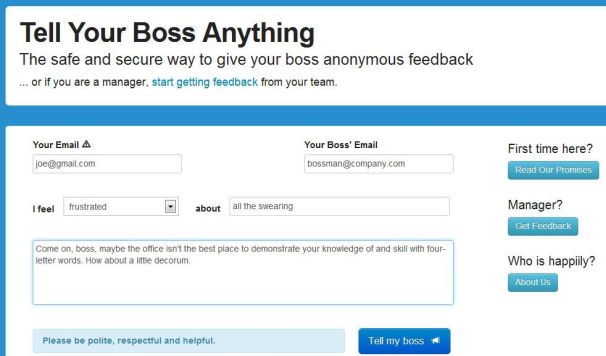
That could prove valuable if your boss is the type who doesn’t typically welcome open, honest, face-to-face communication. On the flipside, I think most bosses would likely be ticked off by an anonymous email from an employee, even one that was positive. What’s more, there’s always the risk that the boss will somehow “know it was you,” which might land you in hot water.
The real value here is for bosses themselves, who can use Tell Your Boss Anything to invite anonymous feedback from employees. It’s like a digital version of the suggestion box, a way to let the team know they can communicate with you without fear of reprisal.
Personally, I have no use for Tell Your Boss Anything, because my bosses are all awesome, and I have no qualms about telling them to their faces. Or, you know, by way of a blog post.
But what do you think? Would you ever use a service like this, either as a boss or an employee?