Tag: robotics

  • Editorial: Can French Robotics Save the Industry?

    Editorial: Can French Robotics Save the Industry?

    Editor’s note French Robotics: French RoboticsLaetitia Vitaud is a blogger, coach, and teacher of U.S. politics in France and is passionate about the digital transition of our economy.

    The French still dream of humanoid robots and electric sheep. Swedish TV series Real Humans, broadcast on French-German TV channel Arte, seduced a surprisingly large audience in France. The president himself proudly promotes flagship robotics projects. Nao is one of those flagship robots, an autonomous programmable humanoid robot developed by French company Aldebaran Robotics. The same company also created Romeo, which was exhibited in Lyon earlier this year.

    Romeo is supported by Paris business cluster Cap Digital and is destined, like Real Humans’ fictitious “hubots” to help the elderly and the sick regain some form of autonomy.

    These are the types of robots used to showcase France’s engineering prowess. Yet a few extra decades will still be necessary to produce robots that can perform half as much as a human maid.

    NAO Robot (Source: Aldebaran Robotics,
    NAO Robot creator, under a 
    CC-BY-3.0 license)

    What’s been known as “Moravec’s paradox” is the fact that high-level reasoning and calculation require little computation, whereas low-level sensorimotor skills require huge computational resources.

    “It is comparatively easy to make computers exhibit adult-level performance on intelligence tests or playing checkers, and difficult or impossible to give them the skills of a one-year-old when it comes to perception and mobility.” Or as Steven Pinker famously put it: “The main lesson of 35 years of AI research is that the hard problems are easy and the easy problems are hard.” This is why no robot can yet perform all of our domestic chores. iRobot’s Roomba can only vacuum the floor and will never empty the dishwasher.

    Humanoid robots are a showcase, not a business. Robots shouldn’t be expected to look human, but to do the “hard” things their own way. The dedicated specialised machinery used in our modern factories (particularly in high-wage countries), fascinating though they may be, are not so new nor are they very French (one immediately has Germany in mind), but French robotics has been conquering warehouses with an increased mastery of “hard” sensorimotor skills.

    Balyo‘s Co-founder Raul Bravo had this vision in 2005: “Logistics is a sector that really needs robotics.” Little did he know that in 2012 Amazon would spend $775 million to buy Kiva Systems, a U.S. company that produces mobile robotics fulfillment systems for Amazon to use in its warehouses.

    Balyo’s MoveBox doesn’t look impressive nor does it look human, but it is replacing human workers in warehouses. It is designed to make any fork-lift truck into a fully autonomous vehicle. The potential market hasn’t yet been fully explored: In Europe alone, more than a million fork-lift trucks are used to move pallets in warehouses, all of which could become automated! The really promising element is that no ground infrastructure is required to use these tools.

    Like warehouses, parking lots are cleared areas dedicated to one purpose. These areas can be made more efficient with robots. German company Serva Transport Systems developed an automated parking system: “279 automated parking spaces at Düsseldorf Airport can now be used via patented robots.”

    In France, two researchers, Clément Boussard and Aurélien Cord, have been working on their own version of that system: Stanley Robotics is developing a solution that would be lighter and more flexible (and cheaper) than Serva’s sophisticated system, something that reminds more of Balyo’s MoveBox.

    Stanley Robotics “Optipark” doesn’t require any modification of existing infrastructure and the solution can be deployed in any parking lot. The potential market in crowded urban Europe seems limitless. And parking solutions could be an entry point to the larger market of driverless vehicles.

    But can these robotics firms really boost the French industry and economy? France’s industrial decline has proved particularly dramatic in the past decade. Robotics doesn’t seem to have changed anything, and the number of factories has dwindled drastically in France. The share of the industrial sector in the country’s added value dropped from 18 percent in 2000 to 12.5 percent only in 2011 and lags far behind that of Germany (26.2 percent) or Sweden (21.2 percent). In the 2000s, France’s export market share plummeted while Germany’s grew. The French industry has seen no other option but to crop its margins, which fell from 30 percent to 21 percent (meanwhile Germany’s margins went up).

    There seems to be a stark contrast between the dynamism of France’s high-tech and robotics entrepreneurs and the catastrophic results of the French industry and its under-equipped factories. There are clearly too few robots in French factories; there are five times as many industrial robots in German factories as in France. German companies have invested an extra $12 billion each year while the French cut their investment by $5 billion. No integration has happened between French startups and the industrial giants that could make good use of their output. It’s as if the industry was worlds apart from the tech scene.

    Former Minister of “Industrial Renewal” Arnaud Montebourg did try to create fruitful interactions between the world of innovation and the industry. In September of last year his 34 “industrial action plans” were designed by the government to boost France’s industrial sector by bolstering the country’s most competitive and innovative industries. Connected devices and robotics were identified as a source of future wealth for the nation and regularly promoted by the Ministry with special events called “Les objets de la nouvelle France industrielle“. Montebourg’s “New Industrial France” aimed to combine the actions of public actors and private companies to help the emergence of future French innovation.

    Even if these plans had not been abandoned with the change in minister, one can doubt the efficacy such measures could have had. French ministers often only pay lip service to the idea of disruptive innovation, but in effect only protect the incumbents and business as usual.

    The construction of bridges between France’s innovative startups and its fast-declining industry is not likely to come only from the French government but rather mostly from private initiatives and improved financing fluidity. Investment Fund Robolution Capital aims to do just that. Bruno Bonnell and his partners at Orkos Capital raised €80 million this year to invest in French (and European companies) and boost the industry in the process. “Robotics will emerge as an industry unto itself that will impact all sectors of the economy,” they say.

    French economist Robin Rivaton in a widely discussed note titled “Relancer notre industrie par les robots” (how robots can help reboot the French industry) argues that factories reflect a country’s economic wealth and that mastering one’s production is a matter of economic strategy. He is convinced that industrial robots offer a path to re-industrializing France. Robots can help the French “insource” its industrial activities and restore its margins.

    There’s no knowing whether France’s industrial decline can still be reversed. But promoting cool French robots can’t do any harm, can it?

    FEATURED IMAGE: STOKKETE/SHUTTERSTOCK Source: Techcrunch
  • Video: Astrobotic Technology to Land a Robot on the Moon and Send Live Video Back to Earth

    Video: Astrobotic Technology to Land a Robot on the Moon and Send Live Video Back to Earth

    Astrobotic Technology, a private technology company, is planning to land a robot on the moon.

    “Whether men have reached the moon” has long been kept to bed as researchers compete to earn a $30 million fortune from Google to beam video back from the moon.

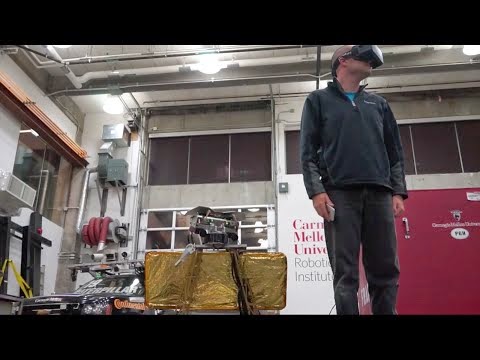
    A researcher at Carnegie Mellon University, Daniel Shafrir, and his team want to do something incredible: they want to send a rover to the moon and then let us, the Earthlings, control it and look out of its stereoscopic cameras as it tumbles around that barren alien rock. The researchers are working to win a $30 million prize from Google to beam video back from the moon.

    The team, called Astrobotic Technology, has to complete the Google Lunar XPrize, a mission to land a robot on the moon and send live video back to Earth while moving it at least 1,600 feet. As you can imagine, this is harder than it sounds, given that they have to help the robot escape Earth’s orbit.

    Shafrir, game designer Ben Boesel, and astronomer Dan Arnett are working together to connect the robot to an Oculus Rift which, in turn, would control the robot. The team said they hope to let children worldwide see what “only 12 other people” have seen on Earth. They will build their lunar lander and fire their little robot, Andy, after Andrew Carnegie, into the stratosphere to pull this off.

  • Video: New Hexapod Robot Learns to Walk in 2 Minutes

    Video: New Hexapod Robot Learns to Walk in 2 Minutes

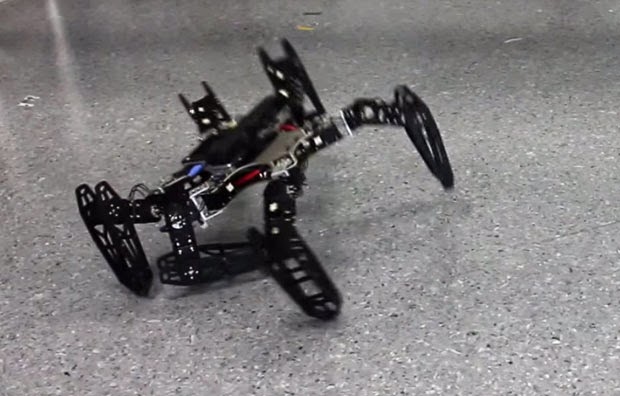
    What do you do if you’re a robotic hexapod and one of your legs is broken? Do you give up? Lie down and burst into flames? Cry from tear duct-less eyes? Or, through a process of trial-and-error, do you brush yourself off, hide your broken leg, and learn to walk again?

    You guessed it.

    Researchers Antoine Cully, Jeff Clune and Jean-Baptiste Mouret have trained a hexapod to try different walking configurations through “Intelligent Trial and Error.” The original version of this algorithm kept the robots stumped for about 20 minutes until they figured out how to go in a relatively straight line after suffering damage. The new system lets the robots learn to walk in about two minutes.

    As you see in the video, the robot tries different walking “styles.” First it hops a little, then it brings its damaged leg up high to try to balance itself. All the while it is sensing its position in the room as well as its speed. If the gait it has chosen is suitably straight and fast, it can keep doing it indefinitely until it gets moving again.

    How does it work? Well, in this case the researchers created a database of potential gaits – 13,000 in all – by running a simulated version of the hexapod and rendering the walking styles. Because the robot is fairly simple it could easily classify the problem it was having (broken strut, mashed leg, etc.) and compare it to the database. Then, using a series of tests, it could decide how to move.

    While this isn’t exactly artificial intelligence, the system does save time in the field and, more importantly, allows the robot to carry out its nefarious mission without stopping, an important consideration when the robots finally rise up to take control of our precious bodily fluids.

    For more on what Hexapod Robots are doing to stay indestructible, check out Spectrum and remember to watch the video above again.

    The original copyright to this post belongs to Techcruch. All rights reserved. Image & Video are the properties of Spectrum.

  • Here is What Google is Doing with all those Robots!

    Here is What Google is Doing with all those Robots!

    Starting from December last year, Google has acquired at least six robots companies or companies creating technologies used in the development of robotics. The acquisition of Boston Dynamic (the creators of Big Dog) on December last year and the recent acquisition of DeepMind Technologies has made a few people to wonder about Google’s actual intentions for buying all those robots.  

    Former Google Android lead and current Google Robot Guru Andy Rubin‘s list of acquired companies reads a bit like a baseline robot kit:

    While we are well aware of Google’s interest in self-driving cars, the robot end-game is unclear. Sure, you can build an army of C-3POs, but for what?

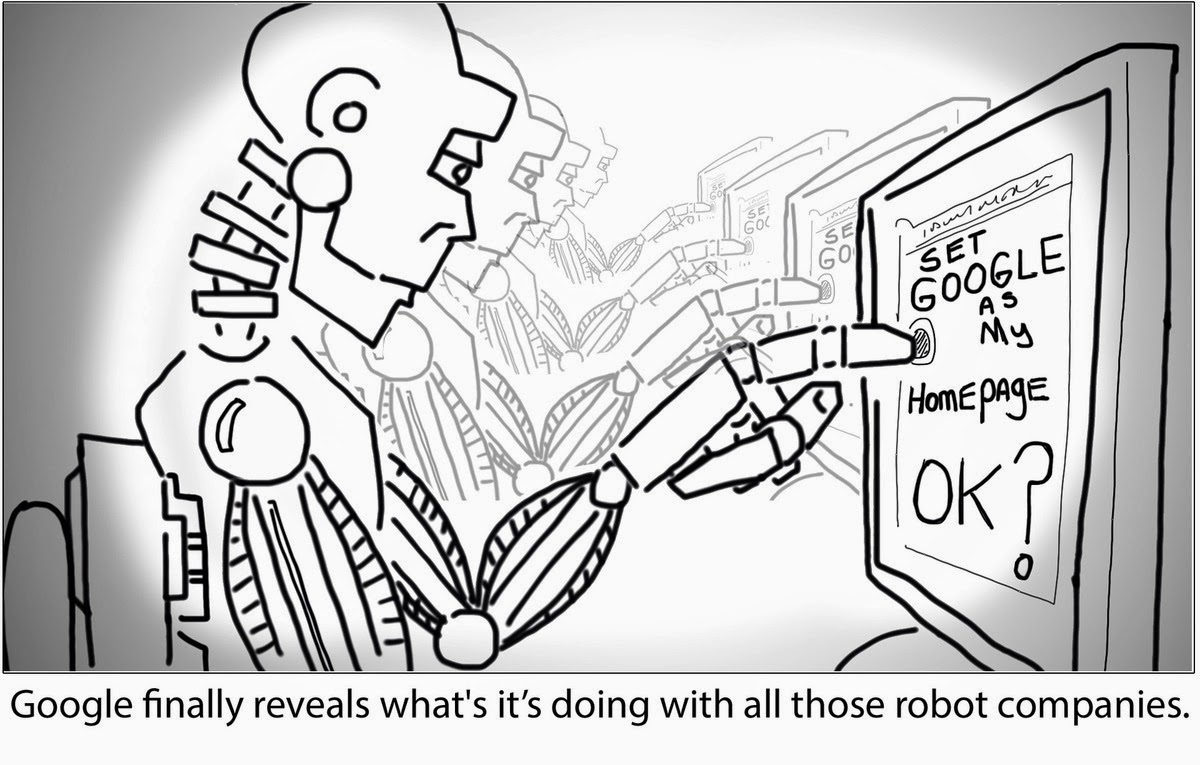
    Well, robots are excellent at repetitive tasks, like changing the settings on millions of computers so that they have Google.com as their home page and Google as their default search engine. Would these Google Robots invade homes to make the change or would Google offer it as a service? Send us your computer and our robots will “fix” them.

    No one knows. Until then, I offer you the comic guesswork above.

  • Google Acquires Boston Dynamics, Creator Of Big Dog

    Google Acquires Boston Dynamics, Creator Of Big Dog

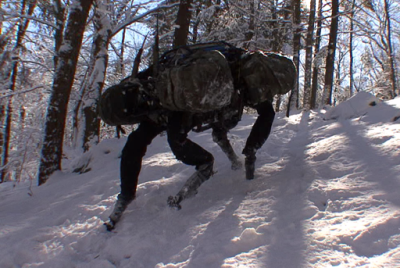
    Google yesterday, announced that they’ve acquired Boston Dynamics. Now, if you remember Boston Dynamics: they are the creators of quad- and bi-pedal robots like Big Dog and PETMAN. This is Google’s eighth robotics acquisition.

    The company, however did not disclose the details of the sale.

    The announcement appeared in the New York Times where Boston Dynamics CEO Marc Raibert said they would honor their DARPA military contracts although Google will not officially be a military contractor.

    The company, founded in 1992, has been working on standalone, gas-powered robots for the past decade. The robots are self-righting and very resilient. Robots like Big Dog can throw cinder blocks, handle rocky terrain, and run at 16 mph.

    The man behind the acquisition, Andy Rubin, stepped down as head of Googe’s Android business in march after turning a little-known mobile OS into a juggernaut. “His last big bet, Android, started off as a crazy idea that ended up putting a supercomputer in hundreds of millions of pockets,” wrote Larry Page on his Google+ page. “It is still very early days for this, but I can’t wait to see the progress.”

  • YouTube’s All-seeing Robot Eye Tagets Video-game Content

    YouTube’s All-seeing Robot Eye Tagets Video-game Content

    If you enjoy watching video-game content on YouTube, today is not your day.

    PC World reports that the site recently activated its Content ID copyright infringement detection system on affiliates of YouTube’s Multi-Channel Networks (MCNs), and the results are far-reaching. Since YouTube updated its terms in an effort to deter copyright infringement, video games channels have received thousands of copyright claims, particularly concerning video games content.

    Video games are (as the name implies) a visual form, so it’s no surprise that video content has grown exponentially in recent years. Both the new Xbox One and PlayStation 4 consoles have integrated support for video output, and the Most-Viewed and Most-Subscribed channel on YouTube belongs to one Felix Kjellberg, a.k.a. PewDiePie, who plays through and discusses video games on his channel.

    YouTube has been an important outlet for game videos because of its affiliate program, which allows content creators to earn money based on their channel views. For the most popular YouTube stars, this can amount to a significant amount of cash—potentially up into the tens of thousands of dollars.

    Until this week.

    Copyright claims

    YouTube’s decision to implement Content ID included affiliates of MCNs (such as Machinima (one of the largest MCNs devoted to games). Game videos are always in a Fair Use gray area—many provide an unedited look at entire hours of a game, with only voiceover commentary added by the video creator. These efforts are easy targets for copyright claims, and publishers have laid down rules about what can be streamed in the past—rules they’ve rarely enforced.

    Polygon reports that some channel operators have already lost up to 15% of their libraries to claims. Copyright claims are particularly damaging because they divert revenue from video views to whoever initiated the claim. You’d guess that the likely culprits in this case would be game publishers. Except the game publishers say no.

    One recipient’s reaction to YouTube’s action

    Capcom, Deep Silver, Ubisoft, and more have gone on record to state that they’ve filed zero copyright claims this week, and Capcom even said it’s fighting over this with YouTube.

    Publishers tend to like it when fans make online video content because it’s free marketing—their games get exposure to enormous audiences, with little effort on the publisher’s part.

    These claims appear to have originated from far weirder sources, which, in some cases, includes companies that don’t really exist anymore.

    Popular games personality TotalBiscuit tweeted, “Apparently THQ is putting out a lot of copyright claims, which is impressive since it no longer exists.” THQ went out of business earlier this year.

    Other channels received copyright claims from third-party companies with no discernible relation to the games in question, but YouTube allowed the claims to go through regardless.

    YouTube, for its part, defended the new system, reiterating that—despite publisher’s claims to the contrary—copyright infringement policies are set by content owners.

    A YouTube spokesman said in an email: “We recently enabled Content ID scanning on channels identified as affiliates of MCNs. This has resulted in new copyright claims for some users, based on policies set by the relevant content owners. As ever, channel owners can easily dispute Content ID claims if they believe those claims are invalid.”

    Implications

    Whether this spells the end of video-games content on YouTube, or whether the system will automatically course correct after a few days of volatility remains to be seen. If YouTube sticks to this path though, it may leave a door open for a competitor to take over games content.

    Judging from the state of Twitter on this subject today (see tweets from theRadBrad and Jim Sterling as examples), some people would welcome a change.