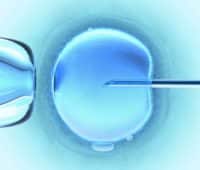
Darwin Life is a new fertility clinic that aims to get women over the age of 40 pregnant with ‘perfect babies’. The World Health Organization (WHO) ranks infertility as the third most serious health condition in the world, after cancer and heart disease. A Chinese founder and researcher Dr. John Zhang is developing controversial methods of fertility that involves replacing some of the chromosomes in a patient’s eggs with those of a younger woman’s.
The treatment is called ‘spindle nuclear transfer’, often referred to as a three-parent-baby technique, and it is outlawed in the United States. It’s been refused for FDA approval because it involves what some view as gene manipulation.
Doctor Zang’s work helped a woman with a rare disease called Leigh Syndrome become pregnant last year. The idea was that with the help of a donor’s chromosomes that the baby would protected against inheriting its mother’s disease, while still remaining genetically related to her.
Zang reported mixed results; the baby was born healthy but damaged DNA from the mother was unintentionally transferred over thus creating a possibility for health problems in the future for the child.
The alternative is standard in-vitro fertilization (IVF) where the entire egg is harvested from the donor and placed inside the mother – thus the baby is genetically related to the donor, even though the mother gives birth.
In this case the chromosomes were harvested in the United States, but the actual application and implanting occurred in Mexico due to US restrictions and ethical concerns. America isn’t the only country concerned about the ethics; the UK allows the procedure, but only in cases where normal conception or IVF might put the baby at high risk for health issues.
Doctor Zang wants to do more than use his method to eliminate hereditary diseases. He wants to impregnate women ages 42 through 47 who often can’t get pregnant even though they produce eggs.
The startup also aims to blow the ‘playing God’ conversation wide-open. The Doctor told Technology Review:
Everything we do is a step toward designer babies, with nuclear transfer and gene editing together, you can really do anything you want.
He’s referring to the ability for parents to choose a child’s eye color or decide if their child will be tall or not. It’s a minefield of ethics concerns – is it okay to edit genes to lower the risk of cancer? What about to increase your baby’s I.Q.?
What happens when intelligence becomes the territory of the wealthy? This is another example of the twisting complexity of the world we live in. Perfect people are on the way and I don’t think any of us are ready for that.
The festive period is almost over and it is my believe that you have already made arrangements to live a healthy live, have a good time and enjoy a prosperous life in this new year.
In less than two weeks from now it will be ‘back to school’ for every college student. As usual, you have made your usual commitments; top your class, be the smartest kid on board or even eyeing a spot in any of the ten ‘2014 scholarships to study abroad’ watch list. I’m also aware that most of you have gone through the games that rocked in 2013 and have decided to take your hands off the gaming pads.
If you have made any of the above resolutions, I am here to show you how to work towards them using your Android smartphone. Sit back, get a pen and let me walk you through the top six Android apps that you need as a science college student.
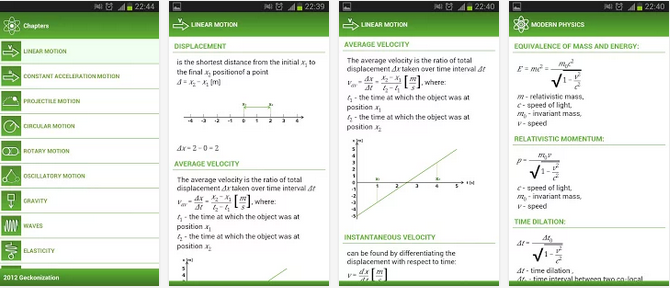
You don’t want to carry a gigantic physics text book to everywhere you go to but you can always carry your Android smartphone around and with this application in it, you can rock Physics from anywhere and anytime.
The application covers most of physical formulas with descriptions and images. It is perfect for students to do physics homework quickly and accurately.
Though this app will cost you a cup of coffee but $3.63 is enough to save you from your algebra & calculus hassles.
Math Helper allows you not only to see the answer or result of a math or algebra problem, but you can also obtain a detailed step-by-step solution so that you may learn how to do the problems rather than just getting the answers.
If you don’t know what for example enzymes means, then this is a great choice. ;). Just avoid as many pop up ads as possible, you really don’t blame them for embedding so many pop up ads, do you? It’s a great app for any student offering biology as a subject or course.
Nice to brush up your knowledge on chemistry and is indeed very helpful. Includes a periodic table with links to wikipedia also allows students to perform simple grams/moles calculations, calculate mass percents and do stoichiometry with that compound.
The application arrays variety of useful tools arranged in tabular forms. The tabular forms are easy for quick remembrance.
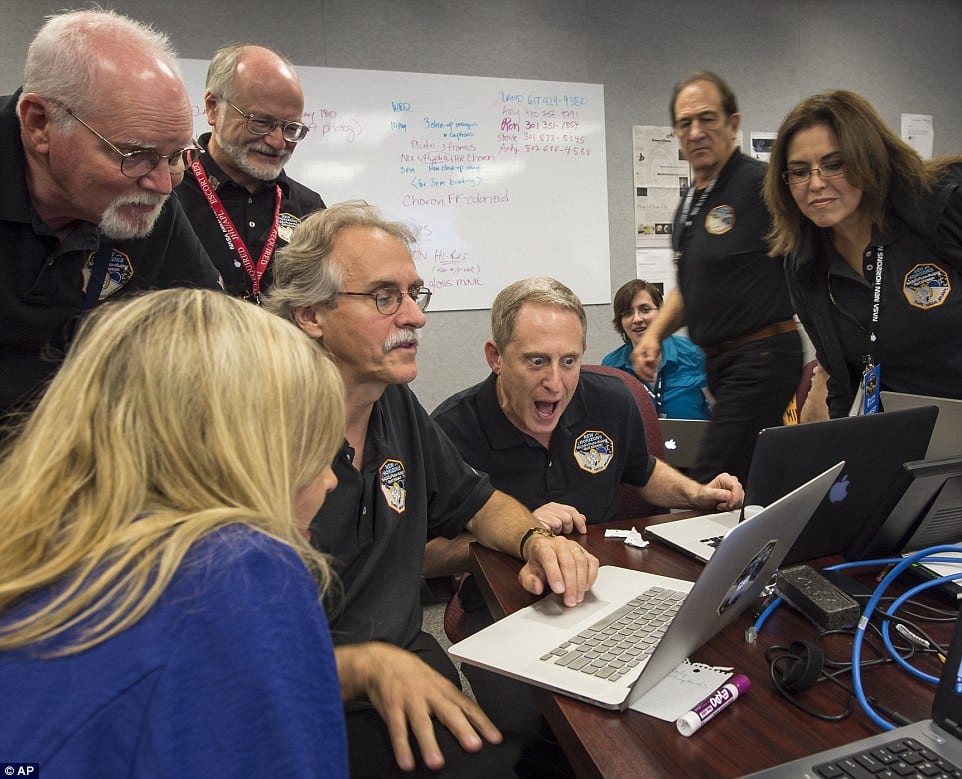
NASA is bringing you even more closer to planet pluto, this time with a photograph that reveals the dwarf planet’s heart-shaped region called Tombaugh Regio – NASA of course, is not a stranger when it come to parading such images..
During New Horizons’ closest flyby in July, the probe’s Long Range Reconnaissance Imager (LORRI) zoomed in on the area and took photos within 9,550 miles of its surface. The stunning images of Pluto’s ‘heart of darkness’ were unveiled alongside two breathtaking animations showing flyovers of the plains and mountains of the frozen world.
‘I’m a little biased, but I think the solar system saved the best for last,’ New Horizons’ principle investigator, Alan Stern, said during the unveiling.
On July 14 the telescopic camera on NASA’s New Horizons spacecraft took the highest resolution images ever obtained of the intricate pattern of “pits” across a section of Pluto’s prominent heart-shaped region, informally named Tombaugh Regio. The image is part of a sequence taken by New Horizons’ Long Range Reconnaissance Imager (LORRI) as the spacecraft passed within 9,550 miles (15,400 kilometers) of Pluto’s surface, just 13 minutes before the time of closest approach. [Image credit: NASA/JHUAPL/SwRI]As you can see, Pluto’s heart is scarred with pits, which New Horizons’ scientists believe may have formed due to “a combination of ice fracturing and evaporation.” These pits seem to follow a pattern, and the team believes it could provide clues on the planet’s ice flow and the exchange of nitrogen between its surface and atmosphere. Whatever secrets the region reveals, this is now how I’ll imagine a scarred heart looks after a number of heartbreaks from now on.
Editor’s note French Robotics: French RoboticsLaetitia Vitaud is a blogger, coach, and teacher of U.S. politics in France and is passionate about the digital transition of our economy.
The French still dream of humanoid robots and electric sheep. Swedish TV series Real Humans, broadcast on French-German TV channel Arte, seduced a surprisingly large audience in France. The president himself proudly promotes flagship robotics projects. Nao is one of those flagship robots, an autonomous programmable humanoid robot developed by French company Aldebaran Robotics. The same company also created Romeo, which was exhibited in Lyon earlier this year.
Romeo is supported by Paris business cluster Cap Digital and is destined, like Real Humans’ fictitious “hubots” to help the elderly and the sick regain some form of autonomy.
These are the types of robots used to showcase France’s engineering prowess. Yet a few extra decades will still be necessary to produce robots that can perform half as much as a human maid.
NAO Robot (Source: Aldebaran Robotics,
NAO Robot creator, under a CC-BY-3.0 license)
What’s been known as “Moravec’s paradox” is the fact that high-level reasoning and calculation require little computation, whereas low-level sensorimotor skills require huge computational resources.
“It is comparatively easy to make computers exhibit adult-level performance on intelligence tests or playing checkers, and difficult or impossible to give them the skills of a one-year-old when it comes to perception and mobility.” Or as Steven Pinker famously put it: “The main lesson of 35 years of AI research is that the hard problems are easy and the easy problems are hard.” This is why no robot can yet perform all of our domestic chores. iRobot’s Roomba can only vacuum the floor and will never empty the dishwasher.
Humanoid robots are a showcase, not a business. Robots shouldn’t be expected to look human, but to do the “hard” things their own way. The dedicated specialised machinery used in our modern factories (particularly in high-wage countries), fascinating though they may be, are not so new nor are they very French (one immediately has Germany in mind), but French robotics has been conquering warehouses with an increased mastery of “hard” sensorimotor skills.
Balyo‘s Co-founder Raul Bravo had this vision in 2005: “Logistics is a sector that really needs robotics.” Little did he know that in 2012 Amazon would spend $775 million to buy Kiva Systems, a U.S. company that produces mobile robotics fulfillment systems for Amazon to use in its warehouses.
Balyo’s MoveBox doesn’t look impressive nor does it look human, but it is replacing human workers in warehouses. It is designed to make any fork-lift truck into a fully autonomous vehicle. The potential market hasn’t yet been fully explored: In Europe alone, more than a million fork-lift trucks are used to move pallets in warehouses, all of which could become automated! The really promising element is that no ground infrastructure is required to use these tools.
Like warehouses, parking lots are cleared areas dedicated to one purpose. These areas can be made more efficient with robots. German company Serva Transport Systems developed an automated parking system: “279 automated parking spaces at Düsseldorf Airport can now be used via patented robots.”
In France, two researchers, Clément Boussard and Aurélien Cord, have been working on their own version of that system: Stanley Robotics is developing a solution that would be lighter and more flexible (and cheaper) than Serva’s sophisticated system, something that reminds more of Balyo’s MoveBox.
Stanley Robotics “Optipark” doesn’t require any modification of existing infrastructure and the solution can be deployed in any parking lot. The potential market in crowded urban Europe seems limitless. And parking solutions could be an entry point to the larger market of driverless vehicles.
But can these robotics firms really boost the French industry and economy? France’s industrial decline has proved particularly dramatic in the past decade. Robotics doesn’t seem to have changed anything, and the number of factories has dwindled drastically in France. The share of the industrial sector in the country’s added value dropped from 18 percent in 2000 to 12.5 percent only in 2011 and lags far behind that of Germany (26.2 percent) or Sweden (21.2 percent). In the 2000s, France’s export market share plummeted while Germany’s grew. The French industry has seen no other option but to crop its margins, which fell from 30 percent to 21 percent (meanwhile Germany’s margins went up).
There seems to be a stark contrast between the dynamism of France’s high-tech and robotics entrepreneurs and the catastrophic results of the French industry and its under-equipped factories. There are clearly too few robots in French factories; there are five times as many industrial robots in German factories as in France. German companies have invested an extra $12 billion each year while the French cut their investment by $5 billion. No integration has happened between French startups and the industrial giants that could make good use of their output. It’s as if the industry was worlds apart from the tech scene.
Former Minister of “Industrial Renewal” Arnaud Montebourg did try to create fruitful interactions between the world of innovation and the industry. In September of last year his 34 “industrial action plans” were designed by the government to boost France’s industrial sector by bolstering the country’s most competitive and innovative industries. Connected devices and robotics were identified as a source of future wealth for the nation and regularly promoted by the Ministry with special events called “Les objets de la nouvelle France industrielle“. Montebourg’s “New Industrial France” aimed to combine the actions of public actors and private companies to help the emergence of future French innovation.
Even if these plans had not been abandoned with the change in minister, one can doubt the efficacy such measures could have had. French ministers often only pay lip service to the idea of disruptive innovation, but in effect only protect the incumbents and business as usual.
The construction of bridges between France’s innovative startups and its fast-declining industry is not likely to come only from the French government but rather mostly from private initiatives and improved financing fluidity. Investment Fund Robolution Capital aims to do just that. Bruno Bonnell and his partners at Orkos Capital raised €80 million this year to invest in French (and European companies) and boost the industry in the process. “Robotics will emerge as an industry unto itself that will impact all sectors of the economy,” they say.
French economist Robin Rivaton in a widely discussed note titled “Relancer notre industrie par les robots” (how robots can help reboot the French industry) argues that factories reflect a country’s economic wealth and that mastering one’s production is a matter of economic strategy. He is convinced that industrial robots offer a path to re-industrializing France. Robots can help the French “insource” its industrial activities and restore its margins.
There’s no knowing whether France’s industrial decline can still be reversed. But promoting cool French robots can’t do any harm, can it?
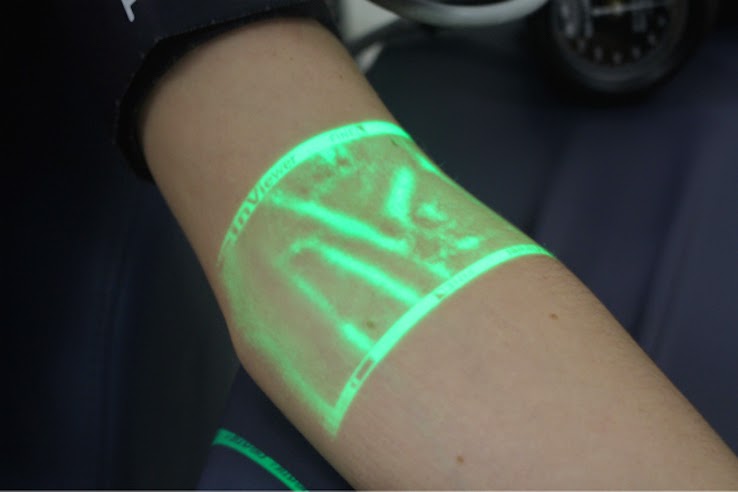
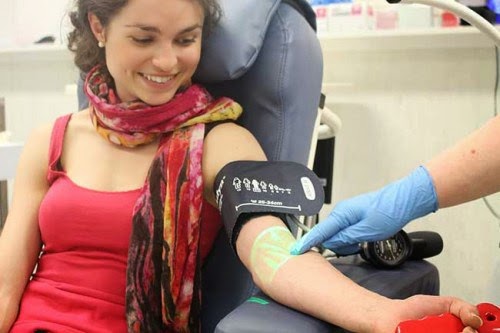
Scientists have discovered a way to find your vein before poking around half a dozen times to find the spot. The Australian Red Cross Blood Service is using a near-infrared vein light device that locates blood to study whether being able to locate hard-to-find veins will result in reduced anxiety and thus make it more likely these types of donors will come back and donate again.
The Blood Service says it will test 300 first-timers and 600 returning blood donors between ages 18 and 30 on different devices from two separate Australian providers. The hope is that if this works for younger donors, they will become lifelong contributors to the Red Cross.
The vein visualization device works by waving a near infrared light source over naturally deoxygenated hamoglobin in the body. The deoxygenated hemoglobin absorbs that light and your veins show up in glowing green. The machines should be safe unless you stare directly at them (so don’t do that). They can also be adjusted for individual differences.
Here’s a little more about how the technology works:
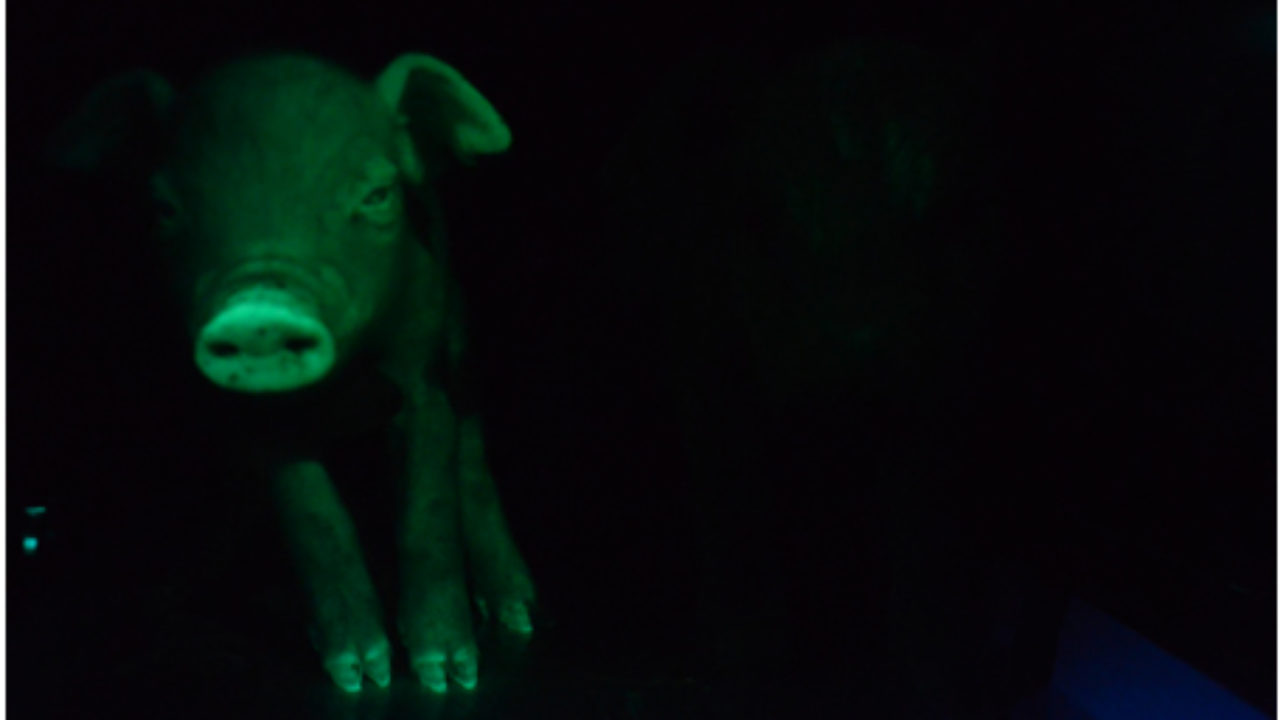
Scientists are one step closer to creating a real-life version of Dr. Seuss’ green eggs and ham, thanks to the birth of ten transgenic pigs in late December that glow green when placed under a black light.
Zhenfang Wu and Zicong Li of the South China Agricultural University used a technique developed by reproductive scientists from the University of Hawaii at Manoa’s John A. Burns School of Medicine to transfer plasmids (small DNA molecules, separate from the chromosomal DNA within a cell) carrying a fluorescent protein from jellyfish DNA into the pig embryos.
Assisted by Dr. Johann Urschitz, an assistant research professor at the University of Hawaii’s Institute for Biogenesis Research (IBR), the team of doctors were able to quadruple the success rate of the plasmid transfer — a feat that bodes well for the technique’s overall goal of introducing beneficial genes into larger animals to create more cost-efficient medicines.
This method of transferring DNA from another organism, known as transgenesis, relies on the embryo’s DNA repair machinery to integrate the transferred transgene DNA (in this case, the fluorescent protein from jellyfish) and transmit that property to its offspring.
Because all organisms share a similar genetic code, scientists can cut DNA sequences that code for a particular protein and insert it into other organisms to produce that specific protein. In transgenesis, the scientists insert the altered DNA into the host’s embryo and the desired DNA becomes incorporated, gaining the ability to produce the new protein (again, in this case, the jellyfish protein). This can be applicable in the production of cheaper medicine — pharming, as it is known, which uses the same process, but inserts genes that code for pharmaceuticals into host animals that don’t express those genes naturally (the anticoagulant ATryn, for example, is produced from the milk of genetically modified goats).
“We can make those enzymes a lot cheaper in animals rather than a factory that will cost millions of dollars to build,” said Dr. Stefan Moisyadi, a bioscientist at the IBR.
According to a statement released by the University of Hawaii at Manoa, the additional green glow does not harm the pigs; instead, it just indicates that the transfer succeeded.
“It’s just a marker to show that we can take a gene that was not originally present in the animal and now exists in it,” Moisyadi said.
This isn’t the first instance of glowing green mammals. Last August, scientists from the University of Istanbul, assisted by Dr. Moisyadi, also used this technique to produce the world’s first green rabbits. The same scientists at the university are expected to make an announcement about their results involving sheep and the first transgenic lamb later this year.
This article and video was originally posted on Mashable








 Zhenfang Wu and Zicong Li of the South China Agricultural University used a technique developed by reproductive scientists from the University of Hawaii at Manoa’s John A. Burns School of Medicine to transfer plasmids (small DNA molecules, separate from the chromosomal DNA within a cell) carrying a fluorescent protein from jellyfish DNA into the pig embryos.
You must be logged in to post a comment.